

You open the app to check one thing — a message, a notification, the time — and twenty minutes later you’re still there, and you couldn’t say what any of it was for.
That’s not a failure of willpower. The card’s own opening line puts it plainly: platforms have moved past simple advertising into persuasive design — architecture built specifically to maximise engagement, not serve your interest. Once that engineering is visible, feeding it becomes a choice rather than a reflex.
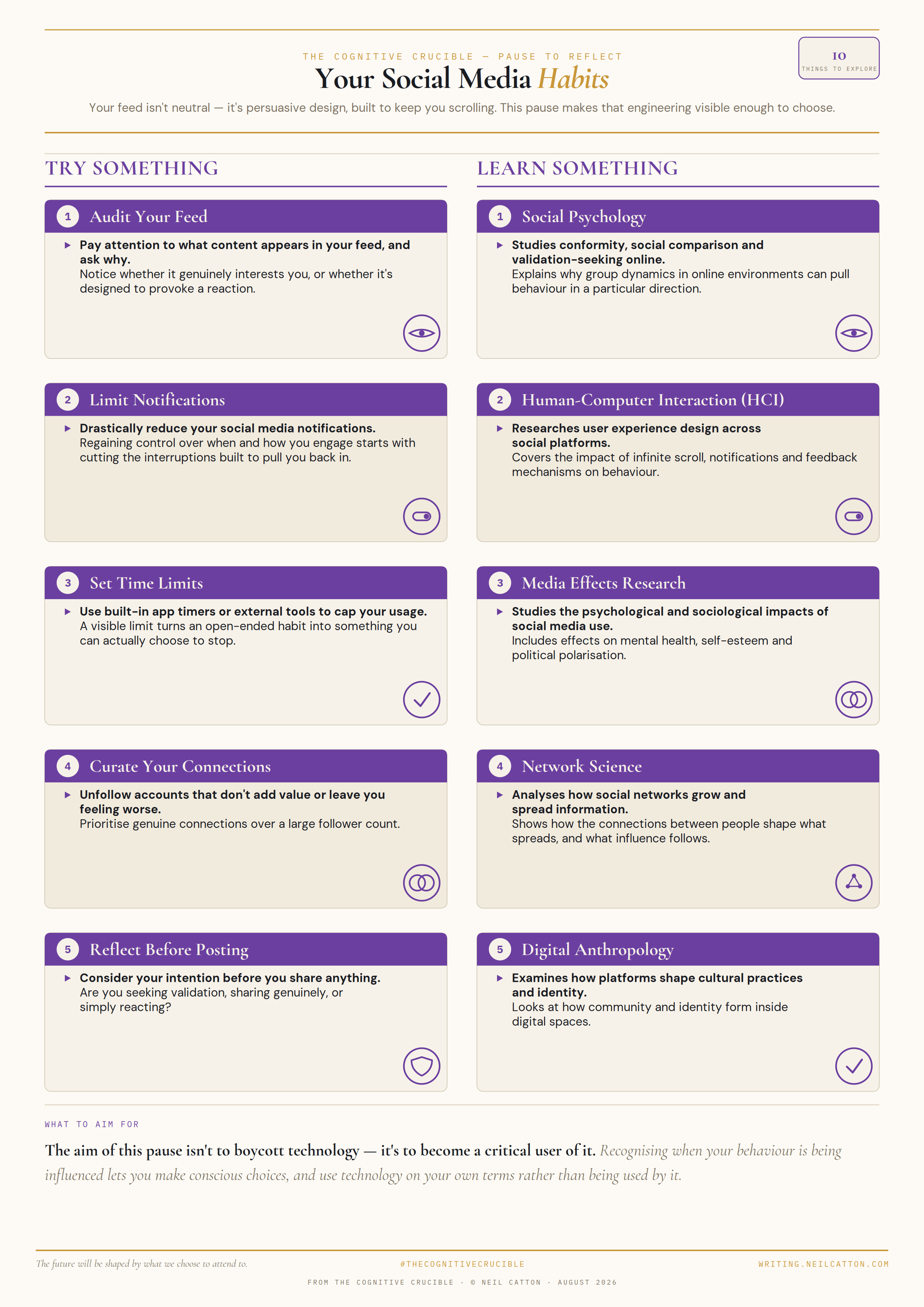
The card holds ten prompts across two columns. Five habits to try this week — auditing what actually shows up in your feed and why, cutting the notifications built to pull you back in, setting a real time limit, curating who you follow down to connections that add something, pausing before you post to ask what you’re actually seeking. And five fields of research if you want to understand the mechanics behind the pull, from the social psychology of validation-seeking to the network science of how influence spreads.
It comes from The Cognitive Crucible, where the fuller argument about persuasive design and attention plays out. The card stands on its own — you don’t need the book to use it.
Print it, or keep it somewhere you’ll see it before you next open the app without thinking.
And here’s the question I’d leave you with: the next time you reach for it without deciding to, whose habit is that — yours, or the one it was built to form?
You’re reading The Next Evolution by Neil Catton, articles that explore the human world and the intersection of technology, they try and ask difficult questions - not to scare - but to inform. If someone forwarded this to you, you can subscribe free at neilcatton.substack.com.
Neil Catton is the author of The Next Evolution, The Cognitive Crucible and The Shadow System - available on Amazon, and writes at the intersection of technology, ethics, and human purpose.