

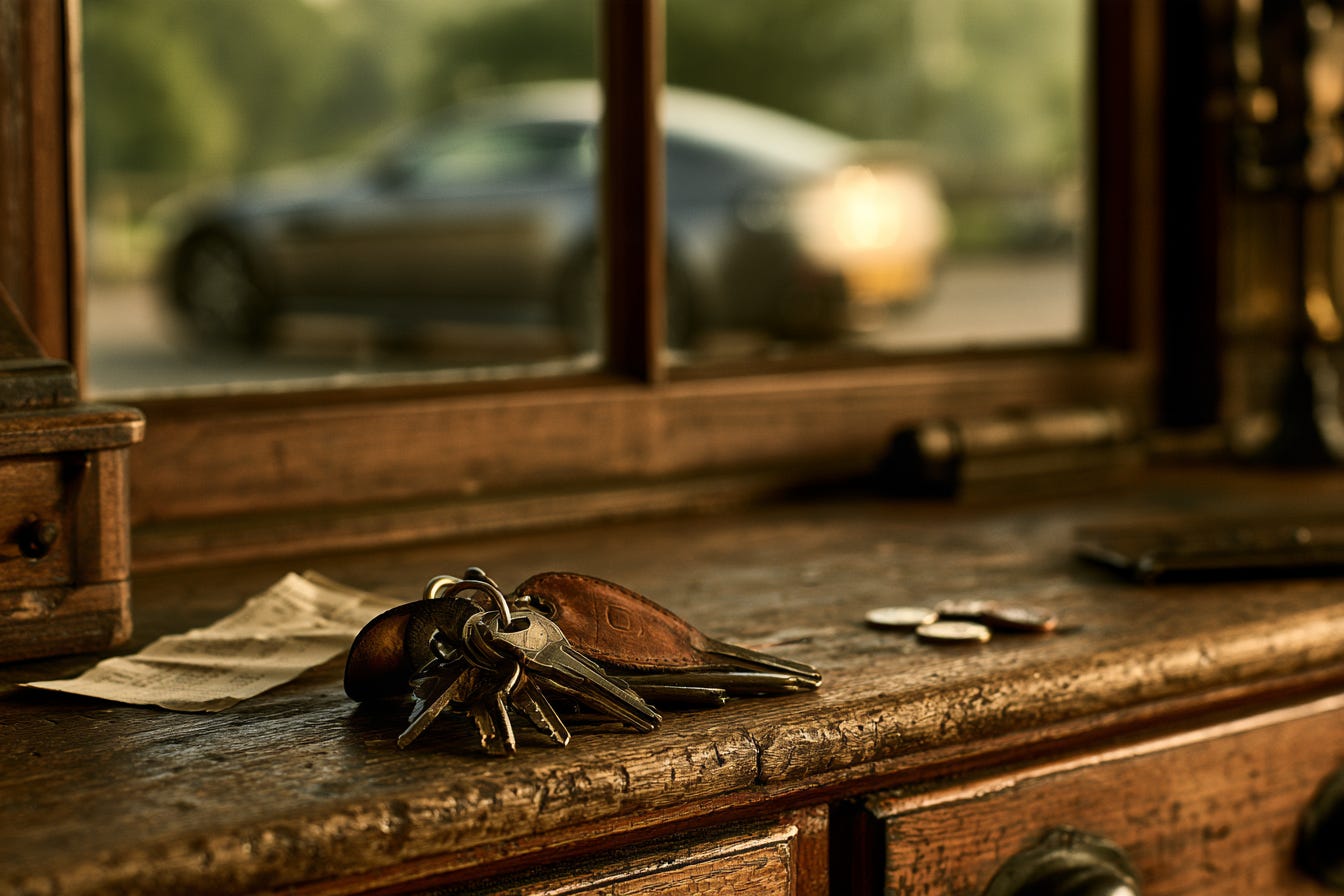
I was standing in the queue at the local DIY shop when the person in front of me turned round and said, “Oh, I was looking for you. Which car is that?”
I had recently bought an Aston Martin Vantage. An old one, hand-built, the sort that gets called a supercar, and it was sitting outside in the car park. They had seen it on the way in and gone looking for whoever owned it. So we talked, and it turned into a long conversation. By the time we reached the front, the person on the till had heard enough to join in, and the three of us carried on while the shopping went through.
Nobody in that conversation wanted anything from anybody else. This keeps happening. Drivers of the same marque lift a hand as they pass. One Sunday a parking warden walked across a car park towards me and I assumed the worst. What they wanted was a long chat about cars.
The car is only the excuse. What interests me is where these conversations take place: a queue, a till, a car park. They are places where a transaction holds people still for a minute and there is somebody else standing there.
The part of the job nobody wrote down
The person on the till was employed to scan the goods and take the payment. Joining a conversation about a car is in no job description I have ever seen, and it is the part of that visit I remember.
A self-checkout would have handled the scanning and the payment just as well. I use them, and most days I am glad of them. Most transactions are only transactions, and people want them over with.
When an organisation decides to automate a till, though, it does its sums on the transaction: staff hours, queue length, cost per sale. The conversation was never in the numbers on the way in, so it is not in the numbers on the way out. Nobody decides to remove it. It goes because it was never counted.
Two grocers have counted it. In November 2023 Booths, which has shops across the north of England, said it was taking self-checkouts out of all but two of its stores, keeping them in Keswick and Windermere. Its managing director, Nigel Murray, told The Grocer: “We pride ourselves on great customer service and you can’t do that through a robot.” By April 2025 the managing director was describing a fall in theft as a “happy consequence” of the decision.
In the Netherlands the supermarket chain Jumbo came at it from the other end. In 2019 it opened a Kletskassa, a chat checkout, in its shop in Vlijmen: a lane for people in no hurry who would like to talk to the cashier. In September 2021 it announced plans for 200 more, choosing areas where loneliness was known to be a problem.
Consider what that second decision admits. Talk at the till was worth enough to a supermarket that it built a lane for it, gave it a name and hung a sign over it. Something that used to come free with the shopping had become something that had to be designed in.
What the shop owner knows
A friend of mine owns a men’s clothing shop in town. I started as a customer, because it was one of the few places where I could find things I liked. They do their own buying and their own marketing, and they run the shop floor themselves. They know a great many of their customers by name.
They know what I like. More usefully, they know what does not work on me, and they will say so.
Selling clothes is the smaller part of what goes on in that shop. The larger part is a rapport, built with some compassion for the person in front of them, and that is how they come to know their customers.
None of that came from a form. It built up visit by visit, across a counter, in conversation. A system could hold my sizes and my purchase history and it would know what I bought. The shop owner knows what I should not buy, which is a different kind of knowledge and one I would not think to give a machine because nobody would think to ask me for it.
The same sums are now being done on customer service desks, with AI agents where the self-checkout used to be. The case is made in the same way: calls handled, time to answer, cost per contact. I would expect the agents to do well on every one of those measures.
What is not on the list is whatever the person on the desk was picking up while they dealt with the call. The thing the customer mentioned in passing. The complaint that was really about something else.
I do not know how much of that an organisation needs. Some of it will turn out to be chatter and nothing more. But it cannot be weighed if it is never listed.
What they all had in common
Think about the people in these stories: the stranger in the queue, the person on the till, the parking warden, my friend in the shop. What they have in common is passion, commitment, drive, enthusiasm, compassion and belief, all of it pointed at making a difference, even if that is to just one person.
That is what we humans bring, and it is far more than technology can currently do. We do not know how technology will evolve. Whatever it becomes, it needs humans to be the drivers behind that evolution.
The DIY shop still has a person on the till. When the question of replacing them comes up, the calculation will be about scanning and payment. The conversation about the car will not be in it.
So the next time you are looking at deploying AI into your business, stop and ask yourself: so what?
You’re reading The Next Evolution by Neil Catton, articles that explore the human world and the intersection of technology, they try and ask difficult questions - not to scare - but to inform. If someone forwarded this to you, you can subscribe free at neilcatton.substack.com.
Neil Catton is the author of The Next Evolution, The Cognitive Crucible and The Shadow System - available on Amazon, and writes at the intersection of technology, ethics, and human purpose.