

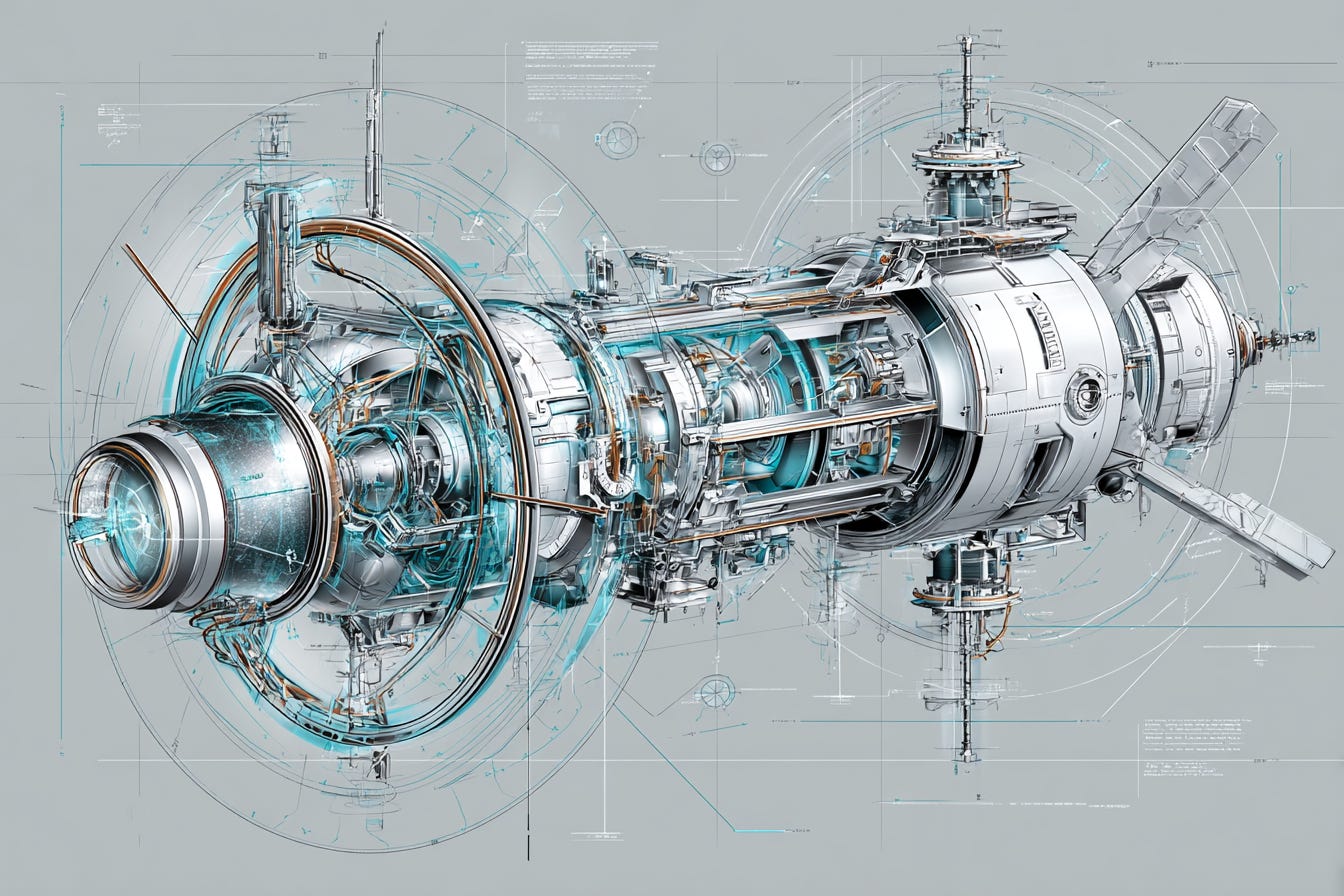
For twenty-five years, the International Space Station has been humanity’s address in orbit — built by governments, run by governments, and costing more than any object ever constructed. Now a startup is building a replacement in a factory in California. The question is not whether the era of private space stations is coming. It is what that era is actually for.
The ISS and what comes next
In a factory in Long Beach, California, a team of engineers is building a space station. Not designing one. Not modelling one. Building one — machining aluminium panels, rolling and welding the pressure vessel that will contain breathable air, testing solar arrays and life-support systems. The station is called Haven-1. The company building it is called Vast. And if the schedule holds, a SpaceX Falcon 9 rocket will carry it to low Earth orbit sometime in early 2027.
Haven-1 is small. At 45 cubic metres of habitable volume — roughly the interior of a small tour bus — it is far from the football-field sprawl of the International Space Station, which took over a decade to assemble and cost upwards of $150 billion to build. It will host four astronauts at a time for missions of up to thirty days. Its operational life is three years. It does not try to be everything. It tries to prove that a private company can build and operate a human habitat in orbit — safely, on a realistic schedule, and without the resources of a national space agency.
That proof matters because the era it is trying to inaugurate has a deadline. NASA plans to deorbit the International Space Station around 2030. After twenty-five years as humanity’s permanent outpost in orbit — the most ambitious collaborative engineering project in history, shared by fifteen nations — the ISS will be guided out of the sky and into the Pacific Ocean. What replaces it, if anything does, will not be built by governments. It will be built by companies.
Whether that is exciting or alarming depends on what you think space is for.
The International Space Station was conceived as a symbol as much as a laboratory. Built in the years after the Cold War, assembling modules launched by American Space Shuttles and Russian Soyuz rockets, it expressed something about what cooperation between nations could achieve. The science it enabled was real and significant — advancing our understanding of human physiology in microgravity, producing pharmaceutical research that could not have been conducted on Earth, hosting thousands of experiments across biology, materials science, Earth observation and physics. But it was also, always, enormously expensive.
NASA spends roughly $3 billion per year to operate the ISS. That sum, compounded over the station’s lifetime, has represented a significant fraction of the agency’s total budget. The calculation NASA is now making is whether the science and presence in orbit justify that cost when private companies are willing to build and run orbital infrastructure and sell NASA access to it. The model shifts from landlord to tenant. Instead of owning and operating the station, NASA becomes a customer, buying crew time and research capacity from whoever builds the next generation of platforms. The $150 billion question is whether that works.
The ISS cost over $150 billion to build and costs $3 billion per year to run. NASA’s bet is that private companies can do this cheaper — and that competition will do what government monopoly could not.
Haven-1 is not the only contender. Axiom Space, which has already been awarded a NASA development contract, is launching a Payload Power Thermal Module to the ISS in early 2027; roughly nine months later that module will undock and rendezvous with Axiom’s habitat module to form an independent two-module station by early 2028. Starlab — a joint venture between Voyager Technologies and Airbus, with Northrop Grumman providing autonomous docking capability, and a design that will launch in a single flight aboard SpaceX’s Starship — is targeting 2028. Blue Origin’s Orbital Reef, billed as a “mixed-use business park in orbit,” is in development. Between 2026 and 2031, NASA plans to provide $1–1.5 billion in funded Space Act Agreements to support commercial station development — a programme it has recently revised, shifting from firm fixed-price contracts after officials concluded that a fully commercial business case does not yet exist in low Earth orbit.
Who is building the next space stations:
Vast (Haven-1): Single module; 45m³; Q1 2027 launch target;
SpaceX Falcon 9 Vast (Haven-2): Nine-module follow-on; Falcon Heavy + Starship; 2028–2032 assembly
Axiom Space: PPTM module docks to ISS early 2027; Hab One joins to form free-flying station by early 2028
Starlab: Voyager/Airbus joint venture; Northrop Grumman docking support; single large launch on Starship; 2028 target
Blue Origin (Orbital Reef): ‘Mixed-use business park’; Sierra Space partnership; late 2020s
NASA role: Transitioning from owner/operator to customer; $1–1.5bn in funded SAAs 2026–31
ISS retirement: Planned deorbit ~2030; guided Pacific Ocean re-entry
Cost comparison: ISS: $150bn+; Haven-1: undisclosed
The gap between the ISS’s retirement and the arrival of its successors is a genuine concern. NASA’s planning assumes overlap between commercial station operations starting in 2028 and ISS retirement in 2030. If commercial timelines slip — as they have already for Haven-1, which moved from a May 2026 target to Q1 2027 — that overlap narrows. Axiom Space chief executive Michael Suffredini has said publicly that the market may not be large enough for more than one commercial station. The company has faced funding difficulties. The question of whether the economic case for private space stations is as solid as the engineering ambition is one that has not yet been answered by the market.
What space is actually for
The commercial case for space stations rests on a set of claims about what can be done in orbit that cannot be done on Earth — and what that is worth. The most substantive of these claims concerns microgravity manufacturing.
Gravity shapes almost everything about how materials form and how biological processes operate. Protein crystals grown on Earth are distorted by gravity-driven convection; the same proteins grown in microgravity form larger, more perfect structures that reveal their molecular architecture more clearly. Drug development that depends on understanding a protein’s shape can benefit from having better data. Major pharmaceutical companies and JAXA have conducted crystallisation experiments on the ISS. One JAXA study of proteins associated with Duchenne muscular dystrophy led directly to a drug candidate — TAS-205 — now in Phase 3 clinical trials. California startup Varda launched a manufacturing satellite in June 2023, producing crystals of ritonavir — an HIV medication — in orbit and returning the capsule to Earth in February 2024.
Optical fibres grown in microgravity achieve purity levels impossible on Earth. Alloys and semiconductors manufactured without sedimentation can have more homogeneous microstructures. What changes with commercial stations is not the science. It is the access — more capacity, lower cost, broader range of customers, and the possibility of operating manufacturing processes at scale rather than as research demonstrations.
Space tourism is the other commercial pillar. Axiom Space has already sold private astronaut missions to the ISS, at prices reported to start around $55 million per person. Haven-1 will accommodate private visitors. Blue Origin’s Orbital Reef explicitly frames its design around commercial hospitality. The market here is narrower — it requires the kind of wealth that makes $55 million an acceptable discretionary expenditure — but it is real, and it serves the less glamorous purpose of underwriting operational costs that the research market alone may not cover.
The science done on the ISS has already produced pharmaceutical advances, materials breakthroughs and discoveries in human physiology that could not have been achieved on Earth. The question is whether the commercial model can sustain access to that environment after the ISS is gone.
The honest uncertainty is about the size and reliability of the non-government market. NASA’s contribution — buying crew time, hosting government science, funding development — is the anchor. If that anchor holds, the economics of commercial stations are plausible. If NASA’s budget is cut, or its priorities shift, or the agency decides it can achieve its goals without a permanent crewed outpost in low Earth orbit, the business cases of every company in this race become significantly harder.
Who inherits the sky
The ISS was many things, but one of them was political. The same hardware that carried American astronauts carried Russian cosmonauts, European scientists, Japanese engineers, Canadian robotics technologists. The station’s assembly required fifteen nations to agree on standards, interfaces, safety protocols and operational procedures. It survived the post-Cold War period, survived Shuttle disasters, survived the tensions that followed Russia’s 2014 invasion of Ukraine — though the latter ultimately prompted the partners to plan for Russian withdrawal and ISS retirement. Whatever its limitations as a scientific platform, it demonstrated that sustained human cooperation in space was possible.
The commercial stations being built now are American. They are funded by American venture capital and American government contracts. They will be operated under American regulatory frameworks and serve primarily American and allied institutional customers. China, which has built its own Tiangong station — permanently crewed since 2022 — is not a customer. The transition from government-operated to commercially-operated orbital infrastructure in the Western world is also, in a geopolitical sense, a transition from international to national. That is not necessarily wrong. But it is a change that deserves to be named.
The science also changes. The ISS was an instrument of national prestige and international diplomacy, which meant science happened on it even when the immediate commercial return was unclear. Commercial stations will prioritise the experiments customers pay for. That will include pharmaceutical companies crystallising proteins, universities running long-duration biology experiments, technology companies testing hardware in the radiation and vacuum of orbit. It will also mean that certain categories of basic science, whose value is not easily priced and whose benefits arrive decades later, will struggle to find a berth.
What the commercial model has to prove
The case for commercial stations is clear enough on paper. A research environment that currently costs $3 billion per year to run could be made more accessible, more competitively priced, and faster to iterate — if the market works as advertised. The pharmaceutical researcher, the materials scientist, the physician studying bone density in long-duration spaceflight, the engineer testing life-support systems for deep-space missions: all of them benefit if orbital access becomes cheaper and easier rather than harder and more expensive. The platform itself does not matter. What matters is whether the transition sustains the access.
The honest question is whether private operation adds something or merely substitutes one expensive monopoly for another. The ISS cost $3 billion per year under government management. The benchmark for commercial stations is not zero. It is whether, over time, the cost per hour of orbital research comes down, whether the range of customers expands beyond governments and billionaires, and whether the scientific output justifies the investment.
The harder question — the one the market cannot easily answer — is what happens to research that does not have an immediate commercial return. A drug candidate for a neglected tropical disease. A long-term study of bone loss that informs treatment for earthbound osteoporosis patients. A materials science experiment whose applications are twenty years away. These are the kinds of research that the ISS accommodated because governments decided they mattered. Whether commercial operators will find business models that serve them too is not yet clear.
My Opinion
The commercial argument is not wrong on its own terms. Making orbital access cheaper and more competitive is good for science. What I’m not convinced by is the assumption that the market will fund the research that takes twenty years to return a result — the kind that doesn’t fit a quarterly report or a drug application. Space has always held something that cannot easily be priced: the pull of the unknown, the technologies that come back to Earth from solving problems nobody had imagined, the slow accumulation of knowledge about what the species can survive and where it might eventually go. The ISS existed because governments decided that the unknown was worth funding. I’d like the decade ahead to find a way to carry that conviction into whatever comes next — not because it’s commercially compelling, but because it’s how we stay curious about a universe that doesn’t owe us answers.
What the decade ahead has to answer
A commercial model optimises for what can be priced. Several of the most consequential questions about the next era in orbit cannot be priced — not yet, possibly not ever.
The ISS was built by fifteen nations working together across geopolitical fault lines. The commercial stations being built now are almost entirely American. What does the transition from international to nationally anchored orbital infrastructure mean for science, for diplomacy, and for who gets to go to space?
Haven-1 slipped from May 2026 to early 2027. Axiom is facing funding pressures. The gap between ISS retirement and commercial successors may be tighter than planned. What happens to continuous human presence in low Earth orbit if the commercial stations arrive late?
The ISS funded science that had no immediate commercial return because governments decided that science mattered. Commercial stations will fund the experiments that customers pay for. Is there a type of research you think is important that might not survive that transition?
A private astronaut mission to the ISS costs around $55 million per person. Haven-1 will be no different in its early missions. At what point — if ever — does the price drop far enough that the question of who gets to go to space becomes meaningfully different?
The last astronaut to walk on the Moon did so in 1972. For more than fifty years, human beings have not left low Earth orbit. The ISS has been the closest thing to a frontier that most of us will ever witness — a small, fragile, extraordinarily expensive outpost at the edge of the world’s reach.
What replaces it will be built not by nations but by companies, and financed not by ideology but by markets. Whether that produces something better, something worse, or simply something different from what the ISS represented will become clear in the decade ahead.
Sources & references
Haven-1 and Vast
Axiom Space
Vast and Axiom awarded new private missions to ISS — NASASpaceFlight
Axiom Space puts a brave face on claims of dire finances — The Register
Starlab
Private Starlab space station moves into full-scale development — Space.com
Voyager Space Announces Teaming Agreement with Northrop Grumman for Starlab — PR Newswire
NASA Commercial LEO Destinations programme
NASA releases details on revised next phase of commercial space station development — SpaceNews
Payload Field Guide: Commercial LEO Destination — Payload Space
Varda Space / ritonavir
JAXA protein crystallisation / Duchenne muscular dystrophy
Creating new and better drugs with protein crystal growth experiments on the ISS — NASA
Creating New and Better Drugs with Protein Crystal Growth Experiments — SpaceNews
ISS context and commercial transition
Commercial Efforts Flail to Replace Aging International Space Station — Engineering
You’re reading The Next Evolution by Neil Catton, articles that explore the human world and the intersection of technology, they try and ask difficult questions - not to scare - but to inform. If someone forwarded this to you, you can subscribe free at neilcatton.substack.com.
Neil Catton is the author of The Next Evolution, The Cognitive Crucible and The Shadow System - available on Amazon, and writes at the intersection of technology, ethics, and human purpose.