

You’ve read the same paragraph three times and still can’t repeat it back. Not because the material is hard — because your attention left the page ten minutes ago and your eyes kept moving without it. It happens by mid-afternoon, in the middle of the one email that actually mattered, on the fourth hour of a task that needed maybe ninety minutes of real focus.
That’s not a discipline problem. Attention is a finite resource, and the brain that keeps drifting has real, built-in limits — not a character flaw showing itself. The card’s own framing is plain about this: it isn’t about achieving perfect focus overnight, it’s about turning that theory into a practical awareness of where your attention is actually going.
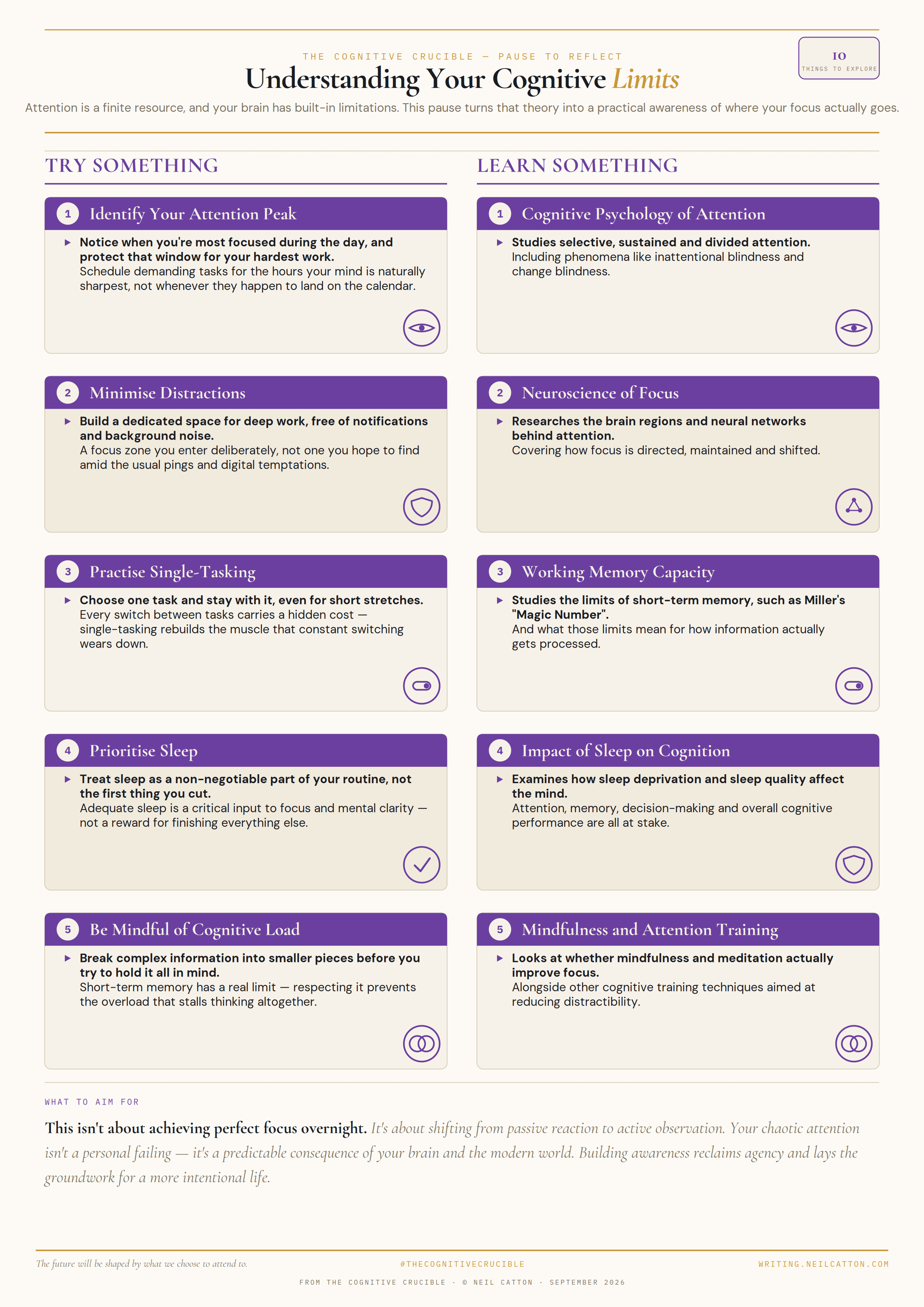
The card holds ten prompts across two columns. Five habits to try this week — finding your natural attention peak and protecting it, building a space genuinely free of distraction, practising single tasks instead of switching between them, treating sleep as non-negotiable, and breaking complex information down before it overwhelms you. And five fields of research if you want the science behind the pull, from the real limits of working memory to what sleep deprivation actually costs your thinking.
It comes from The Cognitive Crucible, where the fuller argument about attention as a finite, contested resource plays out. The card stands on its own — you don’t need the book to use it.
Print it, or pin it somewhere you’ll see it before the next task that needs your full attention.
So next time you catch yourself rereading the same line: is the material actually hard, or did your attention leave the room a while ago?
You’re reading The Next Evolution by Neil Catton, articles that explore the human world and the intersection of technology, they try and ask difficult questions - not to scare - but to inform. If someone forwarded this to you, you can subscribe free at neilcatton.substack.com.
Neil Catton is the author of The Next Evolution, The Cognitive Crucible and The Shadow System - available on Amazon, and writes at the intersection of technology, ethics, and human purpose.