

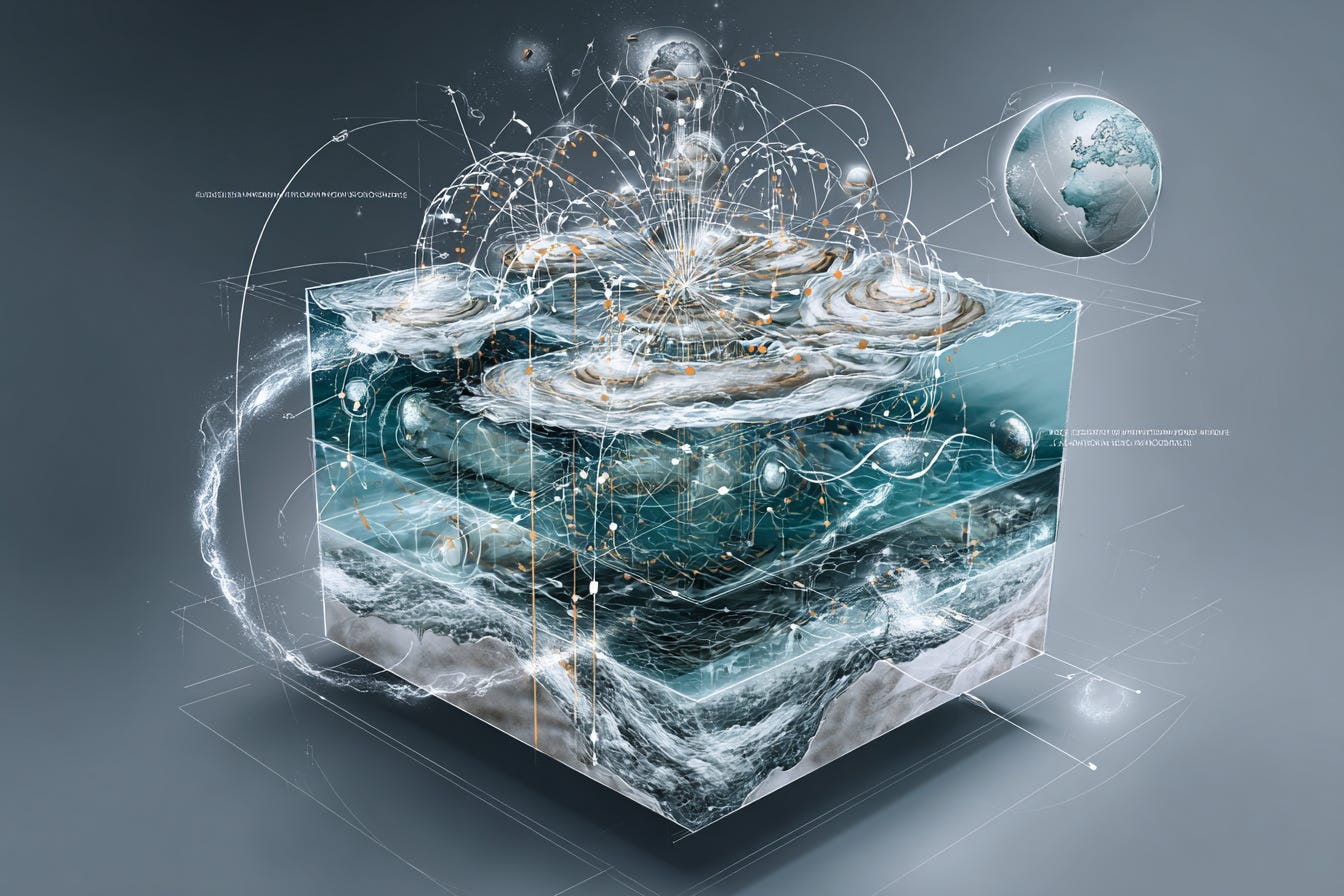
In September 2023, as Hurricane Lee was curving northward west of Bermuda, meteorologists at NOAA and the National Hurricane Center were working to determine where it would make landfall: New England or farther east, in Canada. The sooner they could call it, the earlier they could issue warnings. Evacuations for a major hurricane require at least three full days. Every additional day of warning is not a planning luxury. It is a measurable difference in how many people can get out.
The traditional forecast models locked in on Nova Scotia about six days before landfall. A different model — an experimental AI system called GraphCast, developed by Google DeepMind and running as a live test on the European Centre for Medium-Range Weather Forecasts website — had already called it three days earlier. Nine days out, GraphCast was pointing to Nova Scotia with the same confidence that conventional models would not reach for another 72 hours.
Three days. In the context of hurricane preparedness, that is not a technical curiosity. It is the difference between an evacuation that works and one that does not. It is the difference between a ferry that leaves the island while the roads are still passable and one that does not. It is, in the most direct sense, lives.
This is the AI weather forecasting story — not the version about supercomputers and equations, but the version about what happens in the gap between when a forecast becomes reliable and when people have enough time to act. That gap is shrinking. The implications run further than most discussions of AI and climate have yet acknowledged.
How weather prediction works, and why it is hard
Traditional weather forecasting is an extraordinary intellectual achievement. Starting in the early twentieth century, researchers proposed that the behaviour of the atmosphere could be modelled mathematically — that the physical equations governing fluid dynamics, thermodynamics and radiation could be translated into algorithms, fed with observations from weather stations, balloons, satellites and ocean buoys, and used to project how the atmosphere would evolve over days ahead. They were right. By the 1960s, when computers became powerful enough to run these models, numerical weather prediction began to demonstrate real skill. It has been improving ever since at a rate of roughly one useful day per decade — today’s six-day forecast is as accurate as the five-day forecast was ten years ago.
These traditional models are based on physics. They represent the atmosphere as a three-dimensional grid, apply equations at each grid point, and propagate the simulation forward in time. The equations are derived from first principles — conservation of mass, energy and momentum. When the model produces a prediction, you can trace exactly why: this air mass moved because of that pressure gradient, that front formed because of these temperature differences. The physics provides both the accuracy and the interpretability.
The cost is computation. Running a ten-day global forecast using the European Centre for Medium-Range Weather Forecasts’ flagship model — widely regarded as the world’s best — requires hours of runtime on one of the largest supercomputers in the world, consuming enormous amounts of energy. The ECMWF’s computing infrastructure costs hundreds of millions of pounds to build and operate. Most countries cannot afford anything comparable, which means most of the world’s weather forecasting depends on a handful of institutions with sufficient resources to run the physics.
GraphCast produces a ten-day global forecast in under a minute on a single machine. The equivalent physics-based forecast requires hours on one of the world’s largest supercomputers. The cost gap is measured in orders of magnitude.
AI weather models work differently. Rather than encoding the physics of the atmosphere from first principles, they learn from data. GraphCast was trained on four decades of ECMWF reanalysis data — a historical reconstruction of global weather conditions combining observational records with traditional models to produce a consistent dataset — and learned to predict how weather states evolve by recognising patterns in that history. It does not calculate what the atmosphere will do based on physics. It recognises what atmospheric configurations have historically led to what subsequent states, and applies that learned relationship to new initial conditions.
The result, in terms of accuracy, is remarkable. A paper published in Science in November 2023 showed that GraphCast outperformed ECMWF’s best deterministic model on more than 90% of 1,380 verification targets. Huawei’s Pangu-Weather, published in Nature in 2023, achieved comparable results and runs 10,000 times faster than traditional ensemble models. ECMWF moved its own AI-based model — AIFS, the Artificial Intelligence Forecasting System — to operational status in February 2025, making it the first major meteorological agency to deploy an AI model as part of its official forecast suite. NOAA launched its own suite of AI-driven global weather models in late 2025, built on GraphCast foundations and fine-tuned with NOAA’s own data, requiring up to 99.7% fewer computing resources than their traditional counterparts.
What AI can and cannot do
The models are as notable for what they cannot do as for what they can.
The models excel at medium-range forecasting — the three-to-ten-day window where most consequential weather decisions are made. They struggle with extreme events that fall outside their training data. This is not a minor limitation. Hurricane Otis, which intensified from a tropical storm to a Category 5 hurricane in roughly twelve hours before striking Acapulco in October 2023 — killing more than fifty people and destroying most of the city’s infrastructure — is precisely the kind of event that AI models trained on historical patterns may fail to capture. Rapid intensification over warm ocean water, in conditions that push against the edge of what the historical record contains, is where pattern recognition may fail and physics-based modelling may have an irreplaceable advantage.
The AI models also depend entirely on traditional physics-based systems for their input data. They cannot generate a forecast from raw observations alone — they require a processed, quality-controlled atmospheric state as their starting point, which is produced by the same supercomputer-intensive data assimilation systems that underpin conventional forecasting. If those systems fail or degrade, AI forecasting degrades with them. The models are not independent of the infrastructure they appear to make redundant.
The AI weather forecasting landscape in 2025–2026 —
Google DeepMind GraphCast — Science 2023: >90% of benchmarks beat ECMWF HRES; 10-day forecast in <1 min
Huawei Pangu-Weather — Nature 2023: first AI to outperform NWP on all forecast variables; 10,000× faster
Google DeepMind GenCast — Ensemble probabilistic forecast; 15-day range; 20% improvement on wind power prediction
ECMWF AIFS — Operational since February 2025; first major weather agency AI model in official service
NOAA AIGFS / AIGEFS / HGEFS — Operational late 2025; up to 99.7% compute savings; built on GraphCast
China Meteorological Authority — Pangu-Weather operationalised through CMA
NOAA hybrid model (HGEFS) — Consistently outperforms both AI-only and physics-only ensemble systems
Key limitation: AI models depend on traditional data assimilation for input; struggle with unprecedented extremes
The most sophisticated agencies are already pursuing a hybrid approach that addresses both sides of this. NOAA’s HGEFS — the Hybrid Global Ensemble Forecast System — combines AI-based ensemble forecasts with traditional physics-based ensemble modelling. In early testing, this hybrid consistently outperformed both the AI-only and physics-only systems. The combination captures the AI’s computational efficiency and its skill at medium-range pattern recognition, while the physics-based component provides a check on situations where the atmospheric state is genuinely novel.
There is a further limitation that ECMWF’s own documentation is direct about: AI models do not yet explain their forecasts in the way that physics-based models can. A traditional model can trace the chain of physical causation that led to a prediction. An AI model can say what it predicts but cannot always say why in terms a forecaster can interrogate. When an AI forecast diverges from a physics-based forecast — when the two disagree significantly — that disagreement is valuable information about forecast uncertainty. But resolving the disagreement requires human expertise. The role of the meteorologist is shifting: from running models and reading their output, toward interpreting the ensemble of AI and physics forecasts, identifying where they diverge, and communicating uncertainty to the people who need to make decisions.
What changes when forecasts get earlier and cheaper
Emergency preparedness is the most direct consequence. Hurricane evacuation orders typically need to be issued three to four days in advance to be effective — that is the minimum time required to move a large population out of a coastal zone before a major storm arrives. A model that identifies the landfall region nine days out rather than six gives emergency managers an extra three days to coordinate, to communicate, to move people who cannot move themselves. AI models are extending that window.
Agriculture is the second major domain. Planting, irrigation, harvest and frost-protection decisions all depend on weather forecasts. Farmers in rain-fed agricultural systems — which account for the majority of global food production — manage risk primarily through weather information. A more accurate ten-day forecast, available to a farmer with a smartphone, changes the calculation for whether to plant this week or next, whether to apply irrigation before a forecast rain event or wait. Google DeepMind’s WeatherNext 2 now powers weather information across Google Search, Gemini, Pixel Weather, and the Google Maps Platform Weather API. The agricultural implications of that scale of deployment in low-income farming communities have not yet been fully studied, but access to forecast information that was previously available only to well-resourced agricultural operations is now reaching smallholder farmers for the first time.
Energy system management is the third. Renewable energy generation is inherently variable — wind and solar production depend directly on weather conditions. Grid operators managing the balance between generation and demand need accurate forecasts of wind speeds and solar irradiance to plan how much backup capacity to hold in reserve and when to bring it online. GenCast, Google DeepMind’s probabilistic AI forecasting model, reduces wind power forecasting errors by up to 20% within a two-day lead time compared to traditional ensemble models. At grid scale, a 20% reduction in forecast error translates directly into lower costs for consumers and more efficient integration of renewable energy.
The implications for climate science itself are harder to measure but potentially the most significant of all. The same AI techniques that underpin operational weather forecasting are now being applied to climate modelling at longer timescales — predicting seasonal and sub-seasonal patterns months ahead. NOAA’s Atlantic Oceanographic and Meteorological Laboratory and its Weather Program Office’s Subseasonal to Seasonal Research programme are working toward extending extreme weather forecast lead times from the current two-to-four-day window to two-to-four weeks. If achievable, that shift would change disaster preparedness entirely. A community that knows six weeks in advance that conditions are likely to produce a severe hurricane season, or an anomalous flooding pattern, or an unusual drought, can prepare differently than one that gets four days’ notice.
A more accurate ten-day forecast, on a smartphone, changes the calculation for a farmer deciding whether to plant this week or next. That is not a marginal improvement. At the scale of global food production, it is consequential.
Traditional numerical weather prediction at global scale requires infrastructure that only a handful of institutions worldwide can afford. GraphCast-quality ten-day forecasts can run on a single laptop. NOAA’s AI models require a fraction of a percent of the computing resources of their traditional counterparts. The same countries that have historically depended on ECMWF or NOAA data for their weather services — because they cannot afford to run their own global models — can now run inference on AI models with modest infrastructure. This is not a complete solution to the observation network problem (AI models still need input data from the global observing system that wealthy countries have historically funded), but it opens a door to greater national meteorological capacity that was previously closed by computational cost.
The forecast that arrives and the one that doesn’t
AI weather forecasting helps people anticipate the future well enough to make better decisions, and the improvement is not marginal. Three extra days of hurricane warning, more accurate flood alerts for river communities downstream from atmospheric river events, earlier seasonal outlooks for farmers facing planting decisions under climate uncertainty — these are real improvements. The technology is operational. These improvements are already being delivered.
The question of who receives that improvement is harder. AI weather forecasts are available through Google Maps, through NOAA’s public systems, through the ECMWF website. The infrastructure to receive a forecast is a smartphone. The infrastructure to act on it — the evacuation route, the early warning system connected to the government emergency network, the insurance product that adjusts premiums based on forecast risk — is not universally available. The forecast that tells a coastal community in Bangladesh nine days in advance that a major cyclone is forming in the Bay of Bengal is only useful if there is a system in place to act on that information. The observation networks that produce accurate initial conditions for AI models are denser in wealthy countries than in poor ones. The forecast quality is not equal.
The problem that matters most is the one where AI models are least equipped. The climate system is changing. Atmospheric rivers are intensifying. Hurricanes are undergoing rapid intensification more frequently. The Arctic sea ice that provides boundary conditions for mid-latitude weather is disappearing. AI models trained on historical patterns may be systematically less reliable in the conditions that climate change is producing — precisely the conditions for which the most accurate forecasts matter most. The hybrid approach being pursued by NOAA and ECMWF — combining AI pattern recognition with physics-based modelling — is the appropriate response. But it requires sustained investment in both the AI systems and the physical science infrastructure they depend on. Cutting observation networks to fund AI forecasting would be a category error.
My Opinion
The hybrid approach at NOAA and ECMWF is correct — not because it hedges between old and new, but because the two systems are doing different jobs. AI recognises patterns in historical data at speed; physics-based models reason about conditions that appear nowhere in any training set, which in a changing climate are often the conditions that matter most. Cutting observation networks and physical science funding in the name of AI efficiency would be a category error: the AI models run on the observational infrastructure they appear to make redundant. A forecast that reaches a community with no evacuation route and no warning system is not better forecasting. It is better knowledge of what is coming with no way to act on it.
Questions for the people who have to act
The improvements in AI weather forecasting are already in the systems most organisations use. What follows are questions for the people who have to act on what those systems produce — emergency managers, grid operators, farmers, and policy makers deciding how much to trust a forecast they cannot interrogate.
Three extra days of hurricane warning can make the difference between an effective evacuation and an ineffective one. What other decisions — in emergency management, in agriculture, in energy — depend on the accuracy and lead time of weather forecasts in ways you haven’t previously thought about?
AI weather models are computationally cheap to run but still depend on expensive observation networks and traditional data assimilation systems for their input. If the political pressure to cut meteorological spending increases — as it has in the US with proposals to reduce NOAA’s capacity — what happens to the quality of AI forecasts that everyone now depends on?
The climate system is changing in ways that push beyond the patterns AI models were trained on. Rapid intensification, unprecedented rainfall events, Arctic conditions without historical precedent — these are exactly the situations where pattern-recognition AI may fail precisely when accurate forecasting matters most. How should society balance the efficiency gains from AI forecasting with the continued investment in physics-based modelling that handles genuinely novel situations?
AI weather forecasting is now delivered through consumer products — smartphone apps, mapping services, voice assistants. Most people receive forecasts without knowing whether they came from a physics-based model or an AI. Does that transparency matter? Should it?
Weather forecasting has been improving for more than a century, driven by better physics, better observations, and better computers. AI represents a different kind of improvement in that progression — not a replacement of what came before, but an acceleration that has opened global weather forecasting capacity previously closed by computational cost.
The people who most need accurate weather forecasts are not the researchers at ECMWF or the meteorologists at NOAA. They are the farmer deciding whether to plant, the emergency manager deciding when to order an evacuation, and the family on a coastline in the path of a hurricane trying to understand whether they have enough time.
Three days earlier matters. It has always mattered. The question is who has the infrastructure to act on it.
Sources & references
Hurricane Lee (2023) and GraphCast prediction: National Hurricane Center Tropical Cyclone Report — Hurricane Lee (AL132023). National Oceanic and Atmospheric Administration. https://www.nhc.noaa.gov/data/tcr/AL132023_Lee.pdf
GraphCast performance benchmarks: Lam, R. et al. (2023). “Learning skillful medium-range global weather forecasting.” Science, 382(6677). doi: 10.1126/science.adi2336. Published November 2023. Confirms >90% of 1,380 verification targets outperformed ECMWF HRES.
Pangu-Weather: Bi, K. et al. (2023). “Accurate medium-range global weather forecasting with 3D neural networks.” Nature, 619, 533–538. Published July 2023. doi: 10.1038/s41586-023-06185-3.
ECMWF AIFS operational status: “ECMWF’s AI forecasts become operational.” ECMWF, February 2025. https://www.ecmwf.int/en/about/media-centre/news/2025/ecmwfs-ai-forecasts-become-operational. AIFS version 1.0.0 implemented 25 February 2025.
NOAA AI-driven weather models: “NOAA deploys new generation of AI-driven global weather models.” NOAA press release, 17 December 2025. https://www.noaa.gov/news-release/noaa-deploys-new-generation-of-ai-driven-global-weather-models
Hurricane Otis (2023): National Hurricane Center Tropical Cyclone Report — Hurricane Otis (EP182023). National Oceanic and Atmospheric Administration. https://www.nhc.noaa.gov/data/tcr/EP182023_Otis.pdf
GenCast: Price, I. et al. (2024). “Probabilistic weather forecasting with machine learning.” Nature, 637, 84–90. doi: 10.1038/s41586-024-08252-9. Confirms ~20% CRPS improvement over ENS at 2-day lead times.
WeatherNext 2: Google DeepMind. “WeatherNext 2: Google DeepMind’s most advanced forecasting model.” Google Blog, November 2025. https://blog.google/innovation-and-ai/models-and-research/google-deepmind/weathernext-2/
You’re reading The Next Evolution by Neil Catton, articles that explore the human world and the intersection of technology, they try and ask difficult questions - not to scare - but to inform. If someone forwarded this to you, you can subscribe free at neilcatton.substack.com.
Neil Catton is the author of The Next Evolution, The Cognitive Crucible and The Shadow System - available on Amazon, and writes at the intersection of technology, ethics, and human purpose.
This is a fascinating piece, Neil. The shift from hours on a multi-million-dollar supercomputer to under a minute on a single machine is a massive step toward democratizing global forecasting.
It’s a great example of the impact data and AI can have on society. Weather forecasting is already arguably the single most consumed type of data on the planet!
However, as you rightly point out at the end, a forecast is only as good as the infrastructure available to act on it. Having moved a few years ago from Europe to Australia, the drop-off in local forecasting reliability has been striking. It underscores that while we can democratize the computation, we haven't yet democratized the data collection (ocean data gaps in the Southern Hemisphere) or the localized emergency response systems.