

The early web was built by people who genuinely believed it would open the world up — a commons, not a container. Somewhere between the first portal and the feed you’re using now, the promise didn’t disappear so much as get quietly redirected.
A service that costs nothing to join still has to make money somewhere, and where it makes that money shapes everything about how it’s designed to keep you there. The dependency isn’t an accident of good engineering — it’s the business model, working exactly as built.
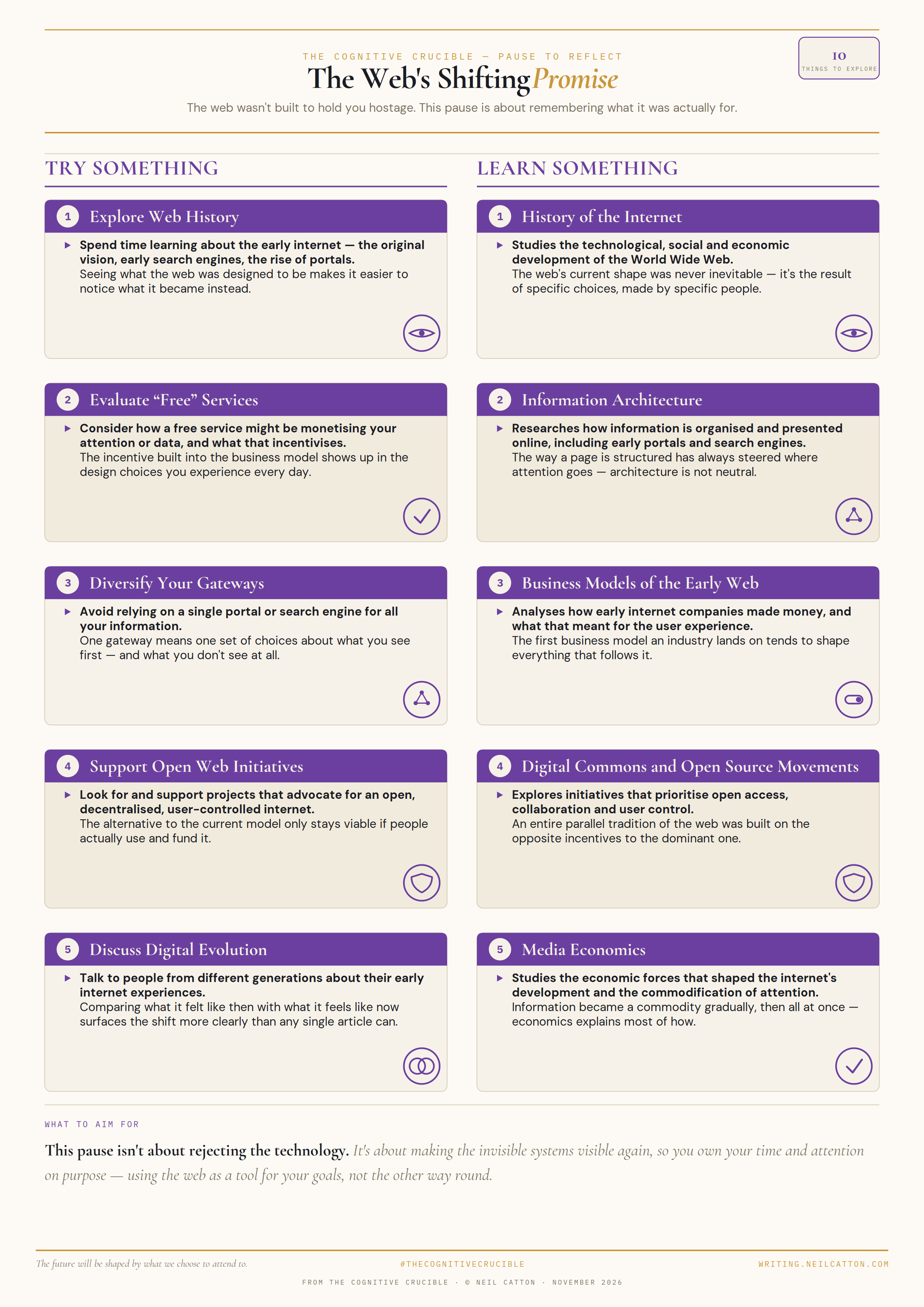
The card splits into two columns — five things to try, from exploring the web’s own early history to diversifying the gateways you rely on, and five research threads for anyone who wants to go further, from information architecture to the economics of the early internet. It’s for anyone who wants to remember what the thing was actually for.
It comes from The Cognitive Crucible, where the fuller argument about attention, technology and the mind lives. The card stands on its own — you don’t need the book to use it.
Print it, pin it somewhere you’ll see it, or send it to whoever still remembers what the internet felt like before this version of it.
What would the web look like if it were still being built for the reasons it started?
You’re reading The Next Evolution by Neil Catton, articles that explore the human world and the intersection of technology, they try and ask difficult questions - not to scare - but to inform. If someone forwarded this to you, you can subscribe free at neilcatton.substack.com.
Neil Catton is the author of The Next Evolution, The Cognitive Crucible and The Shadow System - available on Amazon, and writes at the intersection of technology, ethics, and human purpose.