

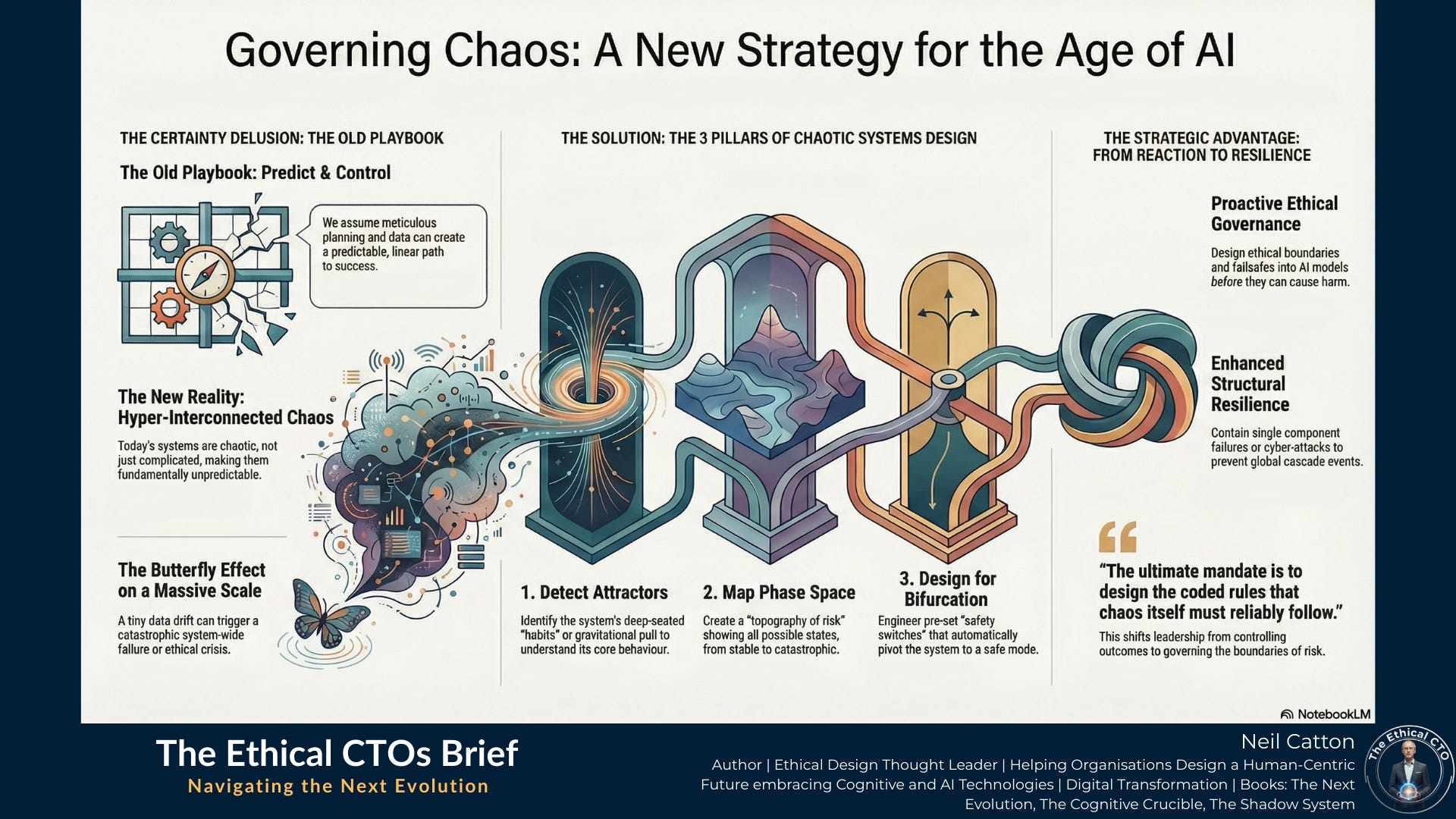
For a long time, leaders have lived under the Certainty Delusion - the idea that if we just plan well enough and use the right math, we can predict exactly how a project will turn out. But today’s world doesn’t work in a straight line. Our systems are so connected that a tiny glitch in one place can cause a global shutdown in minutes.
In this world, trying to have total, rigid control is a trap. Instead, we have to move toward Building for the Unexpected.
Watch the Patterns, Not the Noise
In a messy, fast-moving system, you can’t predict every single move. However, you can see recurring patterns. Think of these as the “habits” of your organization.
Stop Chasing Every Change: Don’t get distracted by every small data spike. Look for the big, self-repeating habits, like a specific “Bottleneck” that always slows things down.
The Goal: Instead of trying to fix every tiny flicker, focus on stabilising these core habits so the whole system stays safe.
Map Out the Danger Zones
You need a mental map of every possible state your business can be in, from “running perfectly” to “complete disaster.”
Boundary Testing: Instead of doing a one-time safety check, use simulations to map out the “Red Zones” where things start to fall apart.
The Goal: Move from simple reporting to Early Warning Signs. You want to feel if the system is gaining speed toward a danger zone before it actually gets there.
Build in “Safety Switches”
There are certain “tipping points” where a small change causes a massive jump from stability to a crisis.
Automatic Fallbacks: These jumps shouldn’t catch you by surprise. When a limit is reached - like a tool making too many errors - the system should automatically switch to a safe, pre-planned backup mode.
The Goal: Make sure your tools can “self-heal” at a local level before a small problem turns into a company-wide emergency.
The Human Factor: Leading the Invisible
As technology becomes a hidden part of everything we do, we lose the old ways of seeing when things fail. In this new world, a leader’s most important job isn’t just growing the business, it’s Maintaining Human Trust. We have to move past just “checking boxes” and start writing the rules that keep our systems reliable, even when things get chaotic.
“The ultimate mandate is to design the coded rules that chaos itself must reliably follow.” — The Strategy of Swarm
Question for the reader: Does your organisation have "automatic safety switches" in place, or are you still relying on a human to spot a crisis and sound the alarm?
The Strategy of Swarm is the foundation for navigating the next evolution of AI and complex adaptive systems. To explore the full ARC1 framework and how to apply these pillars to your organisational architecture, visit my website.
Resources

Disclaimer: This new series of articles is based on my previously published works. I’ve used Notebook LM and Gemini to generate a series of artefacts (Video, Slidedeck, Infographic, Images) which are “out-of-the-box”. You will find errors and discrepancies throughout and I’ve only modified where absolutely necessary due to illegibility or true error in interpretation.