

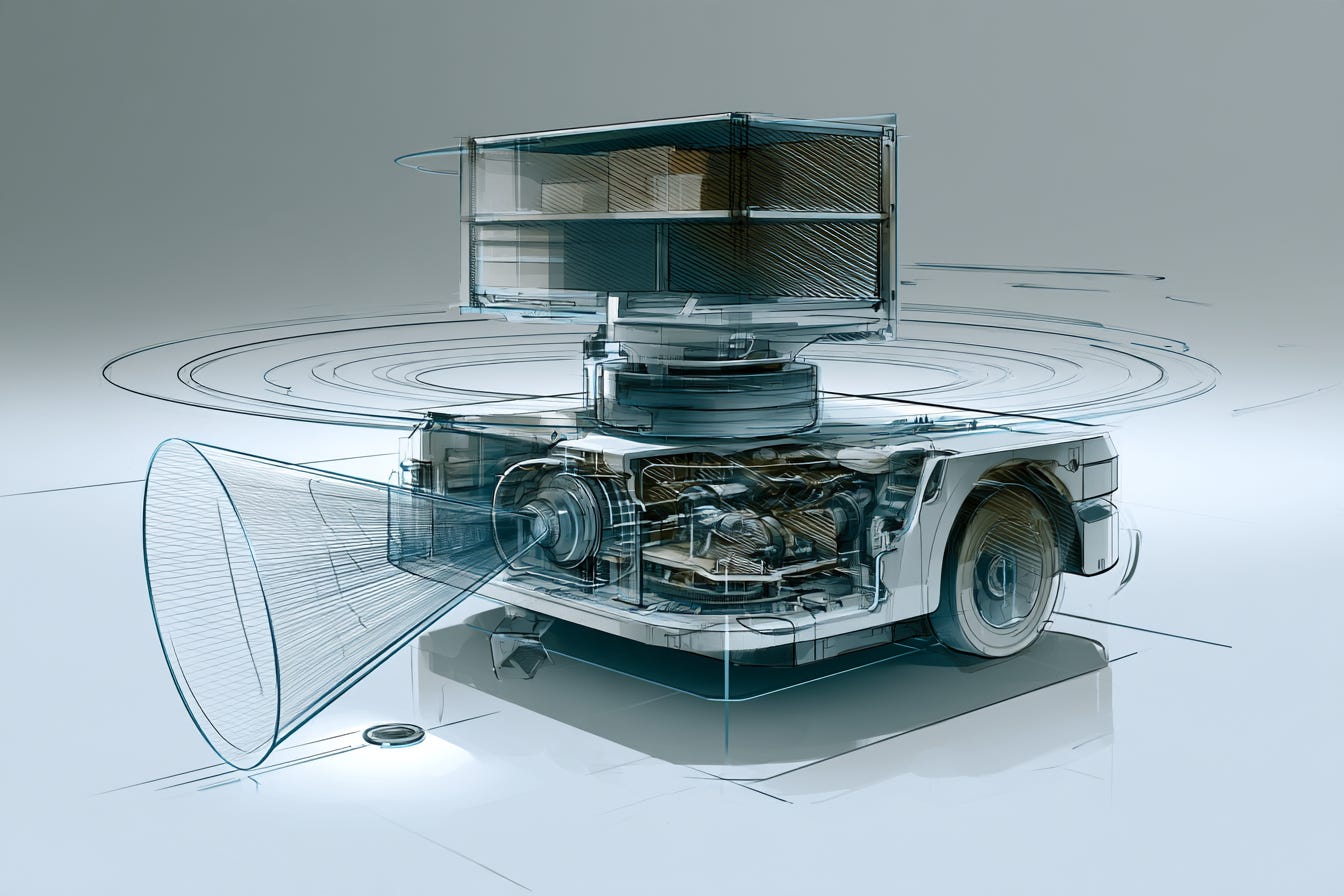
Electric and hybrid cars sold in the European Union must now make a sound, so that people can hear them coming. The robots spreading through warehouses are engineered and tested to see the people beside them. The standard written for them requires them to warn people, but not to be heard.
Since July 2021, every new electric or hybrid car sold in the European Union has had to make a sound it does not need. Below 20 kilometres an hour, and in reverse, an acoustic alerting system plays an artificial noise, because an electric car is otherwise close to silent and people crossing the road had relied on hearing an engine. Blind and partially sighted pedestrians relied on it most. The United States reached the same answer through the Pedestrian Safety Enhancement Act of 2010, and when its regulator wrote the rule, it cited its own finding that hybrid cars were 1.18 times more likely than conventional cars to be involved in a crash with a pedestrian, and 1.38 times more likely during low-speed manoeuvres.
Warehouses are going through their own version of that change. Electric machines that drive themselves now share floor space with the people whose carts and shelves they carry. They are engineered with great care to notice those people. The standard written for them requires them to warn people. It does not require them to be heard.
How the machines find you
There are three broad families. In goods-to-person systems, the stock travels and the worker stays put: Amazon’s drive units, descended from the Kiva Systems robots it bought in 2012, carry shelves of inventory to a fixed station, while Ocado’s grid robots and AutoStore’s systems lift bins from dense stacks and deliver them to a picker. Free-roaming mobile robots go further. When Amazon introduced Proteus in June 2022, it called it its first fully autonomous mobile robot, able to move around employees instead of inside areas kept apart from them, with the stated aim of taking heavy carts out of people’s hands. The third family is the driverless forklift, which has to balance avoiding people against the risk of tipping a heavy load, in the same aisles people walk.
The free-roaming machines and driverless forklifts sense people with lidar, time-of-flight cameras and computer vision, and the international standard for driverless industrial trucks, ISO 3691-4, which covers automated guided vehicles and autonomous mobile robots alike, sets out what that sensing must achieve. The truck must detect a person in its path and stop before it touches someone standing still, and that function carries a formal safety rating, performance level d under the machinery safety standard ISO 13849-1. The standard’s verification clause includes a dedicated set of tests for detecting people. Above the individual machine sits software that plans the whole fleet: Ocado’s grid robots are orchestrated by a single machine-learning system that decides which bin moves where, and when.
This is no longer experimental. The International Federation of Robotics counted 102,900 transport and logistics robots sold in 2024, 14% more than the year before, with transport inside buildings the leading use; the figure comes from a sample of 294 suppliers and is not projected to the whole industry. Growth has limits: the analysts at Interact Analysis cut their mobile-robot forecast in 2025, citing tariffs and weak warehouse construction. The driverless forklift is further behind. A 2026 review in the journal Robotics found deployments still running at between two and fifty vehicles a site, and named unpredictable human behaviour among the reasons laboratory results have not yet scaled.
What the person is given
The standard’s first edition, published in 2020, placed the detection of people among its safety requirements and gave it its own tests. Warning systems, the part that tells a person a machine is there or about to move, sat in a later clause headed “Information for use”, next to the instruction handbook and the markings on the truck. The 2023 edition moved warning systems into the safety requirements, as clause 4.14. That is a real change, and a recent one.
The warning it requires is “visible and/or acoustical”. A light satisfies it. A sound satisfies it. Nothing obliges it to make a sound.
There is a fair case for that wording. Linde Material Handling makes it for its BlueSpot, a blue or red light projected onto the floor ahead of a moving truck: a loud acoustic warning can distract people, or be drowned out altogether. A silent light may well be the better warning in some buildings. Research on how robots should signal what they are about to do is active. One 2025 study found that people followed a robot’s projected directions correctly 93.8% of the time, against 37.5% when the robot simply turned to face them, but it was designed around museums, shopping centres and airports, not warehouses.
The comparison with the road still holds. When cars went quiet, the rule makers put the duty on the vehicle to be heard, and specified the sound, at low speeds: up to 20 kilometres an hour in Europe and 30 in the United States, below which the US regulator found tyre and wind noise could not do the job. The original Kiva drive unit travels at under 5 kilometres an hour. On the warehouse floor, the machine must detect the person, to a tested standard, while the form of the warning back is left to the vendor and the site.
The fleet software knows where every machine will be a moment from now. The person in the aisle knows what they can see, and what they can hear.
Where the demonstration ends
Two consequences are already visible. The first is the familiar risk in any workplace with vehicles. In Great Britain, being struck by a moving vehicle killed 24 workers in 2025/26, the second most common cause of fatal injury at work after falls from height, according to the Health and Safety Executive’s provisional figures. Those deaths involve every kind of workplace vehicle, and none of them can be put down to robots on this evidence; they are the reason the question matters as the vehicles change.
The second is quieter. A study of robotic fulfilment centres published in the ILR Review in August 2025 found severe injuries down by about 40% and non-severe ones, the sprains and strains, up by about 77%, and attributed at least part of that rise to the faster pace of work at robotic sites. Fewer people were badly hurt. The work that remained moved faster.
What the technology has not yet demonstrated is the thing it most needs to: machines and people sharing space at warehouse scale, safely, when the people behave like people. The 2026 review lists human-aware safety among its open problems. ISO lists its own standard as due for revision, with a new draft already in development. The machine’s side of the relationship is specified and tested. The person’s side is the part still being written.
My Opinion
I think the advance in robotics is a real opportunity to help people in hazardous industries, and wherever a task needs repetitive precision. But where robots are being used for automation at scale, in work that directly affects a person, we have to ask whether that is the best model.
On the road, a quiet machine was told to make itself heard. On the warehouse floor, it has been told to see. When the machine can already see the person clearly, who decides whether the person can hear the machine?
You’re reading The Next Evolution by Neil Catton, articles that explore the human world and the intersection of technology, they try and ask difficult questions - not to scare - but to inform. If someone forwarded this to you, you can subscribe free at neilcatton.substack.com.
Neil Catton is the author of The Next Evolution, The Cognitive Crucible and The Shadow System - available on Amazon, and writes at the intersection of technology, ethics, and human purpose.