

There is a moment near the end of most business case meetings that nobody remembers afterwards. The scope is agreed, the timeline has survived its first challenge, the dependencies are mapped and governance has a slide of its own. Then someone notices that the ESG section of the template is still blank. It goes on the action log, against the name of someone who isn’t in the room.
Nothing has gone wrong. The brief is a good one, and the people writing it are good at their jobs. But that small moment shows where the wider question sits in most organisations: at the back of the document, answered by whoever is absent, after the decisions that matter have been made.
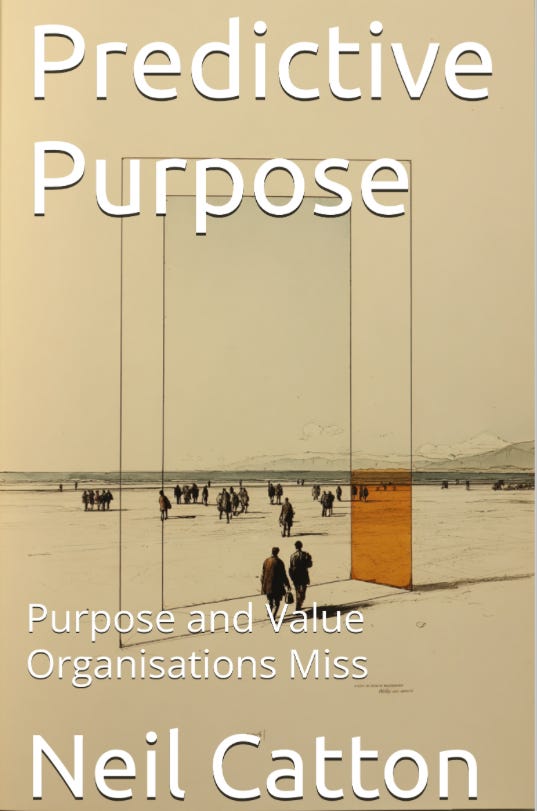
My new book, Predictive Purpose: Purpose and Value Organisations Miss, is about that moment. The Kindle edition is up for pre-order now, and the book is out on 23 October in paperback and on Kindle.
The argument is a plain one. The brief decides what is in scope. Scope decides what gets measured, and what gets measured becomes what success looks like. Whatever sits outside that line is never counted. Nobody rejected it. There was simply no point in the process where anyone was asked to look. So a programme can deliver everything it promised, leave much of what the same capability could have done untouched, and nothing in the success report will show it.
The book argues that the wider value can be counted, in the same units as the business case, and weighed in the same decision. Chapter 6 does the counting in full on a UK local authority social care programme, mapped from the life of the person using the service rather than the requirements of the brief. The figures there are sized for an authority of that kind rather than taken from a client, and the chapter says so before it shows them. The appendix carries the three tools used to do the counting, so you can run the method on a programme where you have the real numbers instead of taking mine on trust.
Some of you watched parts of this take shape in the Predictive Purpose Space here. The book is 149 pages and makes one argument. The Space stays up as the record of how it got there, including the parts that didn’t survive.
It is written for two people who usually work in the same organisation and rarely sit in the same conversation: the one who holds the budget, and the one beside them who saw the wider potential first, raised it once, and watched it get quietly absorbed.
The paperback goes on sale on the same day.
Think of the last business case you saw approved. Whose name went against the section at the back?
A note on XX
XX is a fictional character. Their story is drawn from a combination of professional observation and personal proximity to real events. The experiences described are real. The person is not.
You’re reading The Next Evolution by Neil Catton, articles that explore the human world and the intersection of technology, they try and ask difficult questions - not to scare - but to inform. If someone forwarded this to you, you can subscribe free at neilcatton.substack.com.
Neil Catton is the author of The Next Evolution, The Cognitive Crucible and The Shadow System - available on Amazon, and writes at the intersection of technology, ethics, and human purpose.