

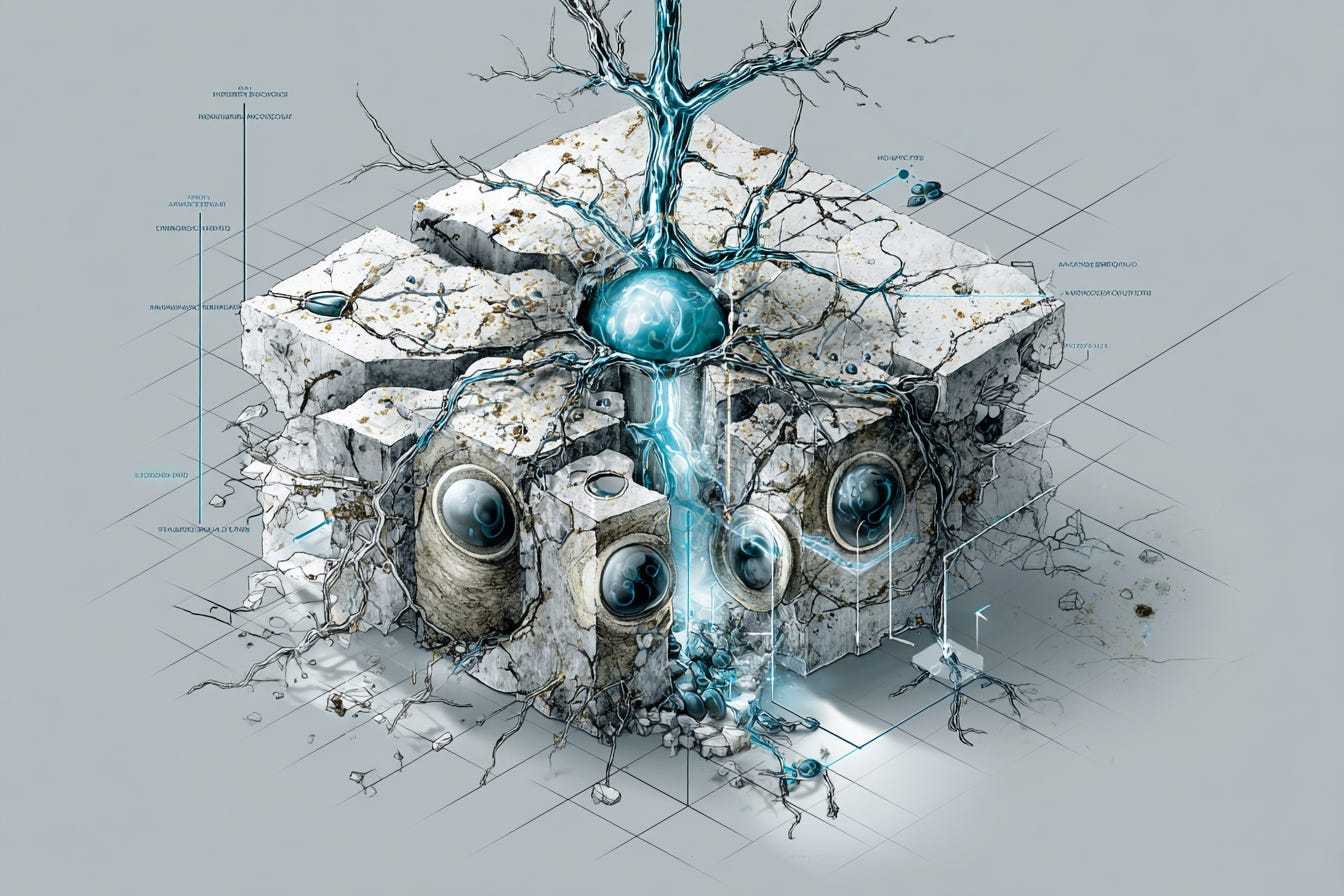
Somewhere beneath the Vijf Eikentunnel in Rijen, a railway underpass in the Netherlands, concrete is doing something concrete has never done before. A crack has formed — the kind that appears in any heavily loaded structure over time, the kind that, left alone, lets water in and corrosion begin and the slow degradation that ends, years or decades later, in a repair bill or a closure or a failure. Except this concrete is not waiting to be repaired. Dormant bacteria embedded in the mix have been activated by the water entering the crack. They are feeding on calcium-based nutrients and producing limestone. The crack is sealing itself.
The idea that a material could detect its own damage and fix it without any external intervention sounds like a property borrowed from living organisms. That is not a coincidence. The research behind self-healing materials draws explicitly on the biology of healing — on how skin closes a wound, how bone knits after a fracture, how trees seal damage to their bark. The scientific ambition is to replicate those capabilities in the inert materials that hold the built world together: concrete, steel, polymers, coatings.
The built world needs this badly. Corrosion and material degradation cost the global economy an estimated $2.5 trillion every year — roughly 3.4% of global GDP, according to a 2016 NACE International study, the most comprehensive global assessment of corrosion costs undertaken. That figure covers the direct costs of repair and replacement and a portion of the indirect costs of disruption, but not the full human cost of infrastructure failures, delayed maintenance, or the carbon embedded in the concrete and steel that gets thrown away and rebuilt. The scale of the problem is so large and so distributed that it rarely registers as a single issue. Cracks in bridges, rust in pipelines, spalling on car park decks, moisture ingress in tunnel linings — these are experienced as individual nuisances, not as a systemic failure of how we build things.
Self-healing materials are a systemic answer to a systemic problem. The question is how close they are to being usable at scale, and what it would take to get them there.
How materials learn to heal
There are two distinct approaches to making a material that can repair itself, and the distinction matters for understanding what each approach can and cannot do.
The first approach is extrinsic: healing agents are stored within the material and released when damage occurs. The most widely studied version of this embeds microcapsules — tiny containers filled with a liquid resin, a polymer, or a mineral-producing compound — directly into the material during manufacture. When a crack propagates through the material, it ruptures the capsules along its path. The healing agent flows into the crack, reacts with a catalyst or with the surrounding material, and solidifies. The crack is sealed. The material continues to function. The bacteria-based concrete works on a similar principle, with dormant bacterial spores taking the place of chemical capsules: water activates the bacteria, the bacteria produce calcite crystals, the crystals seal the gap.
The second approach is intrinsic: the molecular structure of the material itself contains bonds that can break and reform. When damage occurs at the microscopic level, these dynamic bonds — hydrogen bonds, reversible covalent bonds, supramolecular interactions — release and reconnect, the material flows slightly toward the damaged region and the damage heals. This approach works well in polymers and elastomers, where molecular mobility is sufficient to allow the necessary flow. It does not, in general, work in rigid materials like concrete or steel, where the molecular architecture does not allow that kind of movement.
Dormant bacteria embedded in concrete activate when water enters a crack. They produce limestone crystals that seal the gap. The material fixes itself without any human intervention. This is not a laboratory demonstration. It has been built into real structures.
The most advanced real-world deployments of self-healing materials are in concrete, and the most credible research has come from Delft University of Technology in the Netherlands, where professor Henk Jonkers and his team developed the bacteria-based approach over more than a decade. The world’s first building constructed with bacteria-based self-healing concrete was a lifeguard station by a lake in the Netherlands, a demonstration project built by the Delft group. Two further full-scale demonstrator projects followed.
Basilisk, the commercial spinout from the Delft research, expanded deployment of its bacteria-based healing agent into large-scale infrastructure projects in 2025. These are not controlled laboratory experiments. They are structures in the field.
The laboratory results are substantive. For cementitious mixes with inorganic self-healing admixtures designed to seal cracks up to 0.3 millimetres wide, permeability-based healing indices — a measure of how effectively the crack has been sealed — regularly exceed 90% at 28 days. Superabsorbent polymer systems tested against 0.3-millimetre cracks lowered total water flow through the crack by up to 98%.
Beyond concrete, self-healing polymer coatings on car surfaces can repair minor scratches using near-infrared light from sunlight. Self-healing tyres — which use a soft polymer layer that flows into punctures and reseals them — are available commercially from several major manufacturers. Self-healing polymer electrolytes for lithium-ion batteries are an active area of research, addressing the micro-cracking of electrodes that limits battery longevity.
The gap between the laboratory and the bridge
The science works. The engineering challenges that stand between a working laboratory material and wide deployment in real infrastructure are substantial but not unsolvable, and the most important one is cost.
Self-healing concrete costs more to produce than conventional concrete. The bacteria, the encapsulating agents, the additional admixtures — all of these add to the price per cubic metre. The premium varies by system and scale, but it is real, and it creates an immediate procurement problem. Infrastructure projects are costed on initial build price, not on lifecycle cost. A bridge specified with self-healing concrete costs more upfront. The maintenance savings accrue over decades, to a different budget, potentially under a different political administration. The person signing the initial contract and the person who would benefit from lower repair bills twenty years later are usually not the same person, and often not the same organisation.
Self-healing materials — where the technology stands in 2026
Bacteria-based concrete — Dormant spores activated by water; produce calcite to seal cracks; TRL 6–7
Capsule-based concrete — Microcapsules of healing agent rupture on crack contact; TRL 5–6
Intrinsic polymer healing — Dynamic molecular bonds reform after damage; TRL 6–8 in coatings
Self-sealing tyres — Commercially available from major manufacturers; TRL 9
Self-healing battery materials — Electrode crack repair; dendrite prevention; TRL 4–5
Self-healing electronics — Conductive polymers restore circuits after cuts; TRL 4–5
Corrosion cost: ~$2.5 trillion/year globally (~3.4% of GDP)
Key restraint: Higher upfront cost vs. lifecycle saving — procurement systems capture one, not the other
Key players: Basilisk (Netherlands), Delft University, TU Ghent, UCL, DARPA-funded labs
This is not a technical problem. It is a procurement and accounting problem. Whole-life costing — evaluating infrastructure based on the total cost over its operational lifetime rather than just the initial build price — is standard guidance in most developed countries’ infrastructure policy frameworks. It is applied inconsistently. The Treasury Green Book in the UK explicitly requires whole-life cost assessment for public projects. Modelling of US concrete lifecycle emissions found that a 50% increase in structural longevity would have reduced associated CO₂ emissions by an estimated 14% over the twentieth century. Self-healing concrete that extends maintenance intervals well beyond that would compound the reduction further. A bridge built for a 50-year maintenance cycle rather than a 25-year one does not just save money. It reduces the carbon embedded in repeated repair cycles, the disruption of lane closures, and the probability of a failure caused by a crack that was never found.
The second constraint is crack width. Bacteria-based and capsule-based self-healing systems work best on cracks up to around 0.3 to 0.5 millimetres wide. Beyond that threshold, the healing agent cannot bridge the gap effectively. This matters because the cracks that most threaten structural integrity are not always small ones. A mature concrete structure that has been under load for thirty years may develop cracks that exceed what current self-healing systems can address. The technology is most powerful as a preventive intervention — stopping small cracks from becoming large ones — not as a remedial one for structures that are already significantly damaged.
The third constraint is one-time use. Most extrinsic self-healing systems — the capsule-based and bacteria-based approaches — can heal a given location once. The capsules rupture and are gone. The bacteria are consumed. If a crack opens again at the same location, the healing capacity has been depleted. Intrinsic polymer systems, where dynamic molecular bonds reform after each damage event, can in principle heal the same location multiple times. Research into multi-cycle concrete healing systems is ongoing, but the one-time-use limitation of the most commercially advanced systems is a real constraint on where and how they are deployed.
What infrastructure could look like
The consequences of widespread adoption of self-healing materials are not just financial, though the financial case is real. Cement production is responsible for approximately 8% of global CO₂ emissions — one of the largest single industrial sources of greenhouse gases. A consequential driver of cement consumption is the repair and replacement of structures that have degraded faster than their design life suggested. Self-healing concrete that doubles the effective maintenance interval of a structure halves, roughly, the cement demand associated with keeping that structure operational.
Infrastructure degradation disproportionately affects communities where the capacity to fund maintenance is limited — rural road networks, ageing urban bridges in lower-income municipalities, water and sewage infrastructure in countries where regular inspection and repair is not operationally feasible. A pipeline that monitors and seals its own small leaks does not require the inspection regime that a conventional pipeline does. A bridge deck that arrests crack growth autonomously does not generate the maintenance costs that have accumulated as structural degradation.
In England and Wales, a 2025 industry assessment found that 17% of the local road network is in poor condition — structural deterioration that has built up because maintenance funding has not kept pace with deterioration. That gap is not primarily a funding problem. It is also a materials problem.
The field is also moving rapidly beyond concrete into applications with different but equally consequential implications. Self-healing coatings on offshore wind turbines would reduce maintenance costs for one of the most expensive and difficult-to-access classes of infrastructure. Self-healing insulation on undersea power cables would extend their operational life considerably. Self-healing polymer housings for electronic devices would reduce the rate at which functional devices are discarded due to physical damage — one contributor to the 62 million tonnes of electronic waste generated globally in 2022, a figure rising by 2.6 million tonnes every year, according to the Global E-waste Monitor 2024. Self-healing battery electrodes, if they reach sufficient maturity, could extend the calendar life of electric vehicle batteries, reducing the extraction demand for lithium and cobalt that currently constrains sustainable EV adoption.
Cement production causes roughly 8% of global CO₂ emissions. A consequential part of that is repair and replacement of degraded structures. Self-healing materials that double maintenance intervals could cut that demand substantially.
What it would take to build differently
Self-healing materials help structures do their job for longer, with less human intervention. The bridge that arrests its own crack growth reduces the workload on engineers and maintenance teams whose schedules currently scale with every year of infrastructure age. The pipeline that seals its own pinhole leaks reduces the deployment of crews to locate and repair them. The scale of what needs doing is large, and the technology for at least some of the most important use cases has cleared its proof-of-concept stage.
Whether self-healing materials extend what infrastructure can do — allowing structures to be built in environments or to lifespans that would otherwise be impractical — or whether they are primarily cost-reduction tools for existing practice, the honest answer is both. A marine structure with self-healing concrete can be specified for a longer service life in a more aggressive environment than one without it. A pipeline coating that repairs micro-abrasions can be run in conditions that would quickly degrade conventional coatings. These are real expansions of what is buildable. But much of the near-term value will come from the more straightforward task of making ordinary infrastructure last longer and cost less to maintain.
What the industry has not yet seriously addressed is whether self-healing systems should be deployed uniformly at all. At present, they are — the same bacteria concentration, the same capsule density, regardless of where the highest damage risk sits in a given structure. A bridge deck sees very different stress profiles across its span. A pipeline coating experiences different corrosion rates at different locations based on soil chemistry and moisture. A system that modulated its healing capacity to match the risk profile of the structure — higher concentration in the highest-risk zones, lower elsewhere — would do more with the same material. This is technically feasible in principle and not yet routinely implemented in practice.
What the procurement system doesn’t capture
Infrastructure procurement in most countries evaluates initial cost, not lifecycle cost — even where policy frameworks require whole-life assessment. Self-healing materials are more expensive upfront and cheaper over time. What would it take to change the procurement incentive, and who would need to make that change?
Corrosion and material degradation cost $2.5 trillion per year globally. That figure is distributed across thousands of individual failures, repair contracts, and maintenance budgets. Is there a version of infrastructure ownership — public, private, or hybrid — that better captures the value of materials that last longer?
The communities with the most degraded infrastructure are often the ones with the least capacity to pay for repairs. Self-healing materials are currently priced as a premium product. What would a deployment model look like that directed this technology toward the places with the highest need, rather than the highest willingness to pay?
Self-healing materials borrow the concept of biological healing and apply it to inert matter. The research at Delft started with a question: if bone can heal, why can’t concrete? What other properties of living systems — adaptation, response to damage, distributed sensing — are materials scientists currently trying to replicate, and which of those would you most want to see applied to infrastructure?
My opinion
Electric vehicles are heavier than the combustion cars they replace — sometimes by several hundred kilograms — and roads specified for the last generation of vehicle are already absorbing loads beyond their original design. The UK road network, in many places, looks like potholes held together by asphalt. That is not a funding problem in isolation. It is also a materials problem, and one that becomes more urgent with every year that the vehicle fleet changes. Self-healing materials are not a long-horizon technology. They exist, they work, and they are cheaper than the alternative of letting the infrastructure fall further behind.
The lifeguard station by the lake in the Netherlands is still standing. The self-healing concrete in its foundations has been doing its work, quietly, since it was built — sealing the small cracks before they became large ones, without any human action, without any inspection finding them first.
That is a plain description of a consequential idea. Infrastructure that degrades slowly and repairs itself is not just cheaper to maintain. It is safer, more resilient, and less carbon-intensive. The hard part is not the science. It is getting the science out of the demonstration project and into the specification.
You’re reading The Next Evolution by Neil Catton, articles that explore the human world and the intersection of technology, they try and ask difficult questions - not to scare - but to inform. If someone forwarded this to you, you can subscribe free at neilcatton.substack.com.
Neil Catton is the author of The Next Evolution, The Cognitive Crucible and The Shadow System - available on Amazon, and writes at the intersection of technology, ethics, and human purpose.