

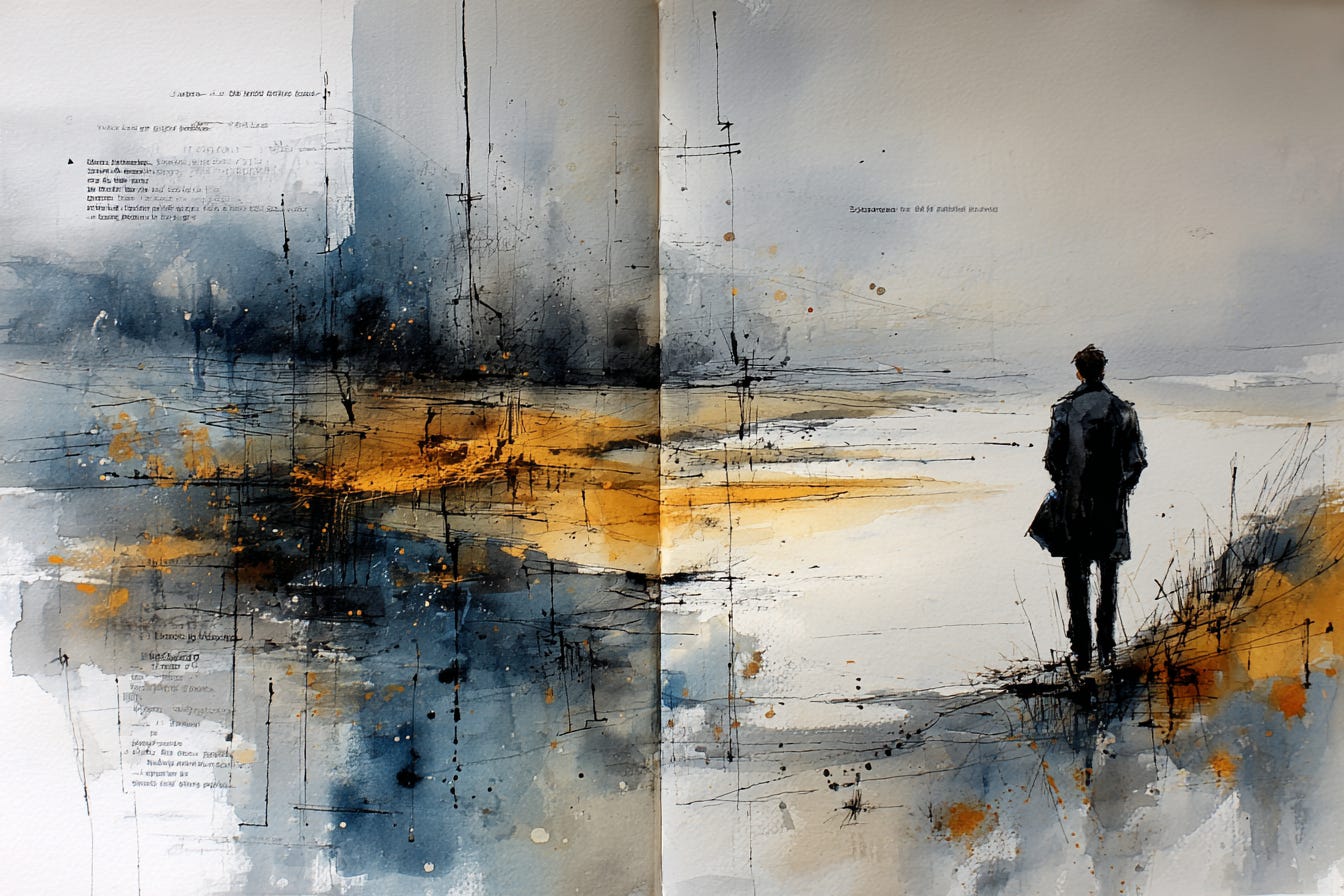
Sam walks the lower fields in winter before anything else. Not because it is efficient. Because it is the only way to know what the overnight rain has done — whether the water is moving through or pooling, whether the drainage that has been slowly improving for three years has held, whether the flood-prone corner that floods briefly and recovers quickly if left ungrazed for six weeks is beginning to saturate. This knowledge cannot be looked up. It was built over twelve years of walking this ground in all weathers, at all hours, through all seasons.
The soil sensor is in the barn. It has been there for fourteen months.
The phone would show no signal here even if they took it out. It has shown no signal on this part of the land for as long as they can remember. That is not a technical problem waiting to be solved. It is a characteristic of these forty acres, in this valley, in rural Wales. The land is what it is. They are doing what they have always done: feeling the soil, watching the drainage, reading what this particular ground is trying to say.
What the grant assumed
The precision agriculture package arrived two years ago with a government agri-environment grant attached and a marketing brochure that described “nature-inspired data systems designed to work with natural variation.” They spent three weeks setting it up: the soil moisture sensors pushed into the ground at the intervals the manual specified, the GPS-guided monitoring app configured on the tablet, the yield-mapping software calibrated against the field boundaries.
The sensors required persistent 4G signal to transmit data to the cloud platform. Signal on the lower fields drops to zero.
The app’s recommendations were calibrated for large-scale arable monocultures: uniform rows, single-variety plots, conventional seasonal rotation. This is a twelve-year permaculture polyculture — a food forest, a market garden, mixed livestock — designed around the specific drainage, soil, and microclimate of this ground. The app had no logic for any of it. The yield-mapping tool produced output that mapped onto nothing being grown there or recognisable on this land.
The problem was not the setup, or the interface. It was that the technology had been designed for a farm this land was not, and no amount of patient configuration was going to change that. Within eighteen months, the sensors were back in the barn and the grant had been spent.
The principle the industry never borrowed
Permaculture has a founding principle, stated plainly since Bill Mollison and David Holmgren developed the practice in 1978: observe and interact. You do not design until you know this place. You walk it across seasons. You watch what it does in rain and drought and frost. The design emerges from sustained attention to specific conditions — not from a template applied to all conditions.
The precision agriculture industry describes its products as nature-inspired. The language is in the brochures, the grant applications, the conference presentations. Adaptive systems. Intelligent sensors. Biomimetic design. What the industry has borrowed is the vocabulary. The founding principle — observe first, design second, never assume the average applies here — was left behind.
The reason is structural. Technology development is funded by scalability. A solution that works for eighty percent of farms is investable. A solution built from sustained observation of this specific land, and a different solution built from sustained observation of the farm next door, is not.
The observation step — the one that would reveal what this land actually needs — is designed out before a line of code is written. Scalable and specific are not the same thing.
In nature, there are no average organisms. Only specific ones, each the product of sustained adaptation to particular conditions. The precision agriculture platform was built on the logic that farms are variations on a theme. This land is not a variation. It is a place.
What twenty-five years of forecasts missed
In March 2026, a peer-reviewed study published in Agribusiness (Wiley) tracked twenty-six precision agriculture technologies across twenty-five years of adoption forecasting data. The researchers — Malone and colleagues — worked through the CropLife–Purdue Precision Agriculture Dealership Survey, the longest-running continuous assessment of precision agriculture technology in the United States. Their finding: input dealers overestimated adoption on nearly every technology, in nearly every year of the study. The overestimation gap widened in the early 2020s, as adoption on several technologies flattened or declined while dealers continued to project steady growth.
The industry’s explanation has been consistent: this is an adoption problem. Farmers are slow to change. They lack the skills, the confidence, the willingness to invest. Twenty-five years of the same explanation, in the face of twenty-five years of the same forecasting error, is not an explanation. It is a refusal to look at the other possibility.
The NFU’s 2025 connectivity survey puts a number on part of the gap. Only 22% of UK farmers have reliable mobile signal across their whole farm. Twenty-one percent of UK farms have broadband speeds below 10 Mbps — compared with a national average of less than one percent. The technology assumes infrastructure that the majority of small mixed farms in rural Britain do not have. These lower fields are not an outlier.
They are the norm.
The grant funding attached to the precision agriculture package does not ask whether the farm has 4G. It asks whether the farmer can demonstrate a commitment to sustainable intensification. They could. The application process had no field for “my lower fields have no signal,” any more than the monitoring app had a field for “food forest polyculture.” The system that allocated the grant and the system that failed to work were built on the same assumption: that the farm in front of them was a version of the average farm, and that any deviation from the average was the farmer’s problem to solve.
The kingfisher and the train
In the early 1990s, a Japanese engineer named Eiji Nakatsu was tasked with eliminating the sonic boom produced by what would become the Series 500 Shinkansen when it exited tunnels. The existing nose design was aerodynamically efficient in open air and catastrophically loud underground, where the pressure wave had nowhere to go. The engineer was a birdwatcher before they were a lead engineer, and the problem reminded them of something they had spent years watching: kingfishers moving from air into water without producing a pressure wave. The kingfisher’s beak is a precise solution to that exact problem — the transition between two media of different densities, at speed, without disturbing the surrounding medium.
The engineer did not spend a two-week research sprint watching kingfishers. They had been watching them for years, as a matter of personal attention rather than institutional programme. The insight was available because observation had been treated as real work, sustained over time, without a deliverable attached to it. The redesigned nose reduced the sonic boom, made the train 10% faster, and reduced electricity consumption by 15%.
The technology that arrived at this farm had borrowed nature’s language. It had not borrowed the engineer’s method. It had not spent seasons watching what these lower fields do after overnight rain. It had not asked what twelve years of permaculture observation had produced.
That accumulated knowledge — the only knowledge that could optimise this specific land — was invisible to the system’s design. It was not data. It was noise.
What observation asks of any system
The common thread between permaculture’s founding principle and the engineer’s decades of watching is not the sector or the technology. It is the decision to treat observation as real work, completed before design begins. The questions that follow are worth bringing to any system you deploy, inherit, or commission — because the answers will tell you whether the observation step was there, or whether it was designed out.
When a technology you use, or your organisation deploys, was designed — how much time was spent observing the specific conditions it would operate in, rather than the average conditions it was modelled on? Would you know if the answer was none?
What knowledge do you carry — about your work, your land, your patients, your tenants, your community — that exists only in your head and has no field in the system you’ve been given? What happens to a decision when that knowledge is absent?
If the technology you’re currently using was built for someone else — a different scale, different context, different connectivity — would the evidence be visible in how it performs, or only in what it cannot do?
Permaculture’s first principle has been available since 1978. What would technology design look like if it had the same founding requirement: that you do not design until you have observed?
Sam still walks the lower fields in winter. The soil sensor is in the barn. The land is doing what it has always done: varying, specific, unaverageable. The technology that was supposed to augment that knowledge had no knowledge of this place. It never did. It was built for somewhere else.
Authors Note
Sam is a fictional character. Their story is drawn from a combination of professional observation and personal proximity to real events. The experiences described are real. The person is not.
You’re reading The Next Evolution by Neil Catton, articles that explore the human world and the intersection of technology, they try and ask difficult questions - not to scare - but to inform. If someone forwarded this to you, you can subscribe free at neilcatton.substack.com.
Neil Catton is the author of The Next Evolution, The Cognitive Crucible and The Shadow System - available on Amazon, and writes at the intersection of technology, ethics, and human purpose.