

Historically, technology has been a powerful enabler, revolutionising tools to boost efficiency and simplify life. From the steam engines of the Industrial Revolution to our fast digital world, it’s persistently reshaped every aspect of existence. However, for much of its history, technology was largely impersonal. Its design focused on solving specific engineering problems or optimising business processes rather than the holistic human experience.
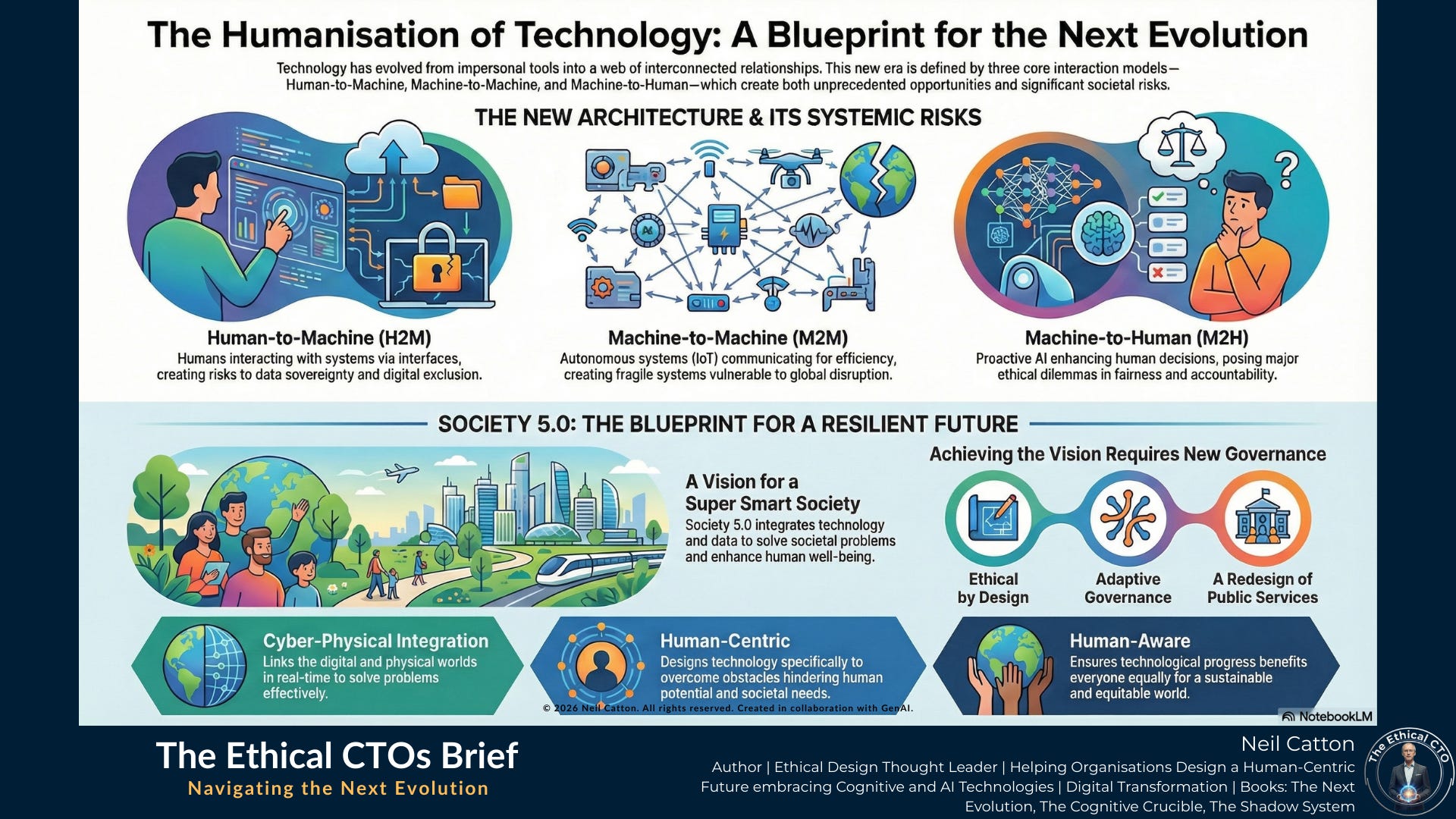
This perspective has fundamentally shifted. We’re now immersed in an era where technology isn’t just a collection of tools or abstract systems; it’s defined by relationships. This change impacts how humans interact with complex machines, how those machines communicate autonomously and crucially how machines are designed to enhance human lives. These three core interaction models – Human-to-Machine (H2M), Machine-to-Machine (M2M) and Machine-to-Human (M2H) – form the defining architectural blueprint of our hyper-connected world.
Human-to-Machine (H2M): This model represents the bridge between humans and digital systems where commands are issued, input is provided, and feedback is received. It encompasses everything from intuitive smartphone interfaces and gestural computing to voice-activated assistants. The goal is to create inherently accessible seamless and user-friendly technology. By reducing interaction barriers H2M aims to maximise a device’s utility and immediate functionality for the end-user.
Machine-to-Machine (M2M): Central to Industry 4.0 and the Internet of Things (IoT) is a model where machines autonomously communicate and exchange data often without direct human intervention. This enables the optimisation of large-scale processes like smart energy grids, balancing supply and demand, or fully automated logistics systems managing complex global supply chains. The primary goal of M2M is to achieve unparalleled efficiency speed and precision on a massive interconnected scale.
Machine-to-Human (M2H): This represents a major paradigm shift. Smart systems are moving beyond waiting for input and proactively offering critical insights, tailored recommendations and direct assistance to humans. This includes advanced AI-driven medical diagnostics, sophisticated predictive maintenance models, and highly personalised education programmes. Ultimately M2H aims to significantly enhance human capability insight and decision-making power.
The Interconnected Architecture: Systemic Risks and Ethical Gaps
The convergence of these three interconnected models – H2M, M2M and M2H – presents both unprecedented opportunities and substantial structural risks. The H2M goal of seamless accessibility achieved through constant personal data collection introduces significant cyber security risks, user manipulation and potential chronic digital exclusion for those unable to adopt or afford new technology. These systems are evolving with the rise of Ambient Technology.
Ambient technology refers to systems that seamlessly blend into their surroundings, processing information contextually and responding without needing explicit prompts. Think smart homes, integrated health monitors and spatial computing environments. This blurring of the line between Human-to-Machine (H2M) and Machine-to-Human (M2H) interaction creates a constant and invisible connection. While incredibly convenient, this pervasive data collection necessitates new standards for Data Sovereignty to ensure individuals maintain true control and ownership over their digital presence and identity.
M2M interactions, while economically vital, create incredibly complex and often fragile systems. When critical national infrastructure logistics or financial markets are managed autonomously, a single point of failure – whether technical error or malicious cyber activity – can swiftly escalate into global disruption. This interdependence means cyber resilience is no longer just an IT concern; it’s a fundamental societal and economic risk management issue.
Crucially, the most challenging area is the growing influence of M2H, which fundamentally shifts the traditional power balance between citizens and institutions. This shift becomes particularly problematic when machines are given the authority to make or influence critical decisions like sentencing recommendations, loan applications, and patient treatment plans. We then face a fundamental ethical dilemma: how can we ensure these algorithmic processes are inherently fair fully transparent and reliably accountable?
The Ethical Imperative: Navigating Bias, Trust, and the Digital Divide
The challenges of machine-to-human interaction are magnified by the sheer volume and speed of data generated in our digital world. This “big data” fuels artificial intelligence but often contains historical biases that algorithms amplify, leading to unfair outcomes for certain demographics. Addressing this requires more than technical solutions; it demands new structural approaches to digital ethics and governance.
Beyond bias, the digital divide remains a significant ethical barrier. This divide is no longer just about access to the internet, but encompasses three critical dimensions:
Access: Ensuring reliable broadband and device affordability for all segments of society.
Literacy: Providing the education and skills necessary to utilise, troubleshoot, and safely navigate complex digital tools.
Adoption: Tackling cultural or generational resistance and ensuring technology is truly designed for diverse needs.
Technology, despite its promise, risks deepening societal divisions if we don’t address these three dimensions simultaneously. Digital natives will reap disproportionate benefits while vast segments of the population are left behind. We’re at a critical juncture where cyberspace’s architecture must be deliberately and ethically redesigned to serve society’s collective values rather than purely commercial or technological imperatives. This demands a profound commitment to systems thinking and a robust ethical framework that centres human values throughout technological development and deployment.
A Blueprint for Resilience: Embracing Society 5.0 and the Digital Twin
Originating in Japan, the concept of “Society 5.0” presents a comprehensive and integrated blueprint for tackling this intricate multi-layered challenge. It’s not just a futuristic theory but an ambitious actionable vision of a Super Smart Society. The core idea is that technology and data must seamlessly integrate into every aspect of civic and economic life to proactively solve critical societal problems and enhance human well-being. This vision sets itself apart from the preceding Information Society by deliberately balancing rigorous economic progress with systemic deep-rooted social problem-solving.
Society 5.0 is constructed upon three non-negotiable pillars:
Cyber-Physical Integration (CPI): This decisively moves beyond isolated data silos. CPI establishes a real-time bidirectional link between cyberspace and the physical world through sophisticated IoT, AI and big data analysis. Digital Twin technology further enhances this by creating virtual replicas of physical assets, processes, or even entire cities. This enables risk-free simulation, predictive maintenance, and optimisation of public services before any real-world changes are made. This real-time evidence-based analysis allows for effective problem-solving.
Human-Centric: This model envisions technology specifically designed to overcome current obstacles hindering human potential. These include demographic challenges like ageing populations, environmental degradation, and persistent regional disparities. The focus shifts from technology’s capabilities to societal needs.
Human-Aware: The ultimate aim is to build a society where technological progress benefits everyone equally. This involves ensuring that people of all ages, physical abilities, locations and socio-economic backgrounds can fully participate and reap the rewards. This will lead to a truly sustainable resilient and equitable world.
Governance, Foresight, and Public Value
To realise the promise of Society 5.0, we need more than faster hardware and complex AI; we need a fundamental shift in our governance and structural models. This is the Next Evolution – a compelling call for legacy institutions like government, healthcare, and education to adapt their frameworks to remain relevant and effective in a world defined by frontier technologies such as spatial computing, quantum systems, and accelerating digital transformation.
This evolution is predicated on three critical imperatives that must guide all technological policy and investment:
Ethical by Design (EbD): Technology must inherently embody core human values from its outset, transcending mere compliance. This demands proactive system design to embed fairness, ensure transparency and establish clear accountability. For example, developers should use tools to detect and mitigate dataset bias before training and deploying models. Ethics becomes a proactive design standard rather than a policing function.
Adaptive Governance: Regulatory and legislative frameworks need to be agile and resilient, evolving alongside the technology they govern at an exponential pace. This demands new models for Moral Foresight – the ability to anticipate the ethical and structural risks posed by future technologies like the impact of generative AI on intellectual property or the potential of quantum computing to render current encryption obsolete. Regulation should be principles-based rather than prescriptive, offering flexibility while maintaining core protections.
Public Service Redesign: We must fully utilise technology to fundamentally transform public service delivery. This shift should move beyond simply cutting costs to delivering long-term resilient and responsive public value for citizens. The goal is to create truly citizen-focused services – not just digitised versions of outdated processes – grounded in a deep understanding of human need and dignity.
A Final Word
The journey towards fully humanising technology and successfully bridging the gap between cyberspace and society is perhaps our generation’s greatest collective challenge. It’s not a passive event waiting to happen; it’s an active, creative, and moral act demanding deliberate effort. The path forward is clear: we must harness our imagination, creativity and ability to sustain a future where technology transcends its role as a mere economic tool. Instead, it should become a trusted partner actively shaping a better world.
Society 5.0 transcends mere conceptualisation; it embodies a shared responsibility and presents an unprecedented opportunity for leaders, policymakers, innovators, and citizens alike to redefine the fundamental relationship between humanity and technological power. As we embark on this crucial journey the true measure of genuine progress should not be the complexity or advancement of our tools but their success and equity in serving the people and planet they are designed to uplift. The future lies not in machines ruling but in technology finally and irrevocably subservient to human purpose.
You’re reading The Next Evolution by Neil Catton, articles that explore the human world and the intersection of technology, they try and ask difficult questions - not to scare - but to inform. If someone forwarded this to you, you can subscribe free at neilcatton.substack.com.
Neil Catton is the author of The Next Evolution, The Cognitive Crucible and The Shadow System - available on Amazon, and writes at the intersection of technology, ethics, and human purpose.