

An advert doesn’t need to be clever to work. It needs a want that feels like a need, a moment of urgency, a face you’re inclined to trust. None of that is new — the platform delivering it is the only part of the equation that’s actually changed.
Edward Bernays was formalising public opinion into a discipline a century before anyone had a feed to scroll. The techniques working on you now have a lineage, built by people who understood exactly what they were doing, long before data made the targeting precise.
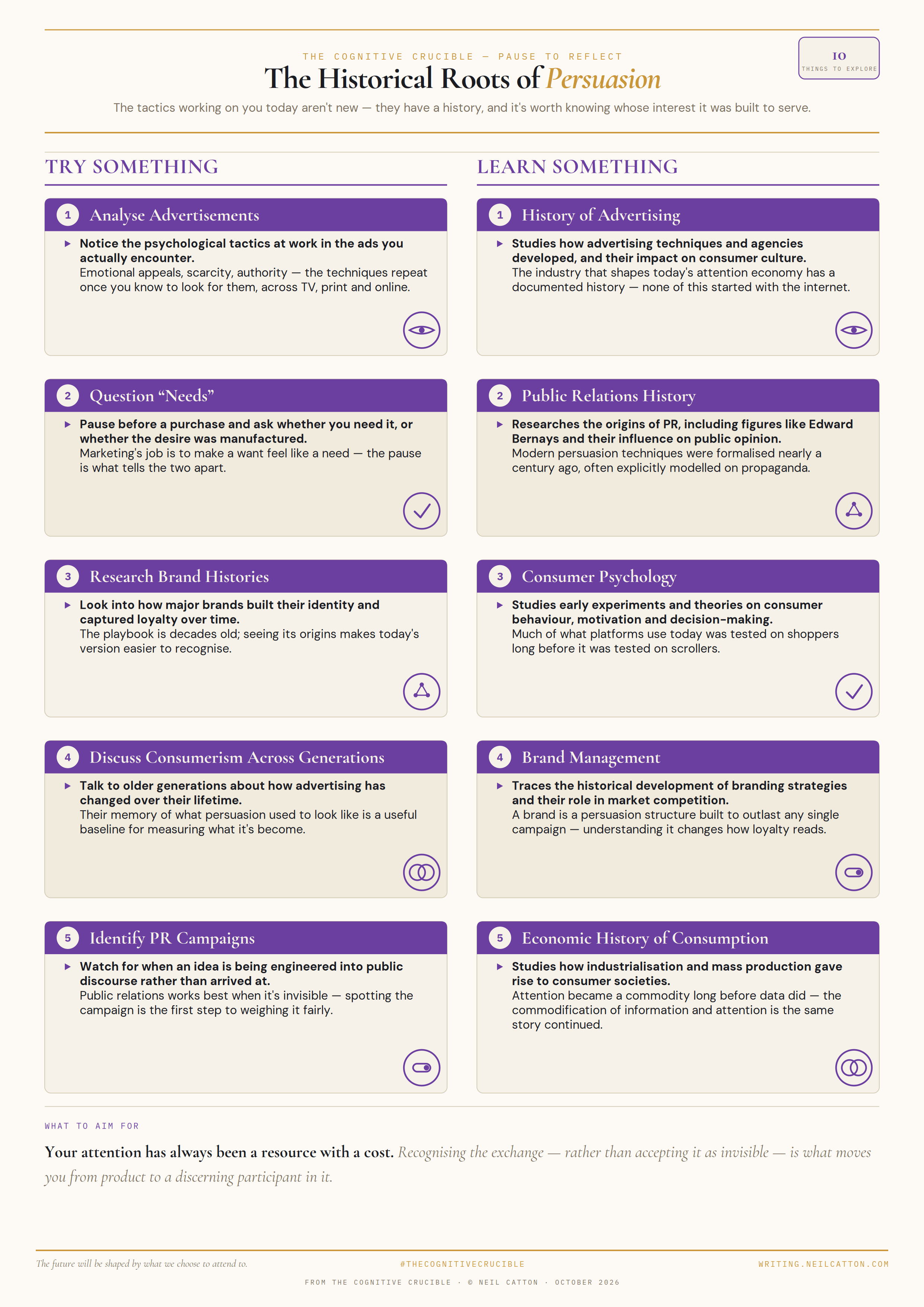
The card splits into two columns — five things to try, from analysing the ads in front of you to tracing a brand’s own history, and five research threads for anyone who wants the fuller picture, from the history of advertising to the economic rise of consumer societies. It’s for anyone who wants to see the architecture behind the message, not just the message.
It comes from The Cognitive Crucible, where the fuller argument about attention, technology and persuasion lives. The card stands on its own — you don’t need the book to use it.
Print it, pin it somewhere you’ll actually see it, or send it to someone who still thinks this started with the internet.
If persuasion has always had a history, whose interest was it actually built to serve?
You’re reading The Next Evolution by Neil Catton, articles that explore the human world and the intersection of technology, they try and ask difficult questions - not to scare - but to inform. If someone forwarded this to you, you can subscribe free at neilcatton.substack.com.
Neil Catton is the author of The Next Evolution, The Cognitive Crucible and The Shadow System - available on Amazon, and writes at the intersection of technology, ethics, and human purpose.