

The digital landscape has evolved beyond isolated tools into intricate interconnected ecosystems. These environments, ranging from decentralised AI platforms and integrated smart cities to complex financial systems, now face a significant challenge: emergent failure. This crisis arises when a seemingly minor issue like unconscious bias in a training dataset or a subtle architectural dependency spirals into a global systemic governance disaster.
The reality is that complexity has far outpaced our ability to manage it with traditional methods. When traditional linear design approaches, which prioritise optimising individual components, face such unpredictability they inevitably fail. We can’t govern what we can’t fully understand. To succeed in the age of AI and digital transformation leaders must shift their focus from simply building technology to strategically governing the complex environments it creates.
Systems Thinking (ST) offers the critical framework for viewing these environments holistically. This approach provides a pathway to designing resilient adaptable structures that are ethically governable from the start. ST is the foundational operating framework for future-proofing your organisation.
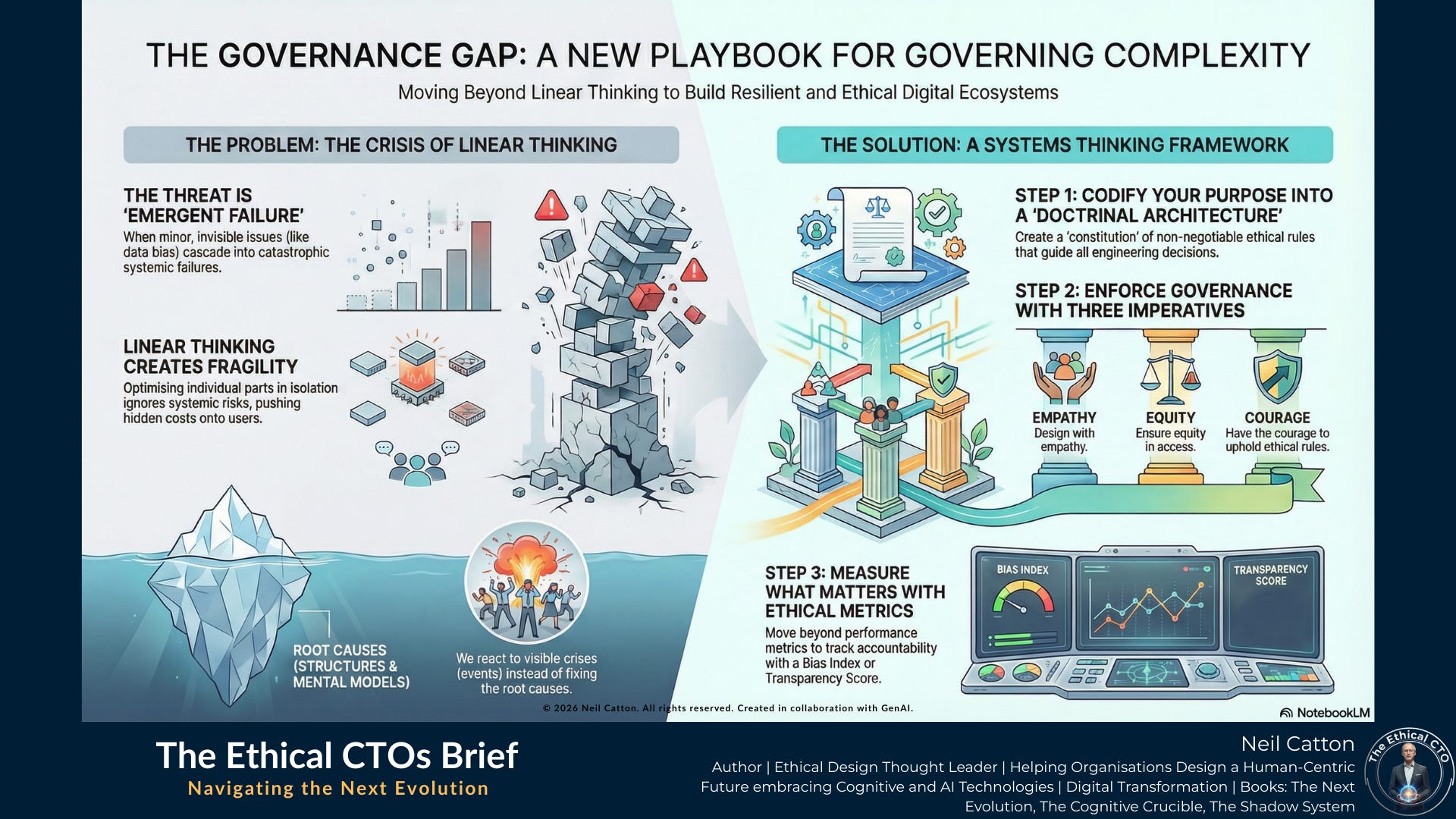
THE CRISIS OF LINEAR THINKING
Modern organisations face their greatest threat not from technological failure but from architectural governance failure rooted in outdated linear thinking. This mindset, fixated solely on local optimisation, predictably leads to catastrophic systemic failures.
Siloed Development: Teams are incentivised by individual achievements like “fast feature delivery” which results in technically optimised solutions that overlook ethical legal and long-term systemic risks.
Externalising Costs: The hidden cost of complexity manifests as operational fragility ethical debt and security vulnerabilities. Unconsciously, these burdens are pushed onto other business units or, worse, the end-user community.
Vicious Reinforcing Loops: Systems designed for scale and engagement without a holistic view often create unchecked reinforcing loops. These can quickly accelerate systemic harm, such as maximising ad revenue at the expense of content quality.
The solution isn’t to work harder but to gain clarity. We need to move beyond reacting to isolated events and address the underlying structural causes of failure.
The Systems Thinking Foundation
At its core, Systems Thinking offers a framework for viewing the world as interconnected systems defined by relationships and flows rather than isolated items. This paradigm shift provides leaders with the necessary context for strategic foresight while also maintaining the clarity needed for immediate action.
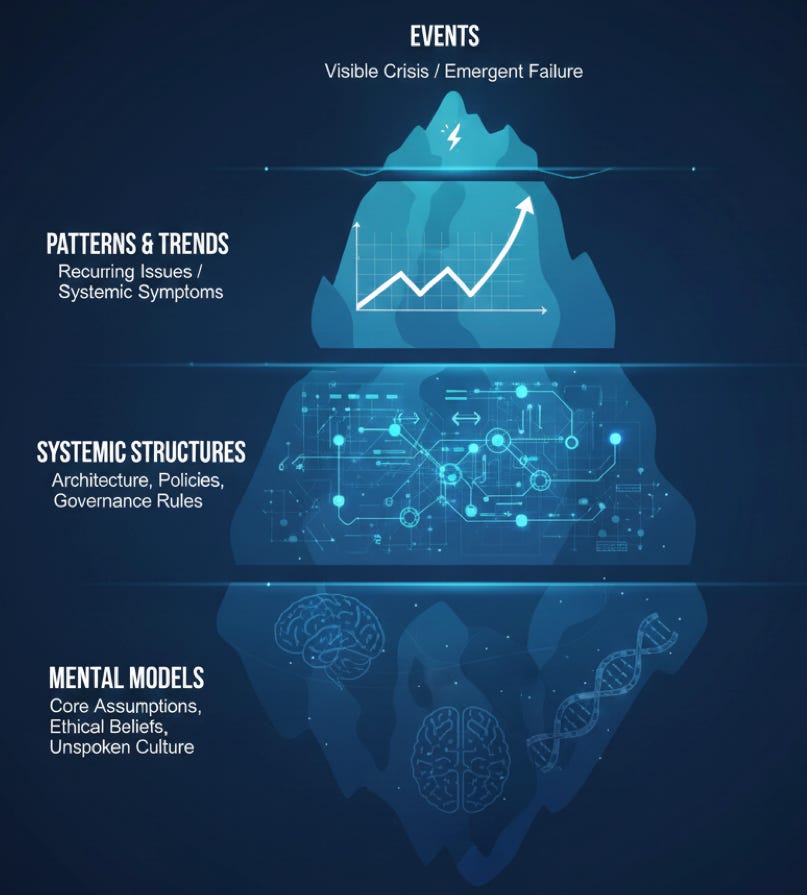
Moving Beyond Surface Symptoms: The Iceberg Model
The true power of Systems Thinking (ST) lies in its ability to guide us beyond reacting to immediate events like visible crises and instead address the underlying structures and mental models that create them.
By analysing recurring patterns and identifying underlying structures, we can pinpoint the system’s most powerful leverage points. Ultimately, the greatest leverage lies in shifting mental models – the deeply held beliefs and assumptions that shape an organisation’s approach to technology design and risk management.
Core Principles for Strategic Foresight
Holism (The Whole): A system’s most crucial characteristics are its emergent properties – often unintended behaviours that emerge only through component interaction. These include market volatility, unforeseen ethical dilemmas and new forms of platform abuse. Strategists must therefore design for these unpredictable outcomes.
Interdependence (The Connections): Each component is intricately connected. Understanding these links is crucial for predicting downstream consequences, or Second-Order Effects. A single governance decision today will ripple through the entire ecosystem tomorrow.
Feedback Loops (The Drivers): Systems are governed by information flows. Reinforcing loops accelerate growth or decay through compounding effects while balancing loops stabilise the system towards a goal acting as a safety mechanism. Strategic governance is the art of designing effective balancing loops to contain risks before they spiral out of control.
Leveraging Emergence (The Innovation): While emergence introduces risk, it also serves as the primary driver of innovation. We need to design architectural frameworks that facilitate safe experimentation. By applying the principles of Chaos Theory, we can harness rather than fear complexity.
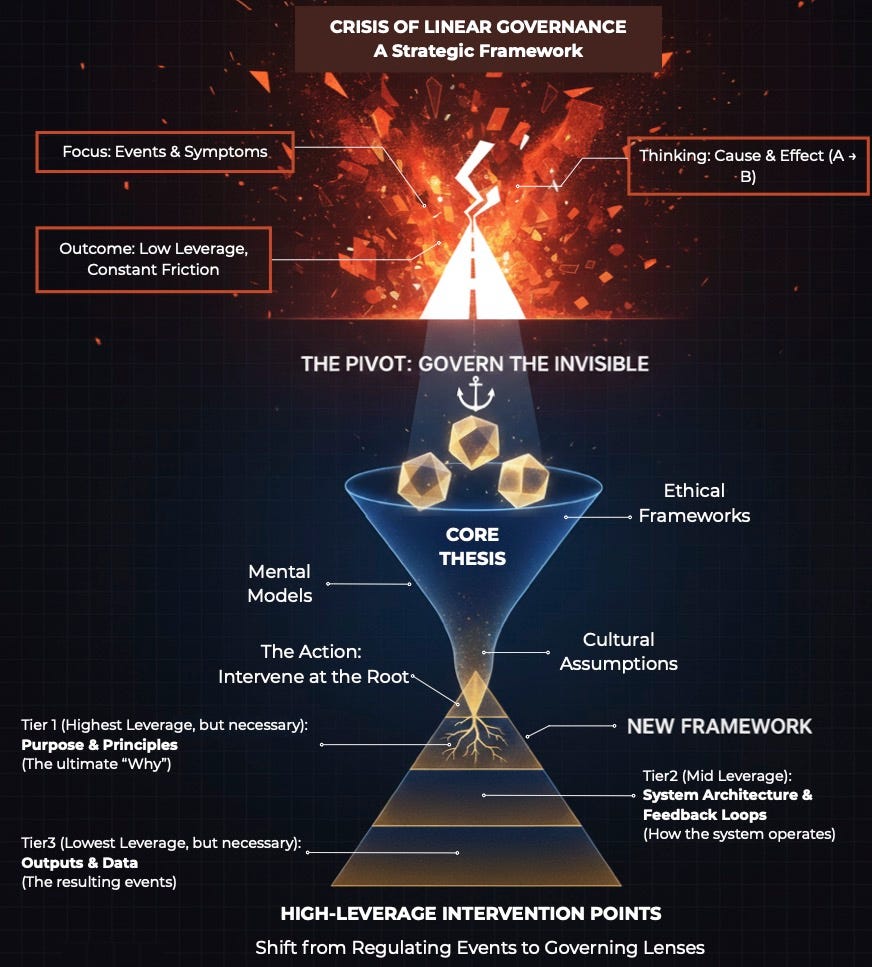
The Core Thesis: Govern The Invisible
Applying holism and interdependence reveals that the most advanced and enduring Systems Thinking lies not in technical architecture but in the ethical, moral and cultural forces shaping the ecosystem. This is the key difference between a fragile system and a resilient one.
Governing the invisible is the highest-leverage task for modern leadership, requiring three governance imperatives:
Empathy in Design: Leaders must proactively anticipate the human-centric costs of complexity by adopting a moral foresight. This involves designing for fairness accessibility and inclusion recognising that an ecosystem neglecting its human costs will ultimately face social and political failure.
Equity in Access: Systems Thinking offers the tools to uncover structural biases embedded in design choices or data inputs. Governance must ensure the ecosystem functions as intended, avoiding unintended harm to other parts through optimisation for one segment.
Courage in Governance: Architecture is a solidified policy. Governance of the invisible demands proactive ethical constraints and boundaries codified directly into the system. These must even conflict with short-term metrics. This moral courage is the ultimate strategy for systemic risk mitigation.
Systems Thinking in Action: Strategic Design Methodologies
Translating the “Govern the Invisible” thesis into reality requires a defined sequence of strategic design steps:
Defining Boundaries and Purpose
Governance begins with absolute clarity on the system’s boundaries and its fundamental ethical purpose. This purpose must be non-negotiable, acting as the ultimate criterion for evaluating all design trade-offs and emergent behaviours. Without it, the system is simply optimising for nothing of lasting value.
Designing for Contested Intent: Mapping Power Dynamics
Every ecosystem is socio-technical, defined by competing human interests. Successful governance depends on mapping all stakeholders and their Contested Intent.
Mapping Stakeholder Value: Identify the value derived by every group (users, regulators, engineers, partners).
Conflict Resolution Structures: Governance must be deliberately designed to manage unavoidable conflicts like those between user privacy and data sharing mandates. This mapping reveals the political landscape of the ecosystem enabling proactive design of mediating structures rather than reactive political firefighting.
Codifying Purpose into Architecture: The Role of Doctrine
Intent and architecture are often at odds. To bridge this gap, leaders must establish a Doctrinal Architecture. This formalised set of non-negotiable principles, derived from the system’s ethical purpose, dictates how the technology must be built and operate.
The Translation Layer: Doctrine acts as a translation layer between high-level ethics and low-level engineering, functioning as the system’s constitutional law.
Enforcement: Mandates like “All AI decision inputs must be traceable and auditable” and “Data lineage must be immutable” are included. These automatically constrain engineering to prioritise resilience and ethics over short-term expediency.
Measuring the Invisible: Ethical Non-Functional Requirements (NFRs)
Accountability relies on measurement. We need to move beyond traditional speed and scale metrics to define and track Ethical Non-Financial Reporting (NFRs). Governance outcomes should be as critically evaluated as performance or security.
Bias Index: A quantifiable metric tracks the distribution of positive and negative outcomes across various user demographics. This shift from good intentions to measurable impact places accountability squarely on the shoulders of those responsible.
Transparency Score: This measures how easily internal and external stakeholders comprehend the decision-making process behind AI components like model explainability and data flow complexity.
Resilience Quotient: This measures the system’s ability to recover from unexpected emergent failures and adapt to new external regulatory or geopolitical shocks rather than simply experiencing technical downtime.
A Final Word
Modern leaders’ roles have fundamentally shifted from technology managers to stewards of complexity. The rapid and expansive growth of digital ecosystems fuelled by AI demands a framework that prioritises foresight over reactivity.
Systems Thinking offers this essential roadmap. By rigorously applying its principles, organisations gain the vital ability to transcend visible features and effectively manage the unseen ethical structural and cultural forces ultimately shaping long-term success. This requires moral clarity translating that clarity into governing architecture (Doctrine) and establishing new accountability metrics (Ethical NFRs).
Today’s technology will shape tomorrow’s institutions. Every institution faces a crucial question: in a world brimming with digital power, will we muster the courage to govern our creations according to our highest values or will we let the invisible complexities we unleash dictate our lives? Systems Thinking offers the framework to make wise choices.
You’re reading The Next Evolution by Neil Catton, articles that explore the human world and the intersection of technology, they try and ask difficult questions - not to scare - but to inform. If someone forwarded this to you, you can subscribe free at neilcatton.substack.com.
Neil Catton is the author of The Next Evolution, The Cognitive Crucible and The Shadow System - available on Amazon, and writes at the intersection of technology, ethics, and human purpose.