

Open your phone at any moment today and something is already waiting — a headline, a notification, a video queued up next. None of it arrived by accident. Somewhere between the event and your screen, a sieve decided what got through and what didn’t, and it wasn’t you holding it.
That sieve doesn’t just filter information. It reinforces whatever you already lean toward, narrows the range of what you actually see, and hands you the result as your view of the world. This pause asks the simpler question underneath: who’s doing the filtering, and how much of that job can you take back?
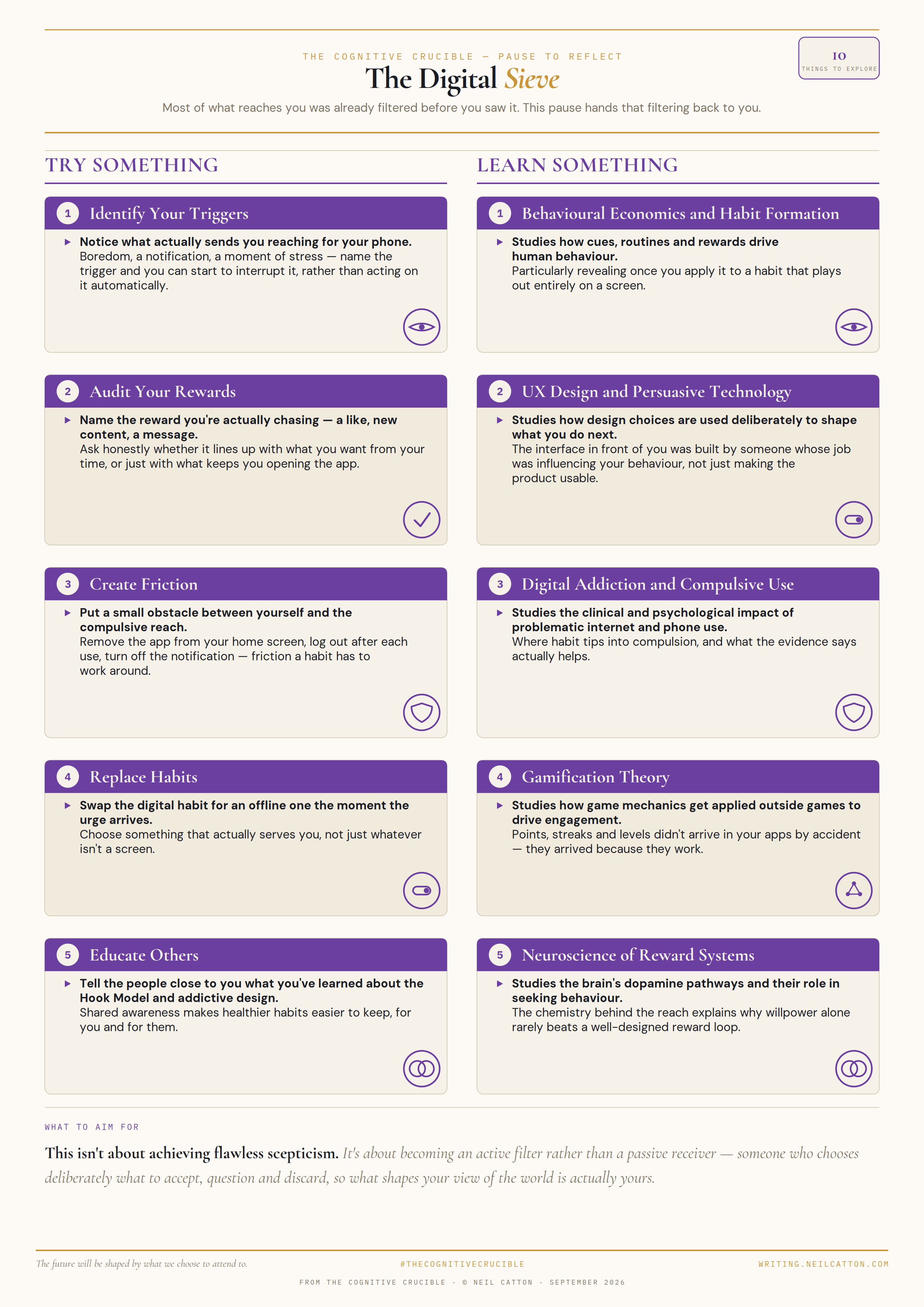
The card lays out ten things to explore, in two columns. Try Something is five habits for noticing your own patterns before reacting to them — naming what triggers the reach for a phone, auditing the reward a platform is actually giving you, building friction into a habit that currently has none. Learn Something is five fields worth a longer look, from the behavioural economics of habit formation to the neuroscience of the reward systems those habits run on.
It comes from The Cognitive Crucible, where the fuller argument about the Digital Sieve and the Cognitive Crucible it feeds gets made at length. The card doesn’t need the book to make sense — it stands on its own.
Print it, pin it somewhere you’ll actually see it, or send it to whoever in your life has stopped asking where their feed comes from.
The card doesn’t resolve the harder part: once you can name the sieve, how much of what’s already settled in your head are you willing to go back and re-examine?
You’re reading The Next Evolution by Neil Catton, articles that explore the human world and the intersection of technology, they try and ask difficult questions - not to scare - but to inform. If someone forwarded this to you, you can subscribe free at neilcatton.substack.com.
Neil Catton is the author of The Next Evolution, The Cognitive Crucible and The Shadow System - available on Amazon, and writes at the intersection of technology, ethics, and human purpose.
Such a timely reminder of how easily our default environment shapes our attention. This is precisely why I’ve clung to physical books and pen-and-paper notebooks over the years, there’s an inherent friction and mindfulness to analog media that digital feeds actively work to erase. Reclaiming that filter feels like taking back ownership of our own cognitive baseline.