

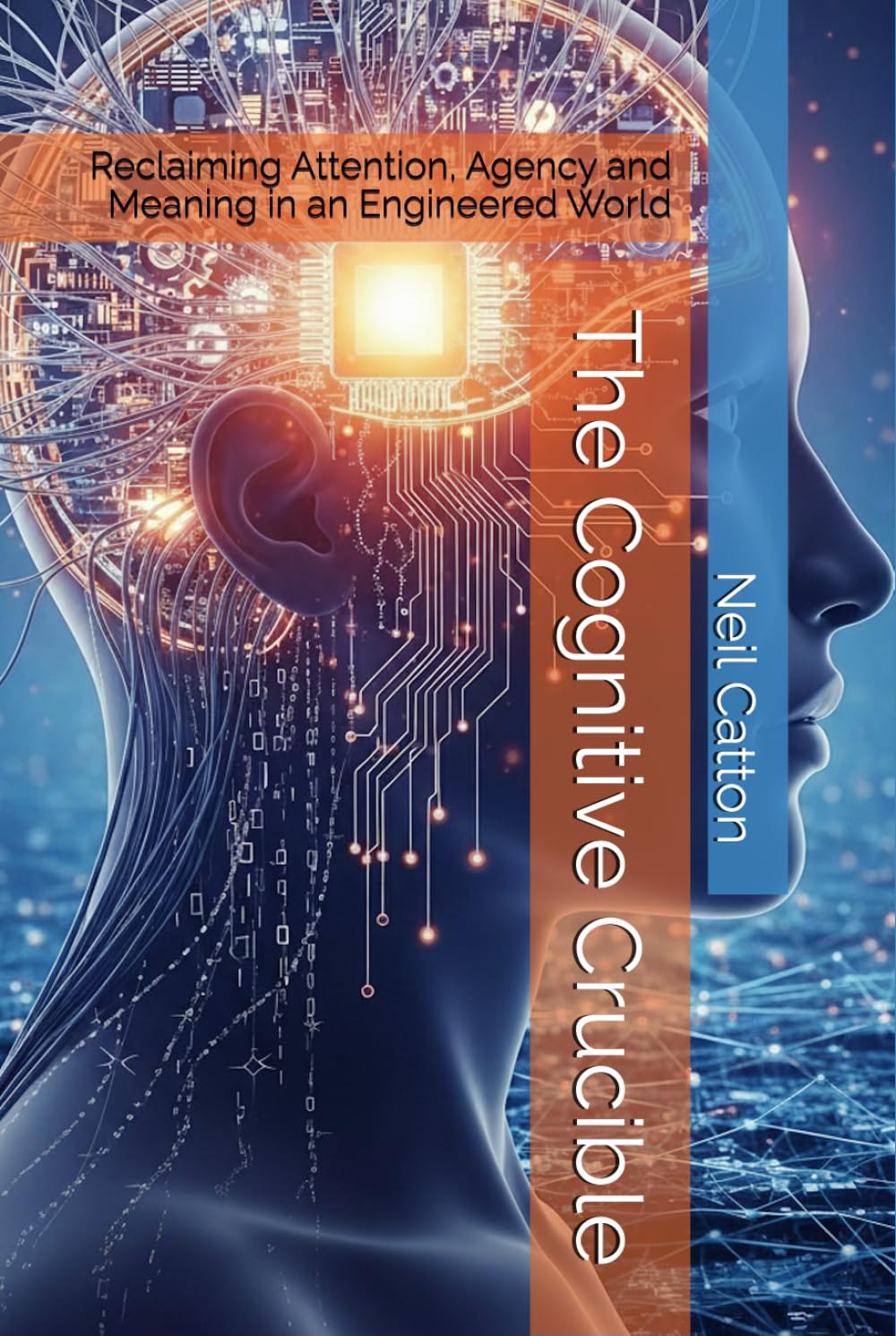
When I sat down to write The Cognitive Crucible, I wanted to move beyond the surface-level complaints about “distraction.” We aren’t just distracted; we are operating within an environment that pushes our biological hardware past its breaking point.
In Chapter 1, I explore the fundamental architecture of our minds to uncover why our “always-on” world is so debilitating. It isn’t a personal failing of willpower, it is a conflict between our ancient wiring and modern design.
Below is an excerpt from the opening chapter.
Excerpt: The Bustling Control Centre
“Imagine your brain as a bustling control centre, constantly bombarded by a dizzying flood of information. Sounds from the street, the hum of your computer, the feel of your clothes, and countless thoughts swirl in your head – an overwhelming amount of data that you could never consciously process at once.
This is where attention, or “spotlight”, comes in, your brain’s remarkable, yet inherently limited superpower. At any given moment, this spotlight can only illuminate a few things brightly.
Too much input can cause our ability to think clearly, remember, or make sound decisions to falter – a phenomenon known as “cognitive load”. In our always-on world, it’s a deeply counterintuitive idea that our brains weren’t built for constant, fragmented stimulation.
We’ll examine the phenomenon of cognitive load and see how every stray notification, open tab, and unfinished thought exacts a measurable toll on our mental energy. By understanding the fragility of our focus, we begin to grasp the true cost of a distracted world.”
Why this matters for the “Ethical CTO”
This foundational concept of Cognitive Load is the missing link in how we design systems and lead teams. As technical leaders, we often focus on the “throughput” of our software, but we ignore the throughput of the humans operating it.
If we build systems that treat human attention as an infinite resource, we are designing for failure. We are creating “Cognitive Debt” that eventually leads to burnout, errors, and a total erosion of agency.
The Discussion: I mention in the chapter that the “feeling of mental exhaustion at the end of a long, distracted day isn’t a sign of hard work; it’s the feeling of a finite system being pushed past its limits”.
As a leader or a creator, have you noticed your team’s “Cognitive Load” reaching a breaking point? How much of that is due to the tools we’ve asked them to use?
I’ll be in the comments all day to discuss the “Architecture of Choice” and how we can start designing for sovereignty rather than submission.
If you want to dive deeper into the neurological consequences of attention fatigue, my book The Cognitive Crucible is available now on Amazon.