

You’re reading The Next Evolution by Neil Catton. Based on my book The Cognitive Crucible, explore the evolution of attention, how technology has changed the game, and the exploitation used in everyday activities to keep and monetise our attention. If someone forwarded this to you, you can subscribe free at neilcatton.substack.com.
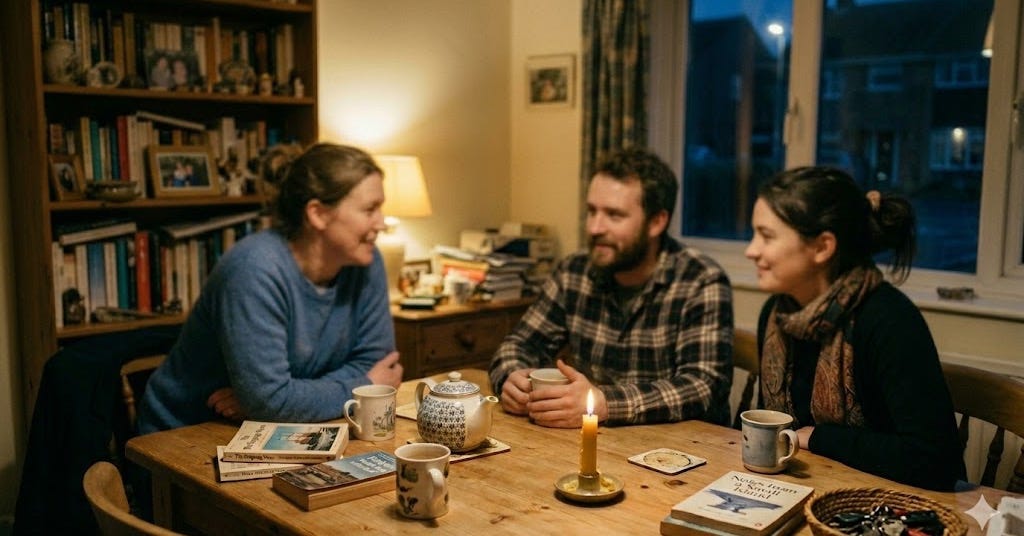
The four of them are in the same room. Dinner is finished. The television is on but nobody is watching it. Sam is on a phone. The teenager is on a tablet. The youngest has a game on a device in their lap. The fourth person, an adult who came to visit, is looking at the others, waiting for a moment that doesn’t arrive.
Nobody is being rude. Nobody is angry. There is no argument happening. Something is absent, but it has no name in this house because it has been absent long enough that its absence has become the default.
What is missing is not conversation, exactly. It is something more fundamental. It is the shared point of focus that once defined what it meant to be in a room together.
Before writing, before agriculture, before any of the technologies we associate with civilisation, human beings gathered around fires. Not only for warmth and protection, though those things mattered, but because the fire did something to attention that nothing else in the natural world could do. It drew it. A flickering point of light in darkness pulled scattered minds into collective stillness. Everyone looked at the same thing. In that moment of shared gaze, something became possible that wasn’t possible when each person looked in a different direction.
The storyteller emerged from this. The elder. The teacher. The person who understood that a group of people all looking at the same point were, for that moment, available to each other in a way that individual attention could not achieve. What passed around the fire, the narrative, the lesson, the ritual, built bonds that held communities together across generations. Shared attention was not incidental to human culture. It was the mechanism through which culture was transmitted.
We have never stopped needing it. We have simply stopped noticing how systematically it has been dismantled.
The campfire didn’t just keep people warm — it was the original technology for making people present to each other.
The platforms that now occupy our attention were not designed to create shared focus. They were designed to capture individual attention, and to hold it. The distinction matters more than it might appear. A fire in a room draws everyone to the same point. A screen in the same room draws each person to a different one. The architecture is not equivalent. It produces a different kind of human experience.
This is not a technological accident. Platforms are built to be personal. The feed is yours. The algorithm learns you specifically, not the people around you. Every design choice optimises for individual engagement because individual engagement is what generates commercial value. The idea that a product should help people be present to each other, rather than present to the product, is not a metric that appears on any dashboard that matters to the people building these systems.
The campfire has been replaced by a million separate feeds, each perfectly calibrated to a single person, each quietly ensuring that no two people in the same room are ever looking at the same thing.
The consequences are not dramatic in the way that makes headlines. Nobody is harmed in any single moment. The person who came to visit goes home. The family continues. But something has been practised. The habit of separate attention, of being physically present and cognitively elsewhere, deepens with each repetition. It becomes the shape of the relationship.
Children who grow up in this environment are not learning that the people around them are the primary claim on their attention. They are learning the opposite. Not because they are being taught it, and not because their parents are failing them, but because the architecture of the room has made individual absorption the path of least resistance, and shared focus the effortful exception.
At scale, this is not a family problem. It is a question about what kind of collective life we are capable of building when the foundational act of shared attention has been quietly privatised.
There is a test I apply to every piece of technology I encounter, whether I am advising an organisation on adoption or simply deciding what I allow into my own life. Three questions:
Is it Assistive — does it genuinely help people do things?
Is it Augmentive — does it genuinely add something that wasn’t there before?
And is it Adaptive — does it respond to the actual individual in their actual circumstances?
Most of the technology in that room fails all three when applied honestly. It is not assistive to Sam, who did not need to be elsewhere in that moment. It does not augment the relationship between the four people in the room — it diminishes it by providing a more frictionless alternative to the effort of presence. And it is not adaptive in any meaningful sense: it adapts to maximise engagement, not to recognise that what Sam’s household needed at that moment was something that no algorithm was designed to provide.
The test is not about technology being bad. It is about being honest about what a specific piece of technology is actually doing in a specific context. Most devices pass the test in isolation. Most fail it when the context is other people.
NOW WHAT?
So when you have read this, ask yourself some personal questions and make some internal observations.
When did you last give another person your undivided attention and what did it feel like for both of you? Not the absence of your phone, exactly, but the active presence of your focus on someone else.
Is there a moment from your own life — a conversation, a meal, an evening — where shared attention changed something? If that moment exists, what made it possible, and how often do those conditions exist now?
If you could change one thing about the technology environment of your home or your workplace, not a personal habit, but a structural feature of how the space is arranged what would it be?
The default state of most households and most meeting rooms is now parallel distraction. Is that the state you’d choose, if you were choosing deliberately?
Attention was always shared before it was sold. Understanding what we’ve lost is the first step in deciding what we want back.
If this piece made you think of someone specific — a colleague, a parent, a friend — send it to them rather than sharing it broadly. One conversation is worth more than a hundred impressions.
This article is part of a series of essays drawn from The Cognitive Crucible. The next article looks at what happens to the mind when the stage gets too crowded — and why the exhaustion you feel at the end of a digitally saturated day is not the cost of hard work.
Neil Catton is the author of The Next Evolution, The Cognitive Crucible and The Shadow System, and writes at the intersection of technology, ethics, and human purpose.