

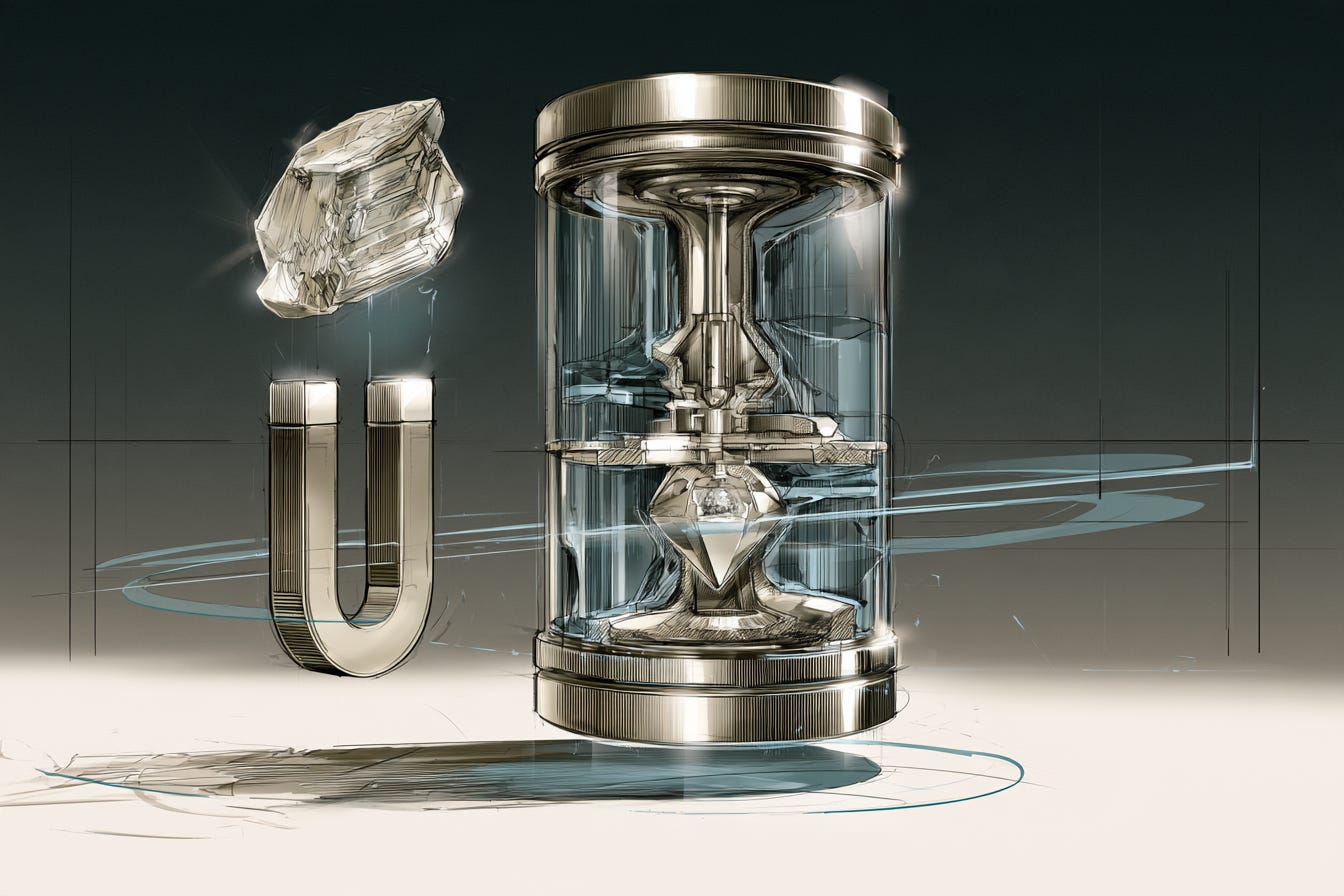
On 22 July 2023, a team at Korea University’s Quantum Energy Research Centre, led by Sukbae Lee, posted a preprint claiming that a copper-doped lead apatite called LK-99 superconducted at up to 127°C, at ordinary atmospheric pressure. If true, it was the physics equivalent of a moon landing: electricity with no resistance, no cooling, no pressure chamber, in a material almost any lab could make. Within days the claim was everywhere, along with video of a small grey flake appearing to half-levitate over a magnet.
It didn’t survive contact with other people’s equipment. Labs across China, Europe and beyond followed the recipe within days and posted what they found. A group at the Chinese Academy of Sciences traced the sudden drop in resistance to copper sulfide impurity left over from the synthesis. The Max Planck Institute for Solid State Research in Stuttgart grew pure crystals and found an insulator. On 16 August, Nature reported the consensus: LK-99 is not a superconductor, just a real result that had been measuring the wrong thing.
LK-99 is usually told as a story about hype, a claim that outran the process built to check it. The record points the other way. The claim moved at internet speed, and so did the checking. Nobody waited for a journal. The correction came back through the same open channels the claim went out on.
The claims that came through the front door
Set that beside the hydride claims from Ranga Dias, then an assistant professor at the University of Rochester. In October 2020, Nature published the group’s report of superconductivity at 15°C in a carbon-sulfur-hydrogen compound squeezed to around 267 gigapascals. In March 2023, Nature published a second: near-room-temperature superconductivity in nitrogen-doped lutetium hydride at a far gentler 1 gigapascal. Both passed peer review. Nature retracted the first in September 2022 and the second in November 2023.
In March 2024, a University of Rochester investigation found research misconduct, including data fabrication and falsification. By November 2024 the physicist no longer worked there. From first paper to institutional finding took more than three years, for claims other physicists had questioned in public almost from the start. LK-99 was honest, wrong, and settled in weeks. The Rochester hydride papers rested on data an investigation later found fabricated, and they carried Nature’s authority while that took its course.
Why the quick route worked this time
LK-99 was cheap to test. The ingredients are common, the synthesis takes days, and the kit to measure resistance and magnetism sits in hundreds of university labs. Anyone who doubted it could check. The hydrides lived inside diamond anvil cells, at pressures only a handful of groups in the world can reach, in samples a fraction of a millimetre across. Almost nobody could check, so almost everybody had to trust.
That split runs through the whole field. The high-pressure hydrides hold the confirmed records: lanthanum hydride, LaH10, was shown superconducting at about minus 23°C in 2019, at around 170 gigapascals. The most extraordinary claims live there too. A 2022 paper from a team at the US National High Magnetic Field Laboratory reported a lanthanum-based superhydride with a superconducting onset at 556 kelvin, well above the boiling point of water, at 160 to 180 gigapascals. I can find no independent reproduction of it, and very few groups could even attempt one.
Ambient-pressure materials are the ones that could become a cable or a transformer, and they are also the ones anyone can test. In March 2026, a University of Houston team reported superconductivity at 151 kelvin, minus 122°C, at ambient pressure in a mercury-based copper oxide. They got there by squeezing the material, cooling it and releasing the pressure to lock the state in. It beat a record that had stood since 1993. It is a long way from room temperature, but it is the kind of result other labs can pick up and try.
The ceiling isn’t what stands in the way. Kostya Trachenko, a physicist at Queen Mary University of London, and colleagues showed in 2025 that the fundamental constants of physics put the upper limit for conventional superconductivity somewhere between a few hundred and around a thousand kelvin, a range that comfortably includes room temperature. Nothing in physics forbids it. What’s missing is a result that survives being checked.
What a real one would change
If an ambient-pressure, room-temperature superconductor does arrive and holds up, the payoff is concrete. The US Energy Information Administration puts transmission and distribution losses at about 5% of the electricity moved across American lines each year. Cables could carry far more current in far less space. Transformers could shrink. That payoff is also why the next claim will spread as fast as LK-99 did, and why who can check it will matter more than where it was published.
My Opinion
I think the lesson of LK-99 has been drawn backwards. The episode that should worry us is the one that went through every proper channel: a claim few labs on Earth could reproduce, published in a journal everyone else was expected to trust, standing for years. LK-99 died fast because thousands of people could test it. When the next extraordinary result arrives, the first thing I will want to know is how many labs in the world could make it by Friday.
The open question is what happens when the next claim comes from somewhere almost nobody can reach, and looks every bit as plausible as LK-99 did.
You’re reading The Next Evolution by Neil Catton, articles that explore the human world and the intersection of technology, they try and ask difficult questions - not to scare - but to inform. If someone forwarded this to you, you can subscribe free at neilcatton.substack.com.
Neil Catton is the author of The Next Evolution, The Cognitive Crucible and The Shadow System - available on Amazon, and writes at the intersection of technology, ethics, and human purpose.