

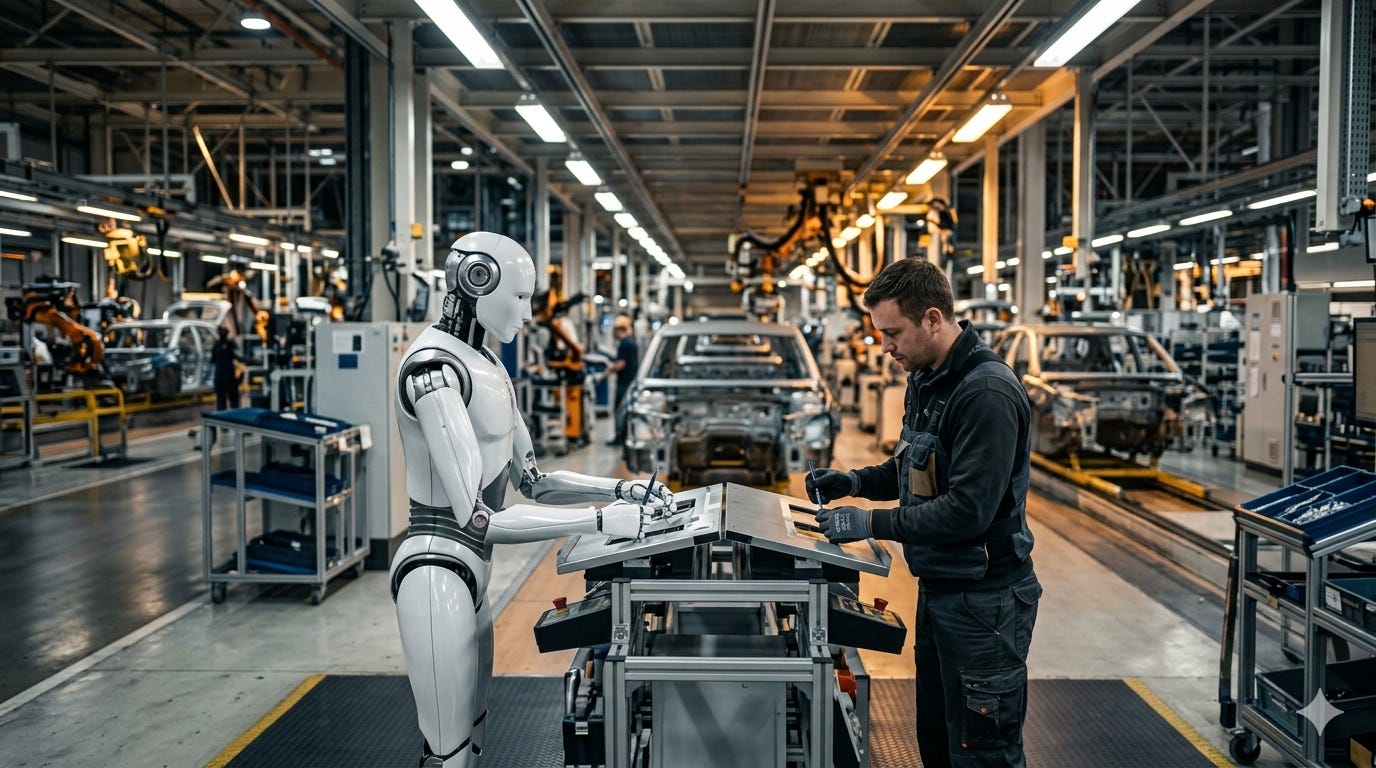
Jordan has worked the same assembly line at an automotive plant for eleven years. The work is repetitive — reach, pick, place, repeat — and over time it has taken a toll. A shoulder injury two years ago put Jordan on light duties for three months. A wrist problem before that. The plant’s occupational health team know Jordan well.
Earlier this year, a robot started working the same line. It is roughly human-shaped, two arms, an upright torso, roughly Jordan’s height. It picks up parts. It places them. It does not call in sick. It does not get injured. And it does not, so far, do anything Jordan cannot do.
Jordan’s reaction, when asked, is measured. “It’s doing the stuff nobody wants to do anyway,” Jordan says. “The boring bits. The heavy bits. I’m doing more of the interesting work now.” Then a pause. “For now.”
That pause carries a lot of weight. We are at the earliest stage of a shift in the physical workplace that could be as significant as the arrival of the personal computer in the office, and the questions it raises are not really about the technology. The machines are arriving. The question is whether the systems around them — the training programmes, the wage structures, the safety nets — are arriving at the same pace.
From Demo to Deployment
For most of the past decade, humanoid robots existed primarily as demonstrations. A company would release a video. The robot would walk across a stage, pour a glass of water, fold a t-shirt. Audiences would applaud. Experts would point out, sometimes in public, that the footage was carefully controlled, that half the tasks were teleoperated, that the gap between a choreographed showcase and a functioning workplace colleague was enormous.
That scepticism was largely justified. And then, quietly, things changed.
In late 2025 and into 2026, the demos gave way to deployments. Tesla’s Optimus Gen 3 robots began working autonomously inside the company’s Fremont and Austin facilities — moving boxes, sorting parts, handling repetitive material tasks. Figure AI’s robots started shifts at a BMW manufacturing plant in South Carolina. Agility Robotics deployed its Digit robot inside Amazon fulfilment centres. Apptronik’s Apollo went into a Mercedes-Benz facility. These are not proof-of-concept trials. They are operational.
The numbers are still modest. Across all deployments globally, the humanoid robot population in real workplaces is measured in the hundreds to low thousands, not the hundreds of thousands. But the trajectory matters as much as the current state. The International Federation of Robotics reported that the global market value of industrial robot installations hit an all-time high in 2026. Goldman Sachs revised its forecast for the humanoid robot market to reach $38 billion by 2035 — six times its earlier estimate.
The demos gave way to deployments. The gap between a choreographed showcase and a functioning workplace colleague has closed faster than most experts predicted.
The acceleration has several causes. Battery life improved, modern units can operate 16 to 20 hours before recharging, making two-shift factory schedules viable. Actuators got cheaper and more precise. And crucially, the AI underneath the robots matured. Large language models gave robots a way to understand plain-language instructions without bespoke programming. What was once a specialist task, deploying an industrial robot, is beginning to look more like managing a member of staff.
The World Is Built for Humans — and That Is the Point
The question that has always haunted industrial automation is: why humanoid? For decades, the answer from robotics engineers was: there is no good reason. A robotic arm bolted to a single point on an assembly line is faster, more precise and far cheaper than any machine trying to walk on two legs. If you know exactly what task needs doing and where, purpose-built automation wins every time.
The humanoid form only makes sense when you don’t know exactly what task needs doing, or where, when the environment is unpredictable and the work is varied. Which describes most of the world beyond the carefully designed production line. Warehouses where the layout changes. Construction sites. Care homes. Kitchens. The human body evolved for generalism, and humanoid robots are a bet that the best way to navigate a world built for humans is to be shaped like one.
This is why the most significant humanoid deployments in 2026 are not in purpose-built robotics facilities. They are in places already designed around human workers: factory floors with standard-width aisles, shelving at human reach height, tools sized for human hands. Boston Dynamics’ Atlas, developed in collaboration with Toyota Research Institute, began testing in Hyundai facilities for exactly this reason — not because the facility was built for robots, but because it was built for people and the robot could work within it without expensive retrofitting.
Who Is Building Humanoid Robots in 2026
Tesla (Optimus Gen 3) — Deploying in own factories; targeting ~$20,000–$30,000 at scale
Figure AI (Figure 03) — Pilots at BMW; Helix AI model for full-body autonomy
Agility Robotics (Digit) — Amazon fulfilment centres; owned by Hyundai
Apptronik (Apollo) — Mercedes-Benz manufacturing; focus on hazardous tasks
Boston Dynamics (Atlas) — Hyundai pilots; NVIDIA collaboration for Large
Behaviour Models 1X Technologies (NEO) — Consumer-facing; $20,000 pre-orders open; 2026 delivery target Chinese Big 5 — Unitree, Agibot, Leju, Fourier, Huawei.
China holds ~90% of 2025 global shipments
China deserves particular attention here. Chinese manufacturers shipped roughly 13,000 humanoid robot units in 2025, representing approximately 90% of global shipments. Agibot, largely unknown outside specialist circles, shipped its 10,000th cumulative unit in early 2026, with half of those deliveries in the three months prior. The Chinese government’s industrial policy has provided both demand, state-owned enterprises buying early, and supply chain advantage, with domestic manufacturers controlling components that every other country’s robotics industry depends on. The race being run is not purely commercial. It is geopolitical.
The Pause in Jordan’s Answer
The labour economics of humanoid robots sit in uncomfortable territory, and the honest answer is that no one fully knows how they will play out.
The optimistic case is straightforward: there are not enough workers. Bain & Company projects a global shortage of nearly eight million manufacturing workers by 2030, driven by ageing populations and declining birth rates in major industrial economies. The United States currently has around 8.1 million job openings but only 6.8 million unemployed workers to fill them. Robots that can handle the dull, dirty and dangerous work — the work that most injures bodies and most struggles to find takers — are not taking jobs. They are filling a gap that the workforce cannot close on its own.
Humanoid robots could also change the character of the work that remains. If a robot handles the repetitive, high-injury tasks on an assembly line, the human workers alongside it shift toward quality oversight, maintenance, exception handling, work that draws on judgement rather than endurance. Some early evidence from automotive deployments points in this direction. Workers in facilities with robot colleagues report fewer repetitive strain injuries and more varied daily responsibilities.
The pessimistic case is also straightforward: McKinsey’s Global Institute estimates that automation could displace between 400 and 800 million jobs worldwide by 2030, forcing roughly 375 million workers — 14% of the global workforce — to change occupations entirely. Cost reductions in humanoid hardware have exceeded projections: Goldman Sachs reported a 40% year-on-year drop in manufacturing costs between 2022 and 2024, against earlier predictions of 15 to 20%. At $16,000 to $20,000 per unit, a humanoid robot costs less than a year of minimum wage in the United States. The economics of replacement are beginning to work.
At $16,000 to $20,000 per unit, a humanoid robot now costs less than a year of minimum wage in parts of the US. The economics of replacement are beginning to work.
The honest position is somewhere between these two narratives, and it depends enormously on what happens in the transition period, the years between initial deployment and mass adoption. History offers mixed lessons. When ATMs arrived in banks, most analysts predicted the end of the bank teller. The opposite happened, at least initially: more ATMs meant more branches, more branches meant more tellers. But that transition unfolded over decades and in a sector with relatively strong institutional structures. The manufacturing workers most at risk from humanoid robots are often in regions and industries where those structures are thin.
The workers who will bear the cost of a poorly managed transition are not abstract. They are people like Jordan, who has built a life and a household budget around a role that may look quite different in five years, and who has limited access to the retraining infrastructure that a smooth transition would require.
Three Tests the Technology Has Not Yet Passed
Humanoid robots, at their best, are assistive — they help people do physically demanding or hazardous work without injury. In the deployments that work well, that is precisely what they do. But assistive does not mean the technology has been designed with the human it affects most clearly in view.
The augmentive test is harder to satisfy. A technology augments when it genuinely adds something — capability, safety, time — rather than simply substituting. The question worth asking of any humanoid deployment is whether the workers alongside the robots end up with more valuable, more interesting, more sustainable work. In some cases, the answer appears to be yes. In others, the robots are doing simpler tasks while the workforce shrinks, the augmentive promise has been made, but the evidence is not yet there.
The adaptive test is the one the industry has barely begun to address. A robot that is deployed the same way in every facility, regardless of the workforce composition, the local labour market, the age profile of the existing workers, or the availability of retraining programmes, is not adaptive. It is standardised. The most honest assessments of current humanoid deployments acknowledge that the machines are advancing much faster than the governance frameworks that should accompany them, the retraining provision, the safety standards, the liability frameworks, the worker involvement in deployment decisions.
The International Federation of Robotics noted in its 2026 trend report that the close cooperation with employees in implementing robots plays a crucial role in ensuring acceptance. That observation sounds obvious. It is, in practice, frequently ignored.
Now What?
We know robots are here and it is evident they can help us do more, but think about a few things:
If you work in or lead a business that uses manual labour, what would the arrival of humanoid robots actually mean for the people in your workforce, and how far in advance would they need to know?
If you or someone you know has spent years developing physical skills in manufacturing, logistics or care work, what does that expertise become when the physical tasks change?
The companies deploying these robots are largely making decisions about workforce composition that used to be made through negotiation with workers and unions. Does the current governance framework feel adequate to that task?
Jordan’s “for now” is carrying a lot. What would a transition that genuinely served Jordan, and the millions of workers in the same position, actually look like? Who is responsible for designing it?
The technology is arriving faster than most of the systems that should accompany it. That is not a reason to resist the machines. It is a reason to move faster on the things that matter more.
A note on Jordan
Jordan is a fictional character. Their story is drawn from a combination of professional observation and personal proximity to real events. The experiences described are real. The person is not.
You’re reading The Next Evolution by Neil Catton, articles that explore the human world and the intersection of technology, they try and ask difficult questions - not to scare - but to inform. If someone forwarded this to you, you can subscribe free at neilcatton.substack.com.
Neil Catton is the author of The Next Evolution, The Cognitive Crucible and The Shadow System - available on Amazon, and writes at the intersection of technology, ethics, and human purpose.