

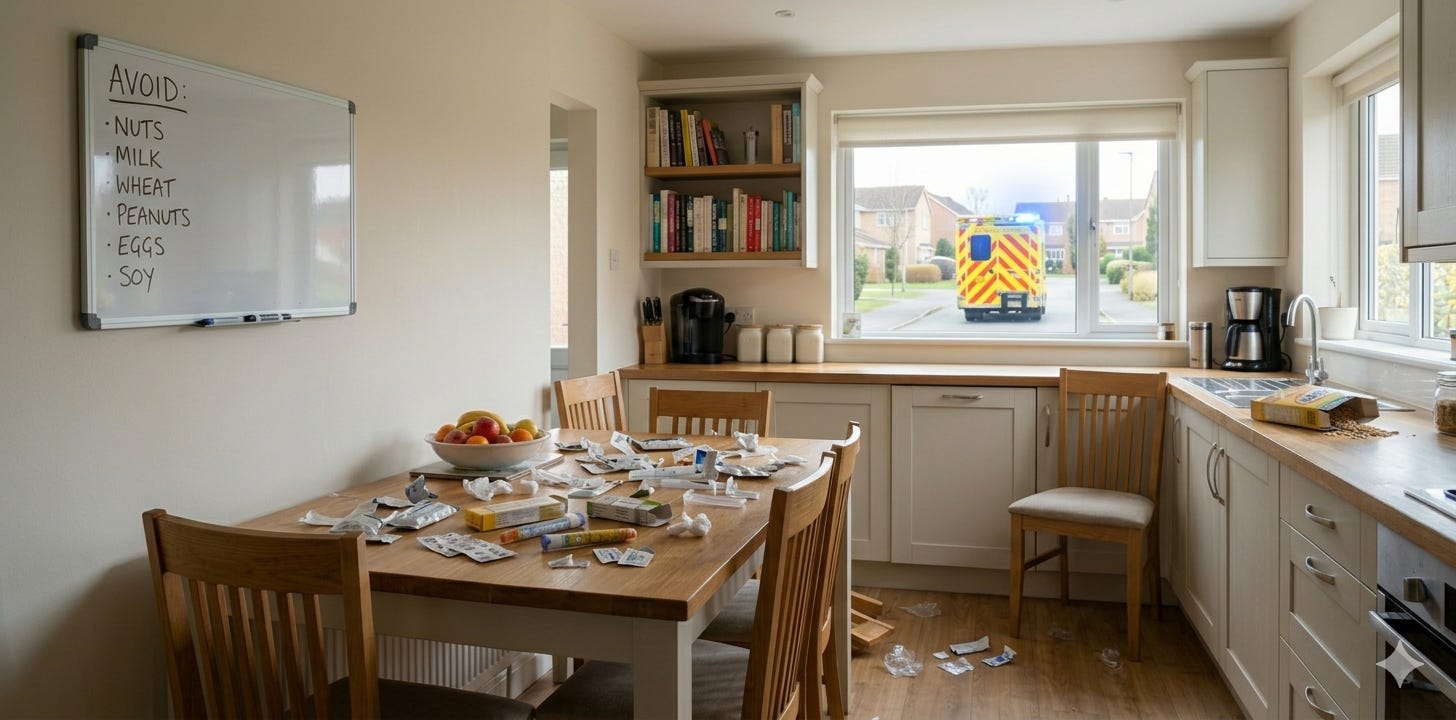
The afternoon my family member nearly died began without warning. A hornet sting — the kind of thing you’d complain about briefly and then forget — and within minutes the immune system had declared war on itself. Blood pressure dropping. Airway closing. A blue-light run to a resuscitation bay where a crisis team did what crisis teams do, which is chaotic, brutal, and clinical, and not something that leaves you easily.
They survived. That part, at least, went the right way.
What nobody told us — what we never understood until we were living it — is that survival is not the same as resolution. The body that came home from that hospital was not the same body that had left that morning. The immune system had been permanently recalibrated. What had been a minor irritant was now a potential death sentence. And the list of things that could trigger a response had begun to grow.
Twenty million people are living this
This is not a rare condition being dramatised for effect. The UK has some of the highest allergy rates in the world. Approximately 20 million people, nearly a third of the UK population, are living with allergic conditions of some form. At the severe end, the trajectory is sharply upward. Hospital admissions for anaphylaxis have more than doubled over the past two decades, now exceeding 25,000 a year. Food-related anaphylaxis admissions more than tripled between 1998 and 2018. The cohort at highest risk for fatal outcomes is adolescents and young adults.
The number of deaths from food-induced anaphylaxis, around ten a year in England and Wales, has fallen over the past two decades, a direct result of improved emergency medicine. The number of people experiencing the crisis has not. It is rising.
The clinical picture is well understood. A sting, or a misplaced ingredient, triggers an immune cascade. Inflammatory mediators flood the body. The vascular system collapses. Blood pressure falls. The airway constricts.
Without high-dose adrenaline, the outcome is not certain. With it, the patient is stabilised, discharged, and returned to an environment that looks exactly as it did before — except that their relationship with physical safety has been permanently severed.
What the clinical picture does not fully capture is what comes after.
The whiteboard on the kitchen wall
In our home, the central artefact of daily life is a whiteboard in the kitchen. It is titled “No Foods.” It is not a list of standard allergens or personal preferences. It is a living document — updated when a product changes its formulation, when a supplier is switched without announcement, when something that was safe last week turns out not to be safe this week, even which vendors own products are not safe. This week the addition - biscuits from one company that were fine 6 months ago.
This is one of the less visible consequences of a severe allergic episode: the initial trauma can destabilise the baseline immune response, making previously safe ingredients suddenly hostile. The immune system, having learned that the world is dangerous, begins to treat a wider range of inputs as threats. A minor recipe alteration by a manufacturer, the kind of change that would go entirely unnoticed by most people, becomes a potential crisis. Every meal is an exercise in risk assessment. Spontaneity, for ordinary food and ordinary eating, is simply gone. Imagine that you can never again go out for a meal, or order a take-away, or grab a sandwich for lunch - that’s not imagination it’s reality.
The psychological cost of this has been measured. Research consistently shows significantly lower quality of life scores and higher rates of severe anxiety in adults with a history of anaphylaxis compared to healthy populations. The correlation between a severe allergic episode and PTSD is well established, a 2020 study found more than 40 per cent of anaphylaxis patients developed the disorder.
The sound of a buzzing insect, something you or I would register briefly and ignore, produces an immediate, involuntary panic response. The brain has matched the sound to the memory of resuscitation. The cortisol floods before the conscious mind has time to assess whether there is actually a hornet in the room. This is not anxiety in the colloquial sense. It is a physiological response to a physiological memory, and it does not switch off.
There’s no cure — just be careful
The social experience of living with severe anaphylaxis has its own particular texture, and it is worth naming plainly.
When people learn about a condition like this, the instinct — a kind instinct, genuinely — is to troubleshoot. Have you tried an antihistamine first? Surely a little bit would be fine? What about when you’re on holiday — do you just not eat out? There’s a new treatment I read about, have you looked into that?
Just the other week a local market stall where I buy coffee from offered something else from the stall - I had to explain thanks but no thanks. The offer was genuine as a thank you, but when I said no to one thing they offered another, then another, then final some honey to which my response was - that will kill. It wasn’t ignorance just someone who was being genuine and kind but who didn’t understand or have the experience to relate.
These questions come from goodwill. They are also exhausting in a way that is hard to explain without sounding ungrateful. Because what they share — what they all have in common — is the assumption that the condition is a problem to be solved, a boundary to be tested, an inconvenience to be worked around with the right combination of effort and information. They place the burden of managing other people’s discomfort with the situation onto the person already carrying the weight of the condition itself. Imagine having to relive the experience every single time you have to explain to someone why you can’t eat something.
The medical answer to “can’t you just be careful?” is: yes, that is precisely what is happening, every hour of every day. Careful is the entire structure of the life. The whiteboard is careful. The pre-reading of every menu is careful. The carrying of two auto-injectors at all times is careful. The hypervigilance about insects in summer, about shared preparation surfaces, about products that changed without warning — all of it is careful. There is no relaxing of careful. There is no holiday from it.
What the well-meaning questioner is actually asking, without quite realising it, is whether the person could do a little less of the work that is keeping them alive.
This is not a criticism of individuals asking those questions. It is an observation about what we, collectively, have never been asked to learn. Severe allergy management is invisible work — constant, precise, and carried almost entirely by the person affected and the small circle around them. The system that should support it — healthcare, food labelling, public understanding, employer awareness — provides partial answers at best. The gap between what the condition demands and what the environment provides is filled by the individual, every day.
Twenty million people in this country are managing allergic conditions. Tens of thousands are in the severe range, where a miscalculation is not an inconvenience but a medical emergency. The numbers are rising.
The more useful question is not what those individuals should do differently. It is what a society that understood this — genuinely understood it, not just acknowledged it — would look like. What would food labelling require? What would employer sick leave and workplace risk awareness cover? What would public education in schools actually teach?
And whether we are, in any meaningful sense, building towards that — or whether we are still, quietly, expecting the person with the whiteboard to carry it alone.
The other side of the whiteboard
What the phrase “carrying it alone” means in practice — for the people in the circle around the person affected is a reality of everyday life.
I know the exact words to say when I call emergency services. Not approximately — exactly. The order, what to lead with, what comes second, what must not be left out. I know this not because I’ve thought about it, but because I’ve had to do it more than once. I am hyper-vigilant about what goes into our food, about whether something has changed on a label, about whether the auto-injectors are where they should be. I challenge. I say no. There are situations I assess before being asked, places we do not go, things we do not order, risks I have absorbed into the background noise of daily life without announcing them.
None of this is something I name as a burden. It is just how we live.
The hardest thing to explain — to a friend, or to an employer — is that there is nothing to point to. After an episode, recovery is not only physical and it is not quick, what direct dose adrenaline does to the body is brutal. It can take days, sometimes weeks, before things settle. The nervous system takes time to stand down. During that time, what is needed is proximity — being close, being home, being available. Not a formal diagnosis. Not sick leave as conventionally defined. Just: present. Employers have no real frame for this. There is no obvious illness to present. There is only the aftermath of something serious, which looks like nothing from the outside.
When I hear the words “I don’t feel well” — for any reason, including something as ordinary as a cold — my heart drops before I notice anything else. The possibility announces itself before the likelihood can be assessed. That response was learned. It does not un-learn. It is not dramatic. It is just there, every time, a fraction of a second ahead of rational thought.
The condition is carried by the person who has it. It is also carried, differently, by the people close to them. The whiteboard is in our kitchen.
Authors note
This time it’s personal and real not a story to highlight a point, but something more - raising awareness, helping people understand and showing that sometimes helpful can be the exact opposite.
You’re reading The Next Evolution by Neil Catton, articles that explore the human world and the intersection of technology, they try and ask difficult questions - not to scare - but to inform. If someone forwarded this to you, you can subscribe free at neilcatton.substack.com.
Neil Catton is the author of The Next Evolution, The Cognitive Crucible and The Shadow System - available on Amazon, and writes at the intersection of technology, ethics, and human purpose.