

EMERGING SCIENCE & TECHNOLOGY BRIEF • ARTICLE 1
Topic: Editing Genes is not Science Fiction | Domain: Biotech & Life Sciences | Status: Hot
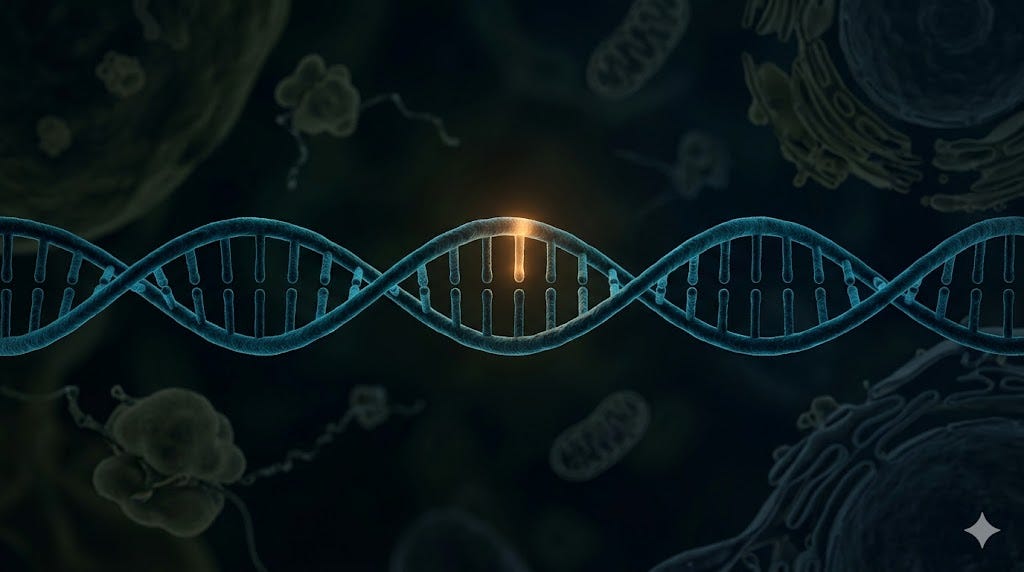
There’s a version of medicine that most of us grew up believing was science fiction: find the typo in a patient’s DNA, fix it, cure the disease. One treatment. Done.
That version of medicine is no longer fiction. And in the past year, it’s moved from early experiments to real patients including, in one remarkable case, a newborn baby given a custom-built gene therapy in under six months.
This is the story of what’s sometimes called CRISPR 2.0, a new generation of gene-editing tools that are sharper, safer, and starting to work in ways the original technology couldn’t quite manage.
Wait — Wasn’t CRISPR Already a Big Deal?
It was. CRISPR-Cas9, the gene-editing technique that won its inventors the 2020 Nobel Prize, gave scientists a way to locate a specific sequence in the human genome and cut it — a molecular scissors guided by a biological GPS. It was genuinely revolutionary: faster, cheaper, and more precise than anything that came before.
But the original version had a fundamental limitation. When you cut DNA with molecular scissors, the cell has to repair the break. And cells, it turns out, are sloppy repairmen. They often seal the cut using a method called non-homologous end joining, essentially taping the ends back together with no regard for accuracy. Sometimes this works fine. But sometimes you get unintended insertions, deletions, or off-target cuts elsewhere in the genome. For a technology that’s supposed to fix genetic diseases with surgical precision, that’s a significant problem.
Researchers knew from the start they’d need something better.
The Upgrade: Base Editing and Prime Editing
Two newer tools, both pioneered by biochemist David Liu at the Broad Institute of MIT and Harvard, represent what the field often calls the “next generation” of gene editing.
Base editing, introduced in 2016, works without cutting both strands of the DNA double helix at all. Instead of snipping and repairing, it uses a modified Cas enzyme fused to a chemical converter, essentially a molecular eraser, that can swap one DNA letter for another directly. Think of the difference between deleting a paragraph and fixing a single misspelling. Base editing enables single-letter DNA changes without generating double-strand breaks, producing highly predictable nucleotide conversions. This matters enormously: no break means far less risk of the chaotic repair that plagued first-generation CRISPR.
Prime editing, unveiled in 2019, goes even further. If base editing is a pencil swap, prime editing is closer to a search-and-replace function in a word processor. Prime editing directly writes new genetic information into a targeted DNA site using a fusion protein and an extended guide RNA that both identifies the target and provides the replacement sequence. It can handle not just single-letter changes, but small insertions and deletions too, corrections that base editing can’t make. Prime editors do not frequently create the unwanted insertions and deletions (indels) that complicate traditional CRISPR editing.
Together, these two tools dramatically expand the range of genetic diseases that could theoretically be corrected. Over 75,000 pathogenic genetic variants have been identified in humans and while earlier gene-editing methods could address only a minority of those, prime editing adds considerably more precision and flexibility to what’s possible.
In Vivo: The Real Frontier
Here’s a detail that matters more than most coverage acknowledges: until recently, even the most celebrated gene-editing success stories weren’t truly editing DNA inside the body.
CASGEVY — the first CRISPR-based therapy approved by the FDA, designed to treat sickle cell disease and beta-thalassemia — works by extracting a patient’s blood stem cells, editing them in a lab, and infusing them back. This approach, called ex vivo editing, is impressive. But it’s also expensive, time-consuming, and limited to diseases where you can harvest, edit, and return cells without killing them.
In vivo editing is different. It means delivering the gene-editing machinery directly into the patient’s body and letting it do its work inside living tissue. No extraction. No lab processing. Just an injection that navigates to the right cells and rewrites their DNA.
This is harder. The human body is large, complex, and full of immune defences that can attack foreign molecules. But it’s also where the real medical revolution lies because most genetic diseases affect tissues that you simply cannot remove, edit, and put back.
What’s Actually Happening Now
The progress in the past 18 months has been striking.
A Phase 1 trial at Cleveland Clinic tested CTX310, an experimental CRISPR-Cas9 treatment delivered as a single intravenous infusion. The therapy carries the editing mechanism into the liver, where it switches off a gene called ANGPTL3, reducing LDL cholesterol and triglycerides in patients with difficult-to-treat lipid disorders. Both LDL cholesterol and triglyceride levels were substantially reduced within two weeks and stayed at low levels for at least 60 days, with no serious adverse events. Phase 2 trials are now underway.
That example targets the liver which turns out to be the organ most amenable to in vivo editing right now, because it’s large, metabolically active, and reachable via the bloodstream using lipid nanoparticles (tiny fat-based delivery vehicles, the same technology that carried the COVID mRNA vaccines). But it’s a proof of concept that the approach works.
Then there’s the case that stopped many scientists in their tracks. A team of researchers, including scientists from the Innovative Genomics Institute, created a bespoke in vivo CRISPR therapy for a newborn infant, developed and delivered in just six months, the first time a personalised CRISPR treatment has ever been administered to a patient. The child had a rare metabolic disorder that would previously have had no cure. This landmark case sets a precedent for a regulatory pathway for rapid approval of platform therapies in the United States.
Meanwhile, on the prime editing front, Prime Medicine reported in December 2025 that two patients treated with PM359, the first prime editor to enter human clinical trials, had been effectively cured of chronic granulomatous disease — a rare immune disorder that leaves patients unable to fight certain bacterial and fungal infections.
As of early 2025, more than 250 clinical trials involving gene-editing therapeutic candidates are being monitored worldwide, with more than 150 currently active spanning blood disorders, cancers, cardiovascular disease, and immune conditions.
The Hard Parts
The things that could still go wrong deserve the same attention as the breakthroughs.
Off-target editing remains a genuine concern. No tool is perfect, and an edit in the wrong place in the genome could, in theory, disrupt a gene that matters potentially contributing to cancer. Newer tools like base editors and prime editors substantially reduce this risk, but they don’t eliminate it.
Delivery remains a bottleneck. Getting editing machinery to the liver is manageable. Getting it to the brain, the heart muscle, or the lung epithelium is a different and largely unsolved problem. Lipid nanoparticles accumulate in the liver. Viral vectors (like adeno-associated viruses) can reach other tissues, but carry their own safety questions, and the immune system sometimes destroys them on contact.
Informed consent is genuinely complicated. Editing the DNA of a living person means making a change that is, in most cases, permanent. Unlike a drug you can stop taking, a gene edit persists. What happens if we discover, years later, that a particular edit has unexpected consequences? What level of uncertainty is acceptable when treating a dying child versus a manageable chronic condition?
These aren’t rhetorical questions. Regulatory agencies in the US, UK, and EU are actively working through frameworks to address them and the answers will shape how quickly these treatments reach patients at scale.
Who’s Working on This
The field is concentrated in a handful of companies and research institutions, mostly in the US and UK.
Intellia Therapeutics and Beam Therapeutics are leading the in vivo base-editing push, targeting liver diseases and genetic blood disorders respectively. Prime Medicine has now demonstrated that prime editing works in human patients. CRISPR Therapeutics is advancing a pipeline of lipid nanoparticle-delivered in vivo therapies beyond its already-approved sickle cell treatment.
On the academic side, the Broad Institute of MIT and Harvard (where David Liu runs his lab) remains the intellectual center of the field, with the Innovative Genomics Institute at Berkeley playing an increasingly prominent clinical role.
China is investing heavily — multiple clinical trials for blood cancers and immune disorders are being run out of Chinese academic hospitals and biotech companies — and Southeast Asia is emerging as a significant site for enrolment, given the high prevalence of genetic blood disorders like thalassemia in the region.
Why This Matters More Than It Might Sound
Gene-editing headlines have a habit of generating hype cycles that leave readers vaguely numbed to each new announcement. More CRISPR news. Got it.
For the entire history of medicine, genetic diseases, conditions written into a patient’s DNA at birth have been essentially incurable. You could manage them, sometimes effectively, but you couldn’t fix the underlying cause. Sickle cell disease. Huntington’s. Muscular dystrophy. Alpha-1 antitrypsin deficiency. Dozens of metabolic disorders that consign children to lifetimes of treatment, hospitalizations, and early death.
The premise of in vivo gene editing is that this changes. Not for every disease at once. Not without risk. Not cheaply, at least not yet. But the trajectory is clear: we are learning to rewrite the instructions that cause these diseases, inside the bodies of the people who have them.
The question the field is now grappling with, in the words of IGI scientist Fyodor Urnov, is how to go from “CRISPR for one to CRISPR for all.”
That’s the scale problem. And given the pace of progress in the last three years, it would be unwise to assume it stays unsolved for long.
Further reading: CRISPR Medicine News tracks the global clinical trial landscape in real time. The Innovative Genomics Institute at UC Berkeley publishes accessible explainers on new developments. For the original science, Nature and Cell remain the journals of record.
You’re reading The Next Evolution by Neil Catton, articles that explore the human world and the intersection of technology, they try and ask difficult questions - not to scare - but to inform. This is part of the Emerging Science & Technology series.
If someone forwarded this to you, you can subscribe free at neilcatton.substack.com.
Neil Catton is the author of The Next Evolution, The Cognitive Crucible and The Shadow System - available on Amazon, and writes at the intersection of technology, ethics, and human purpose.