

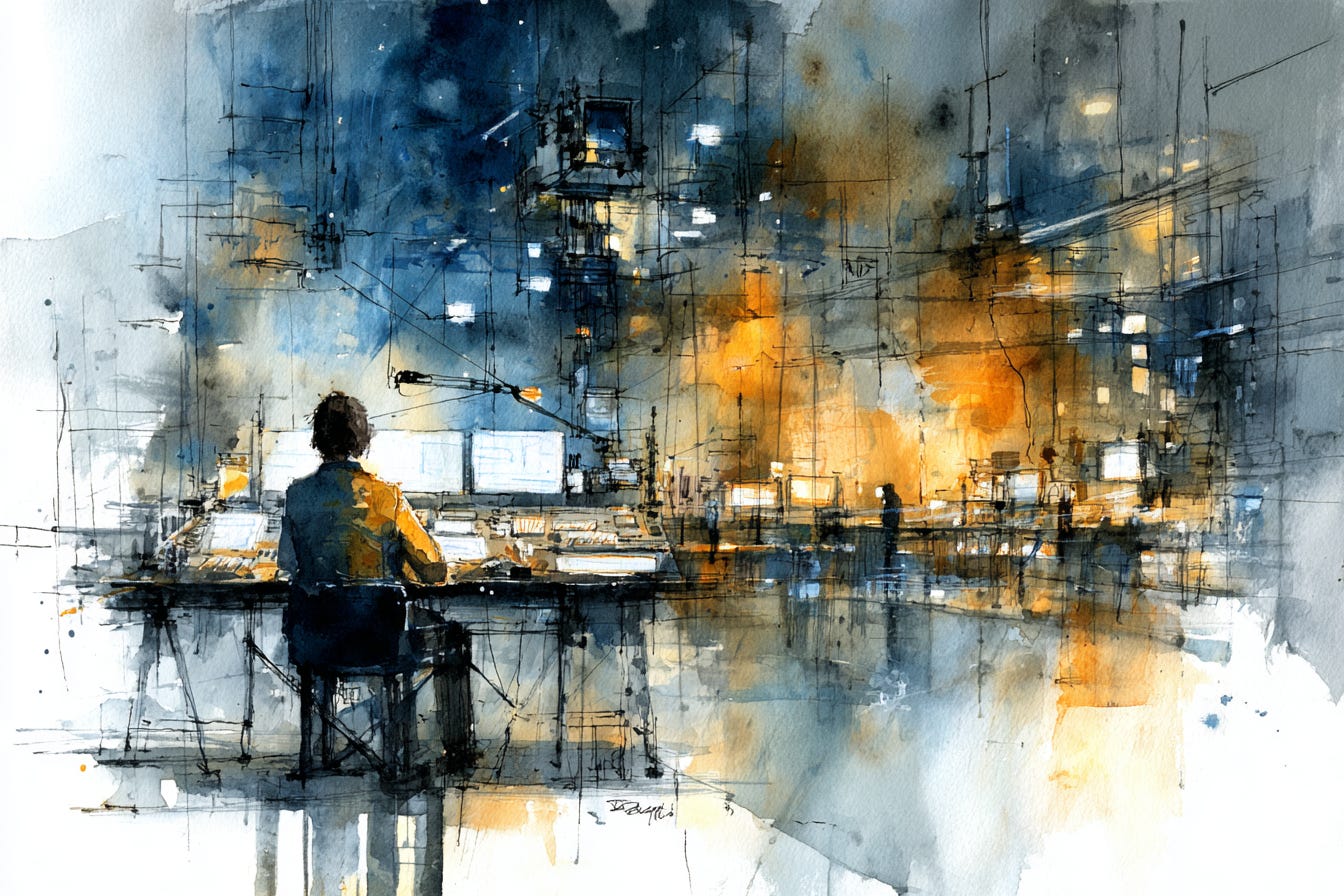
Sam has been reading the same paragraph for the third time. The words are there. The comprehension isn’t. Something, unclear what, has been pulling at the edge of attention for the last twenty minutes without ever resolving.
The message arrives that Sam isn’t going to read yet. The alert that Sam already half-knows exists. Some unfinished conversation sitting just below the surface of thought, unanswered, unresolved, quietly taking up space in the mind that was supposedly committed to this page.
Sam isn’t distracted. Sam is present. Physically here, eyes on the text, doing the right thing. The presence is real. The attention is somewhere else entirely.
The attention you were certain you had
In 1999, two psychologists at Harvard asked participants to watch a short video and count how many times a basketball was passed between players wearing white. The task was specific and demanding.
Halfway through the video, a person in a full gorilla suit walked into the frame. Faced the camera. Beat their chest. Walked out. Fifty per cent of participants never saw it. Not because it was subtle. Because their attention was committed elsewhere, and the gorilla wasn’t part of what they’d been asked to track.
We believe we’re present because we’re physically in a situation. The eyes are open. The body is there. But presence and attention are not the same thing, and the gap between them is where a great deal of modern life is quietly disappearing.
Inattentional blindness — the brain’s tendency to miss even obvious stimuli when focus is elsewhere — isn’t a rare laboratory phenomenon. It’s the operating condition of most people’s daily lives.
The brain doesn’t see everything in front of it. It samples, filters, and constructs a picture based on what it has been primed to look for. When that priming mechanism is overwhelmed — when there are too many things competing for focus — the filter becomes less a tool of selection and more a tool of exclusion.
What has changed since the gorilla experiment isn’t the cognitive architecture. It’s the scale and sophistication of the systems competing to own the priming. Every notification, every feed, every platform is fighting to be the thing your brain gets told to track. When they win, everything else becomes the gorilla. Invisible. Present. Missed.
We don’t lose the ability to pay attention. We lose the choice about where it goes.
The things that disappear without announcement
The gorilla in modern life isn’t a person in a suit. It’s the conversation not had. The warning not noticed. The colleague who needed support and didn’t get it because you were technically in the room while mentally somewhere else entirely.
It’s the child who asked a question and got a distracted non-answer, then stopped asking. The friend who was struggling and mentioned it once, sideways, and you were there but not there when it came up. The decision made quickly because the depth of focus required to make it well wasn’t available that day.
The cost isn’t always visible. It rarely arrives labelled. It accumulates in the quality of what you produce, the depth of the relationships you maintain, and the gradual narrowing of what you actually notice about the people and moments that are directly in front of you.
We have been taught to understand this as a personal failing. A concentration problem. A discipline issue. The technology industry is clear, in its habits if not its language, that this framing suits it perfectly. Because if the problem is you, you don’t look at the design.
What the design is actually doing
A system that competes for the priming of your attention, that inserts itself into the filtering mechanism the brain relies on to distinguish signal from noise, is not supporting you. It is working against the very cognitive function it claims to support.
The argument that social platforms augment connection holds only if the connections they produce are of comparable quality to those they replace or displace. The gorilla experiment suggests a direct relationship: the more demanding the competing task, the more complete the blindness. Connection that comes at the cost of presence isn’t connection. It’s substitution.
The deepest failure is this: any system that makes you selectively blind to your immediate environment cannot claim to respond to your actual circumstances. The person sitting with their child. The person driving. The person in the conversation that matters. A system that doesn’t know — or doesn’t care — which of those moments it’s interrupting has no basis for calling itself designed for you.
This is one of the questions at the centre of my book The Cognitive Crucible — not just what technology does, but what it costs us without announcing the price.
My opinion
Attention is the most finite resource we have. I don’t think the platforms taking it are confused about what they’re doing — the design is not accidental, and the framing of distraction as a personal discipline problem is not a misunderstanding either. What concerns me most is the picture of society these platforms have constructed: not a reflection of how people actually live, but of what drives engagement. The two are not the same thing, and recovering the ability to tell them apart — to notice what is actually in front of you rather than what you’ve been primed to track — is, in the most direct terms I can offer, how you get your cognitive agency back.
What this asks of you
The point is not to understand inattentional blindness. The point is to know where it is operating in your own life.
What have you noticed yourself missing lately — at work, at home, in conversation — that you’d have caught if you weren’t distracted?
Is there someone in your life who has been trying to tell you something you haven’t fully heard? What would it take to change that?
What would you need to change about your environment to make genuine presence your default rather than your exception?
If someone was watching how you spend your attention across a typical week, what would they conclude about what matters most to you?
Authors Note
Sam is a fictional character. Their story is drawn from a combination of professional observation and personal proximity to real events. The experiences described are real. The person is not.
You’re reading The Next Evolution by Neil Catton, articles that explore the human world and the intersection of technology, they try and ask difficult questions - not to scare - but to inform. If someone forwarded this to you, you can subscribe free at neilcatton.substack.com.
Neil Catton is the author of The Next Evolution, The Cognitive Crucible and The Shadow System - available on Amazon, and writes at the intersection of technology, ethics, and human purpose.