

The breach that actually reaches you rarely announces itself. It’s a message from someone you trust, an update you meant to install last week, a login you haven’t checked since the account was new. None of it feels urgent until the moment it very suddenly is.
Most of what keeps an account safe is unglamorous by design — a password manager, a second factor, a backup nobody thinks about until the day it’s the only thing that saves the files. The defences that matter most are usually the boring ones.
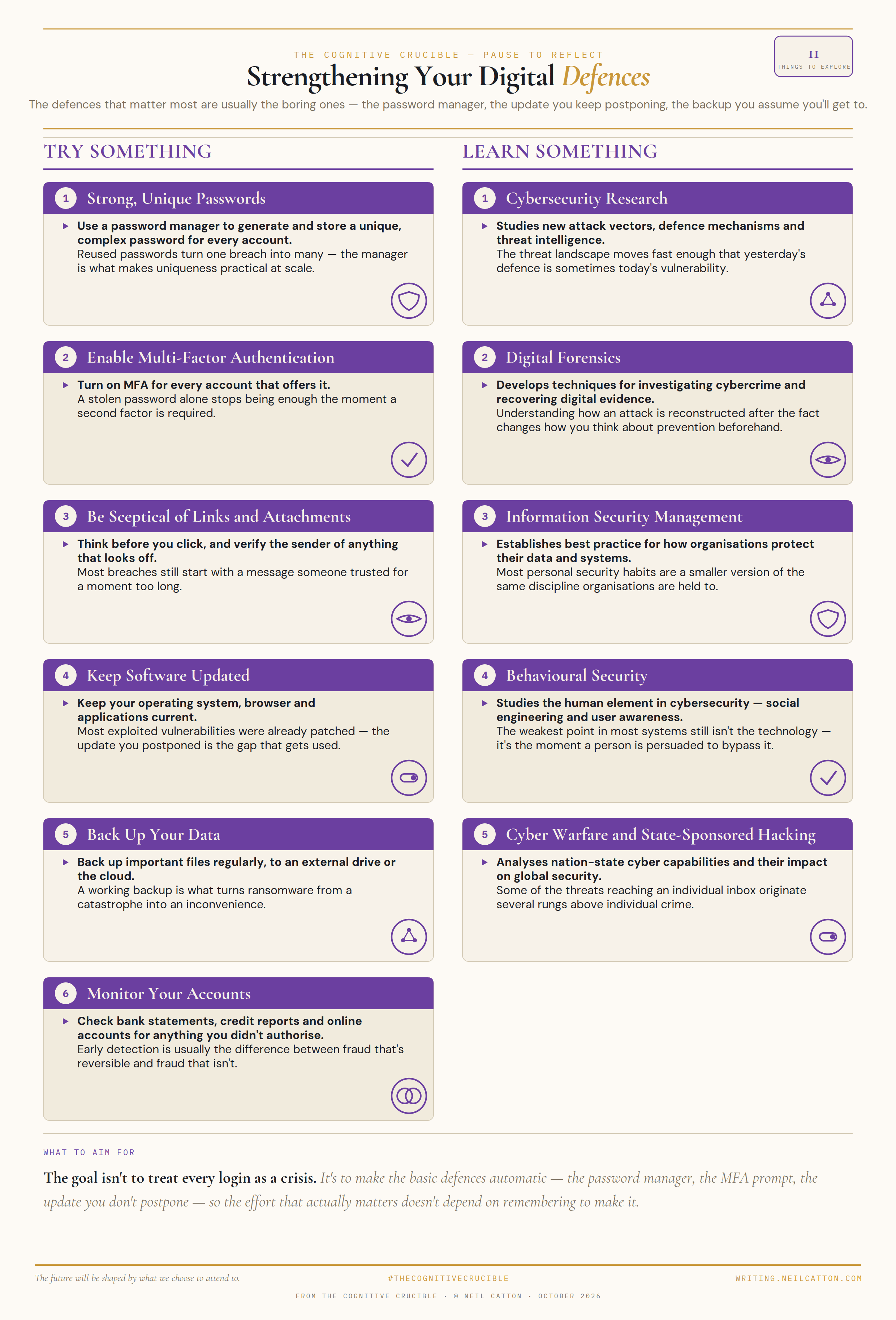
The card splits into two columns — six things to try, from a password manager to regular account monitoring, and five research threads for anyone who wants the wider picture, from digital forensics to the human factors that make social engineering work. It’s for anyone whose defences are one postponed update behind where they should be.
It comes from The Cognitive Crucible, where the fuller argument about attention, technology and the mind lives. The card stands on its own — you don’t need the book to use it.
Print it, pin it by the desk, or send it to whoever still shares one password across everything.
Which one of these have you actually been putting off?
You’re reading The Next Evolution by Neil Catton, articles that explore the human world and the intersection of technology, they try and ask difficult questions - not to scare - but to inform. If someone forwarded this to you, you can subscribe free at neilcatton.substack.com.
Neil Catton is the author of The Next Evolution, The Cognitive Crucible and The Shadow System - available on Amazon, and writes at the intersection of technology, ethics, and human purpose.