

The message arrives at the wrong moment — mid-meeting, half asleep, walking to the car — and it doesn’t ask, it insists. Your account’s been compromised. Verify now. Or it isn’t a message at all: a clip surfaces of someone you’d trust, saying something they never said.
The card’s own framing names what’s actually happening. Your attention is being exploited, not because you’re careless, but because the systems behind scams, deepfakes and disinformation are built to outrun your judgement rather than persuade it. Noticing that in the moment is most of the defence.
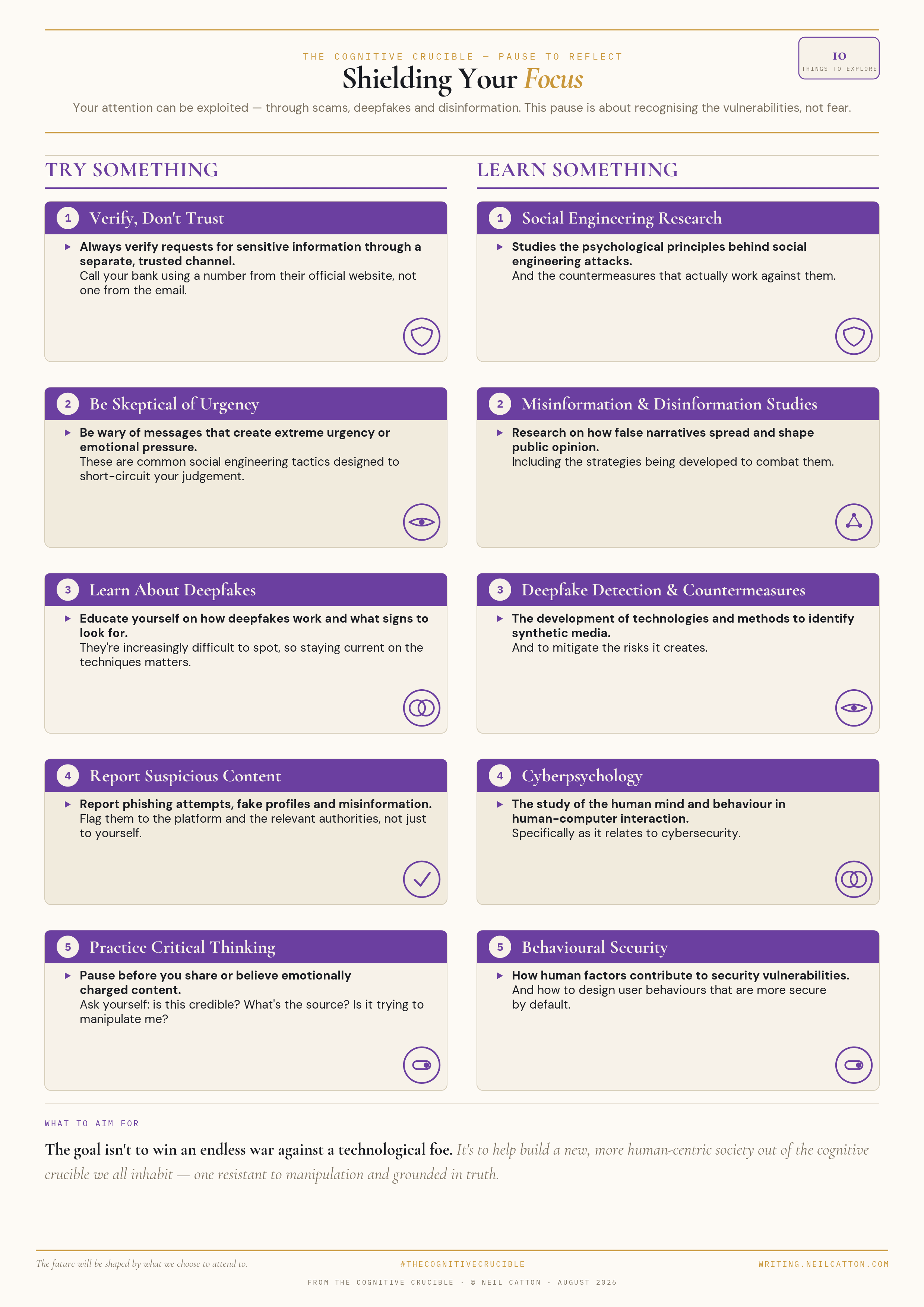
The card holds ten prompts across two columns. Five habits to try this week — verifying any urgent request through a separate channel you trust, treating urgency itself as a warning sign, learning what a deepfake actually looks like, reporting what you catch instead of scrolling past it, pausing before you share anything built to make you feel first and think second. And five fields of research if you want to know why the manipulation works, from the psychology behind social engineering to the study of what makes some people harder to fool than others.
It comes from The Cognitive Crucible, where the fuller argument about attention as contested ground plays out. The card stands on its own — you don’t need the book to use it.
Print it, or keep it somewhere you’ll see it before you next reach for your phone.
And here’s the question I’d leave you with: the next time a message tells you to act immediately, whose interest does that urgency actually serve?
You’re reading The Next Evolution by Neil Catton, articles that explore the human world and the intersection of technology, they try and ask difficult questions - not to scare - but to inform. If someone forwarded this to you, you can subscribe free at neilcatton.substack.com.
Neil Catton is the author of The Next Evolution, The Cognitive Crucible and The Shadow System - available on Amazon, and writes at the intersection of technology, ethics, and human purpose.