

The kettle finishes boiling and your hand is already reaching for your phone before you’ve decided to. A notification badge, a podcast queued for a four-minute walk, the radio left on because the kitchen felt too quiet without it — none of it urgent, all of it there, filling a gap before you’ve noticed one exists.
That’s ambient attention: the low hum of pings, badges and background noise that never quite lets a moment sit empty. The card’s own framing names it plainly — this isn’t a failure of discipline, it’s an environment built so silence reads as something to fix rather than something to have.
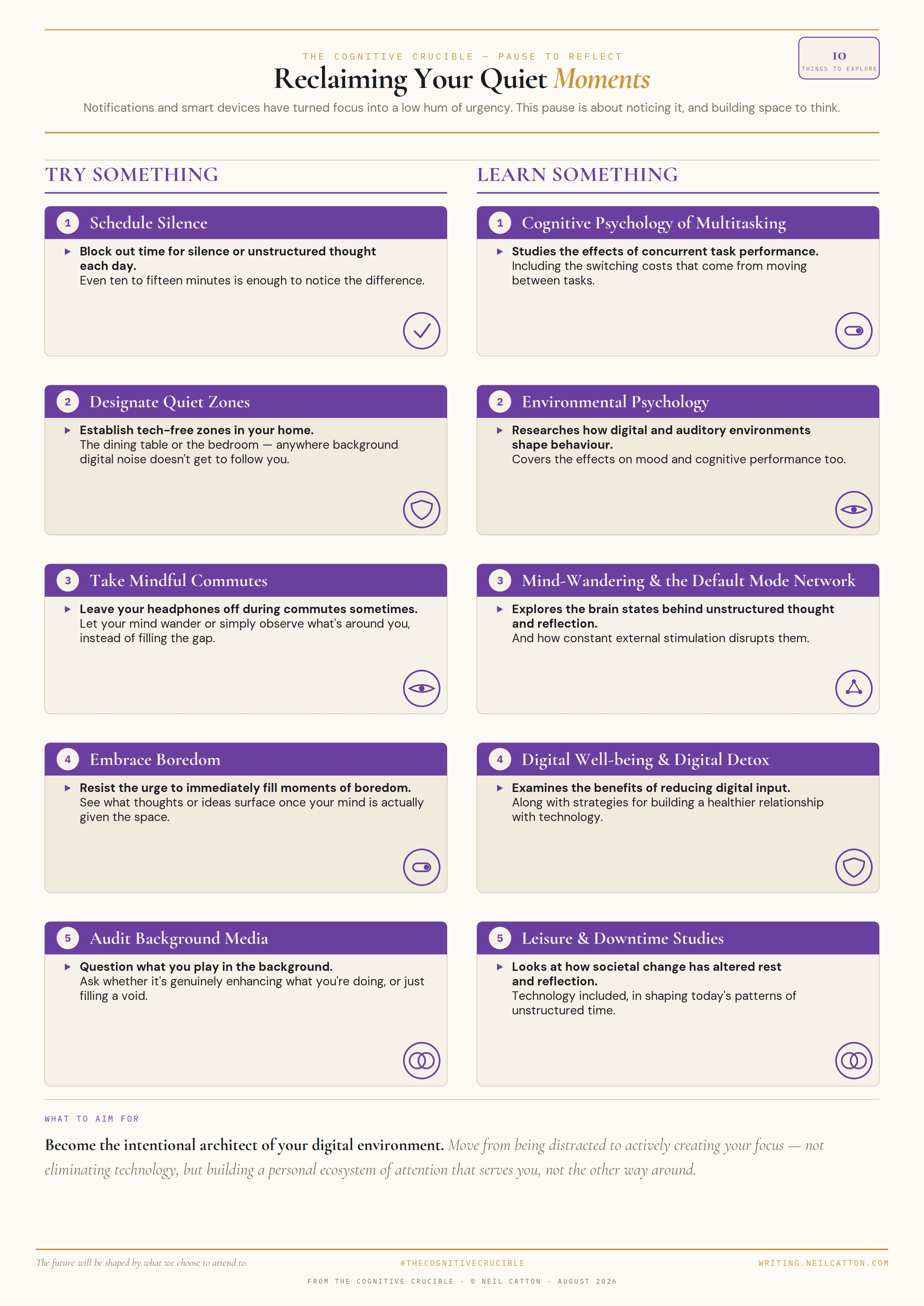
The card holds ten prompts across two columns. Five habits to try this week — blocking out real unstructured time, turning part of the house tech-free, leaving the headphones off on a short commute, letting boredom sit instead of reaching past it, questioning what’s actually playing in the background and why. And five fields of research if you want to understand the pull behind it, from the cost of switching between tasks to what the brain does with genuine idle time.
It comes from The Cognitive Crucible, where the fuller argument about attention as contested ground plays out. The card stands on its own — you don’t need the book to use it.
Print it, or keep it somewhere you’ll see it before you next reach for something to fill a gap.
And here’s the question I’d leave you with: the next time a moment goes quiet, is the silence actually empty — or is that just the first thing you’ve noticed in a while?
You’re reading The Next Evolution by Neil Catton, articles that explore the human world and the intersection of technology, they try and ask difficult questions - not to scare - but to inform. If someone forwarded this to you, you can subscribe free at neilcatton.substack.com.
Neil Catton is the author of The Next Evolution, The Cognitive Crucible and The Shadow System - available on Amazon, and writes at the intersection of technology, ethics, and human purpose.