

The message went out to three hundred and forty members. Eleven saw it.
Alex checked the notification twice because the number looked wrong. Three hundred and forty people had signed up, over several years, to receive updates from a local support network — a community group that had grown from a handful of neighbours into something with real presence, real relationships, real weight in the lives of the people who depended on it. Eleven of them had been shown the message.
The event went ahead. Eight people came.
Nobody unsubscribed. Nobody said they were not interested. Nobody made a choice. The choice was made for them, quietly, by an algorithm that Alex had not been consulted about and could not appeal. The community was still there. The platform had simply decided, in the logic of its own optimisation, that reaching them was no longer part of the service.
Organic reach on the page had been declining for months. Alex had noticed it, adjusted the posting frequency, tried different formats, read the guidance the platform provided. The guidance suggested boosting posts, paying to reach people who had already asked to be reached. Alex had not built a community group in order to run an advertising campaign. The community had arrived on this platform because that was where people already were, and because the tools for creating a group, sending messages, and organising events were simple, capable, and free. None of that had required a commercial relationship. Until it did.
What a platform change looks like from inside a community
In January 2018, Facebook changed its News Feed algorithm. The stated purpose was to prioritise content from friends and family over content from pages and publishers, to make the feed feel like connection rather than consumption. The change was announced publicly. It was implemented across all pages simultaneously. For news organisations, advocacy groups, local charities, and community groups that had spent years building their audiences on the platform, organic reach fell sharply — in some cases by more than half — within weeks. There was no transition period and no compensation. The communities those pages had built were still there. The platform had simply changed the terms on which they could be reached.
Community page administrators, who ran local support networks, neighbourhood organisations, voluntary groups had no mechanism for challenging that decision, no alternative channel through which to reach their members immediately, and no warning that the ground they were building on could shift without notice. They had been issued terms of service. They had not been offered a relationship of mutual obligation.
Alex’s group did not exist in 2018. But the logic of what happened then is the logic Alex is living now: the platform makes decisions in the interests of its business model, and the communities built on the platform experience the consequences without having been part of the decision. The relationship was always asymmetric. It became impossible to ignore only when it produced a visible cost.
What was transferred without acknowledgement
The migration of community life onto commercial platforms did not happen as a policy decision. It happened gradually, by individual choice and social gravity. A group needed a space to organise. The platform was free, widely used, and reasonably well suited to the task. The people the group wanted to reach were already there.
Each individual decision to use the platform was rational. The aggregate of those decisions produced a transfer of civic infrastructure, the actual fabric of community organisation, into commercial ownership, without anyone deciding that transfer was acceptable.
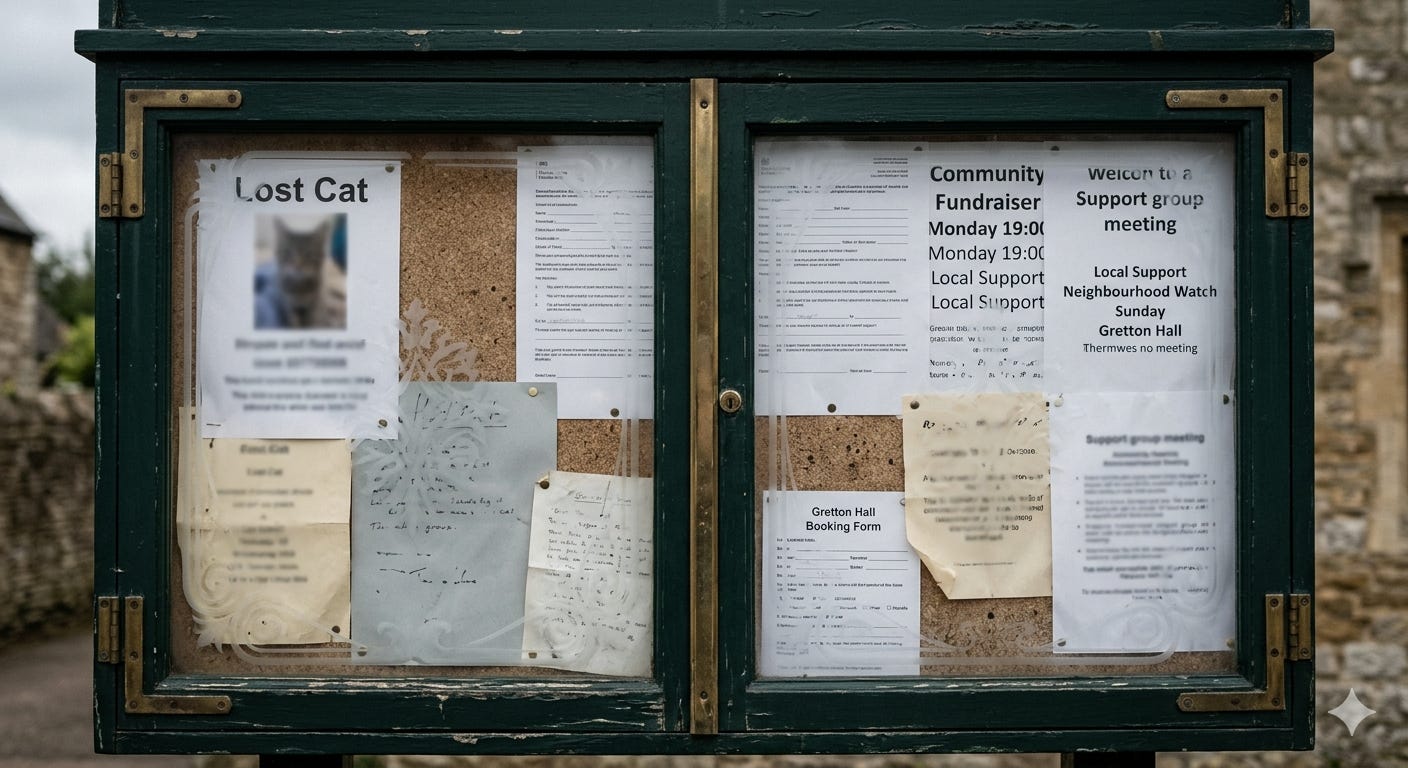
The town square was never owned by an advertising company. The community hall was not subject to a reach algorithm. When people organised a local support group in the hall, they could put a notice in the window and be confident the window faced the street. They did not have to pay to ensure the notice was visible. They did not have to optimise their message for an opaque system that might or might not choose to surface it to the people walking past.
This matters because public infrastructure carries obligations that commercial infrastructure does not. A public library cannot decide that certain community groups will have reduced access to its shelves because they are not commercially valuable. A public broadcaster operating under a public service obligation cannot choose to amplify only the content that maximises advertising revenue. Roads do not charge more to reach certain postcodes.
The obligations that define public infrastructure — universal access, non-discrimination, accountability to the people served rather than to shareholders — do not exist in commercial platforms because the platforms were not built as public infrastructure. They were built as products. The fact that they became public infrastructure happened without anyone deciding that the obligations should follow.
What was transferred was not just a location. It was the conditions under which communities function: the ability to reach people who have asked to be reached, the ability to speak without algorithmic mediation, the right to exist in a shared space without commercial compliance. None of those conditions were written into the terms of service because the terms of service were not written for communities. They were written for users.
The distinction matters. A user has an individual relationship with a platform. A community has a collective one. The platform has obligations to its users in law, in commercial interest, in reputational risk. It has no equivalent obligations to the communities those users have built on its infrastructure.
The cost of building on someone else’s land
The consequences of this arrangement are not hypothetical. They are specific and documented. During the Covid-19 pandemic, community pages and public health groups faced content moderation decisions — posts removed, pages suspended, groups restricted — based on policies that had not been written for emergency civic communication and could not be appealed in time to be useful. There are documented cases of mental health support groups being suspended without warning for violating content policies their administrators did not know existed, removing the medium through which vulnerable people were connected to support at the moment they needed it. Political campaigns and advocacy organisations across the political spectrum have been deplatformed during active campaigns, without appeal processes that operated at the speed the situation required.
In each case, the platform was making a decision it was entitled to make under its own terms. In each case, the communities affected had no equivalent entitlement to contest, delay, or override that decision. The asymmetry is structural. The platform owns the infrastructure. The communities are tenants, and the tenancy agreement was written by the landlord.
The speed at which these decisions operate compounds the harm. An appeal process that takes three weeks is not useful to a support group that has been suspended from the only space where its members know to find it. A content removal that occurs on a Friday and is reviewed on the following Wednesday has, by the time the review completes, already caused the harm it was appealed against. The platform’s governance timescales are designed for individual users making individual complaints. They are not designed for communities for whom continued access to the platform is the condition of their continued existence.
The platform does not make that distinction because the platform does not have the category. It has users. The fact that some of those users are communities with obligations to other people is not part of the platform’s operational picture.
Alex’s situation is less dramatic than any of those examples and identical in structure. The community exists on the platform’s terms. The platform’s terms have changed. Alex’s community is subject to the consequence of a commercial decision that the community had no part in, and the community has no mechanism to contest that consequence, because the platform is not accountable to the community. It is accountable to its shareholders.
What the platform does and does not do
A platform that assists a community grants access to its tools, its user base, and its reach, up to the point where the community’s interests and the platform’s commercial interests diverge. At that point, what looked like assistance reveals itself as conditional access. The reach that the community built by creating good content, engaging its members, and growing its audience is held in a structure the community does not own. When the platform changes its terms, the reach does not belong to the community. It never did.
The platform augmented community life, at first, and in ways that were real. The ease of creating a group, sending messages, and organising events was real. The ability to reach people who were already on the platform was real. That augmentation is now conditional on commercial compliance: pay for the reach you thought you had, or accept the reach the algorithm permits. The value that was added is being extracted. The community is doing the work of building an audience that makes the platform worth advertising on, and is being charged for the ability to reach that audience.
The platform cannot adapt to what the community needs not because adaptation is beyond it, but because it adapts to different targets. It adapts to its own optimisation targets. It adapts to what its ad auction rewards. An algorithm tuned for engagement does not ask whether what it amplifies is good for the communities it connects. It asks whether it produces the signal that the platform has decided to optimise for. When those two things coincide, when engaging content is also useful content, the platform performs well for its communities. When they diverge, the algorithm follows the commercial signal. The community experiences the consequence.
The communities that depend on platforms for their continued existence are, in aggregate, providing the platforms with the social density that makes the platform a place people come to rather than a place they leave. The platform extracts that value. The communities that produce it have no claim on it and no protection when the platform decides to change the terms under which it can be produced.
The arrangement, examined
Most communities that depend on commercial platforms have not traced the logic of that dependency, not because they couldn’t, but because nothing has yet forced them to. Alex’s situation is not unusual. It is the default condition for community life organised on commercial infrastructure. The questions below are not abstract. Each has a practical answer, and the practical answer shapes what happens next.
How many of the communities you belong to, personally or professionally, exist primarily on commercial platforms? If those platforms changed their policies tomorrow, what would you lose, and what alternatives would you have? Have you ever had that conversation with the people in those communities?
If you work in technology or policy, what would genuine public digital infrastructure look like in practice? Not a utopian vision, a practical first step. Where does the model for public libraries, public broadcasting, or public roads break down when applied to digital public space, and what would need to be different?
Have you ever lost access to a community, a network, or a conversation because of a platform decision you had no part in? What happened to the people in it and where did they go?
Is it acceptable for the infrastructure of public life to be owned and operated by companies whose primary obligation is to their shareholders? If it is not acceptable, what specifically would need to change and who would need to decide that change is required?
Alex is still running the support network. The membership is still there, or most of it. The algorithm continues to decide, day by day, which members see which messages, according to logic Alex cannot interrogate and cannot change. The community exists, but it exists on terms it did not agree to, on infrastructure it does not own, subject to decisions made by people who have never met the people the community was built to serve.
That is the condition. Not a crisis, not a failure — a condition. The question is whether it has to be.
Authors Note:
Alex is a fictional character. Their story is drawn from a combination of professional observation and personal proximity to real events. The experiences described are real. The person is not.
You’re reading The Next Evolution by Neil Catton, articles that explore the human world and the intersection of technology, they try and ask difficult questions - not to scare - but to inform. If someone forwarded this to you, you can subscribe free at neilcatton.substack.com.
Neil Catton is the author of The Next Evolution, The Cognitive Crucible and The Shadow System - available on Amazon, and writes at the intersection of technology, ethics, and human purpose.