

You read something on your phone that agrees with you almost too well — the argument, the tone, even the example, sitting exactly where your own thinking already was. A year ago you’d have called that confirmation. Increasingly, it’s worth asking whether it’s construction.
Generative AI hasn’t only changed what gets written; it’s changed how much of what reaches you was ever chosen by anyone at all, human or otherwise. The feed decides before you do, and most of that deciding happens somewhere you can’t see it. This pause is for the part of the process you can still get back.
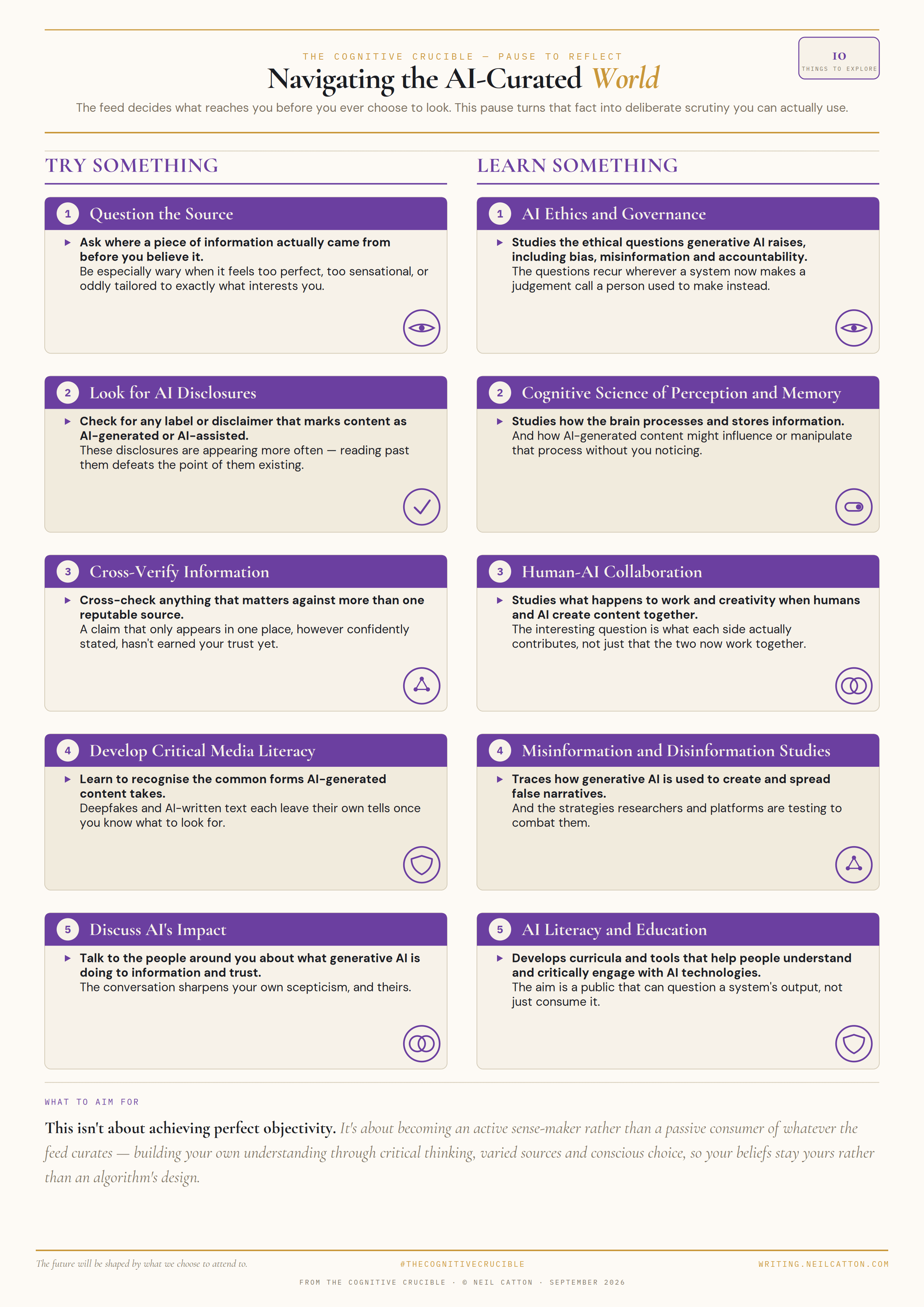
The card lays out ten things to explore, in two columns. Try Something is five habits for anyone reading a feed today — questioning a source, checking for an AI disclosure, cross-verifying a claim before it settles into belief. Learn Something is five fields worth a longer look, from AI ethics and governance to the cognitive science of how perception and memory actually work, for anyone who wants the mechanism underneath the habit.
It comes from The Cognitive Crucible, where the fuller argument about cognitive agency in an AI-curated world gets made at length. The card doesn’t need the book to make sense — it stands on its own.
Print it, pin it by your desk, or send it to whoever in your life still assumes their feed is neutral.
The card doesn’t answer the harder question: once you know the feed is choosing for you, how much of what you already believe are you willing to go back and check?
You’re reading The Next Evolution by Neil Catton, articles that explore the human world and the intersection of technology, they try and ask difficult questions - not to scare - but to inform. If someone forwarded this to you, you can subscribe free at neilcatton.substack.com.
Neil Catton is the author of The Next Evolution, The Cognitive Crucible and The Shadow System - available on Amazon, and writes at the intersection of technology, ethics, and human purpose.