

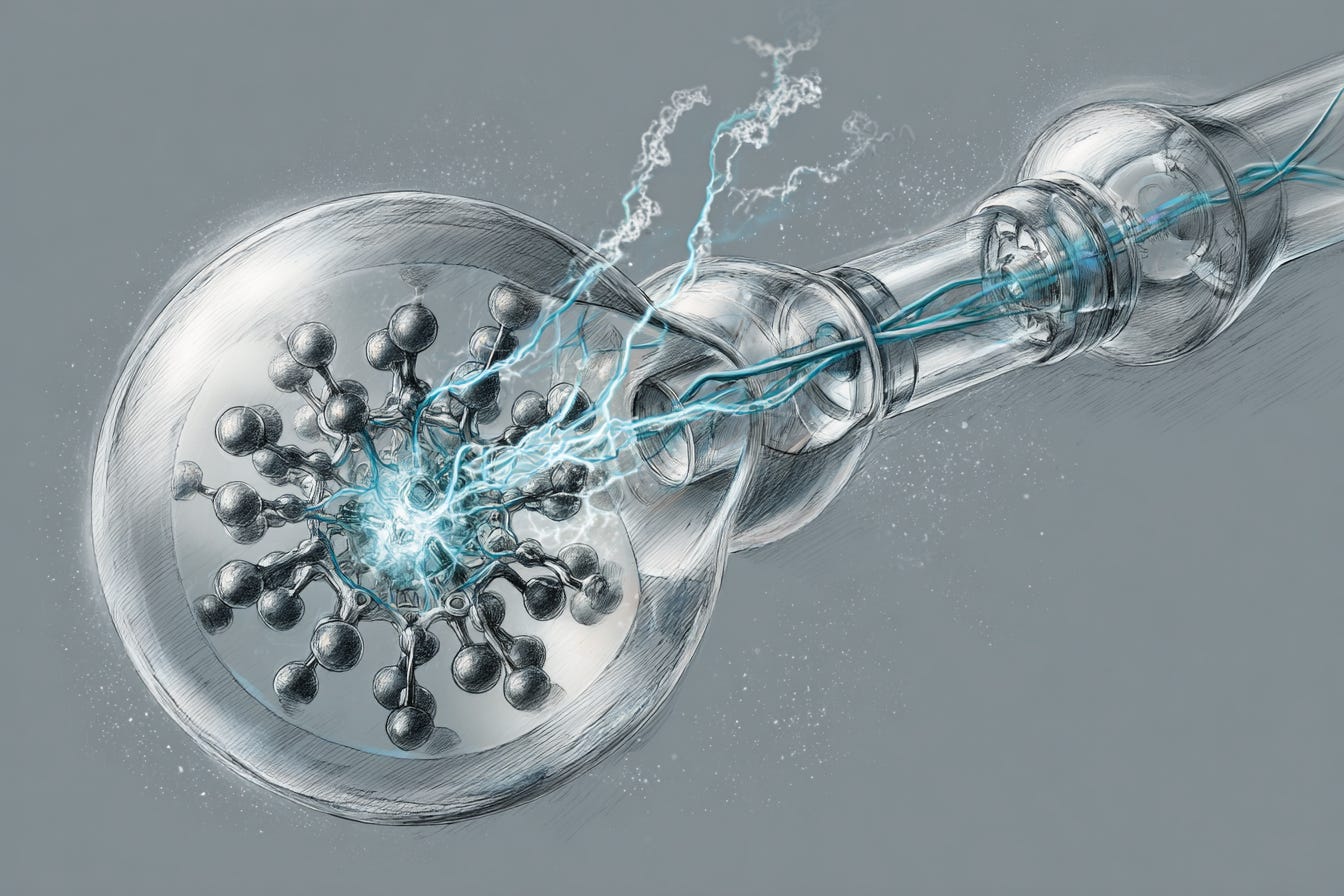
A surgeon is treating a blocked artery. The traditional approach involves threading a catheter to the blockage and expanding a stent using a balloon, an elegantly simple procedure, but one that requires precision inflating of the balloon to exactly the right pressure in a precise anatomical location. Too much force and the artery wall is damaged. Too little and the stent does not open properly. The clinician is managing a mechanical problem with a mechanical tool, and the margin for error is narrow.
In the operating theatre next door, a different kind of stent is being placed. This one is made from nitinol - a nickel-titanium alloy with an unusual property. It has two stable crystal structures, one that exists at low temperatures and one that exists at higher temperatures, and it can be programmed to remember a specific shape in its high-temperature form. The stent is manufactured in its intended open configuration, then cooled and compressed into a delivery catheter narrower than a matchstick.
Once positioned at the blockage site, it is released. As it warms to body temperature, its crystalline structure undergoes a phase transition. It opens into the shape it was programmed to remember. No balloon. No precise mechanical inflation. The material does the work.
This is shape memory, and it is one of the most counterintuitive properties in materials science: a material that can be deformed, held in a different configuration, and then recover its original form when a trigger is applied. The trigger is usually temperature, but it can also be light, a magnetic field, moisture, or an electrical current. The range of materials that exhibit some version of this property — alloys, polymers, hydrogels, liquid crystal elastomers — is broad. The range of things they can do, at a moment when additive manufacturing is giving engineers the tools to program shape changes in three dimensions, is expanding rapidly.
Why materials that change shape are hard to build
Shape memory alloys like nitinol work through a reversible phase transition in their crystalline structure. Below a transition temperature, the alloy exists in a phase called martensite, a more flexible, deformable structure. Above it, it exists in austenite, a more ordered, rigid structure with a different geometry. The trick is that you can program the austenite geometry: heat the material to a high temperature, hold it in the desired shape, and the crystal structure locks that geometry in as its remembered form. Cool it, deform it, and when you heat it again, back it comes. The recovery can be almost instantaneous, and the recoverable strain, the amount of deformation the material can undergo and still return from, is around 8%, far beyond what conventional metals can manage without permanent damage.
Nitinol has been in clinical use since the 1980s. It is the standard material for self-expanding vascular stents, the type used in peripheral arterial disease, carotid artery stenosis, and neurovascular applications. Orthodontic arch wires made from nitinol apply gentle, continuous corrective force as they try to return to their programmed shape, a force that moves teeth without the patient needing to return for frequent tightening. Bone anchors, spinal correction devices, and neurovascular occluders for treating aneurysms all exploit the same phase transition. It is a mature commercial technology that millions of patients encounter every year, in most cases without knowing the material in their bodies is doing something physically unusual.
A nitinol stent is manufactured in its intended open configuration, compressed into a catheter narrower than a matchstick, and deployed at the target site. Body temperature triggers the phase transition. The stent opens into the shape it was programmed to remember. No balloon. No mechanical inflation. The material does the work.
Shape memory polymers, a broader and more chemically diverse class of materials, work on different principles, and their design space is considerably wider. A shape memory polymer has two distinct phases: a soft segment that can be deformed and a hard segment that stores the programmed shape. Deform the material above its transition temperature, cool it while deformed, and it holds the temporary shape. Heat it again and the stored shape is recovered. The transition temperature can be tuned across a wide range by adjusting the polymer chemistry, which makes shape memory polymers adaptable to applications where the trigger needs to be body temperature, or a slightly elevated temperature, or a specific heat source.
The third major class is the soft, fluid-like materials: hydrogels that swell or contract in response to moisture or pH, liquid crystal elastomers whose molecular ordering changes under heat or light, and magnetically responsive composites that deform when a magnetic field is applied. These materials are the substrate of most research into soft robotics: mechanisms that move and grasp and bend without rigid components, actuated by the properties of the material itself rather than by motors or pneumatics. A soft robotic gripper made from a shape-responsive hydrogel does not require a power source to grip it requires the right chemical environment. A structure made from liquid crystal elastomers can fold and unfold in response to light, performing actuation that would otherwise require electronics and motors with no moving parts at all.
The gap between what the laboratory shows and what reaches patients
The most mature commercial applications of shape memory materials — nitinol stents, orthodontic wires, endoscopic instruments — are all in medicine, and they share a common property: the transformation happens once, or a small number of times, in a controlled environment where the trigger is predictable and the required recovery force is modest. The stent opens once. The orthodontic wire applies a known corrective force. The deployment is the function.
The applications that attract the most research attention — soft robots that repeatedly cycle through configurations, implants that actively adapt to changing anatomical conditions over years, aerospace structures that morph their shape mid-flight — require something more demanding: reliable, repeatable transformation over thousands or millions of cycles, in environments where the trigger must be controlled precisely, and where the forces involved may be substantially larger than what current materials can generate reliably. The gap between single-deployment devices and actively programmable adaptive structures is the central engineering challenge of the field.
Shape-memory & programmable materials state of the field in 2026
Shape memory alloys (SMAs): Nitinol (NiTi) dominant commercial material; standard for self-expanding vascular stents globally
Recovery strain: ~8% for nitinol; far exceeds conventional metals without permanent deformation
Activation: SMAs typically thermal; SMPs thermal, light, moisture, magnetic, pH
4D printing: 3D-printed objects from stimuli-responsive materials; shape change after fabrication
Soft robotics: Hydrogels, liquid crystal elastomers, magnetic composites — actuation without motors
Medical milestones: IMPEDE-FX embolisation device (Shape Memory Medical); stents; orthodontics
Aerospace: Deployable satellite structures, thermally responsive fasteners; morphing wing research
Current TRL: Alloys TRL 8–9 (commercial); SMPs medical TRL 5–7; soft robotics TRL 4–5
Challenge: Fatigue over thousands of cycles; precise trigger control; scalable manufacturing
Players: MIT labs, Raytheon, Shape Memory Medical, Mitsubishi, academic research groups
4D printing market: USD 207M in 2024; projected USD 1.3bn by 2030 (Grand View Research, CAGR 35.8%)
4D printing, 3D printing with stimuli-responsive materials, where the fourth dimension is the shape change that happens after fabrication, is the technology most likely to bridge this gap. The concept is straightforward: instead of printing a static object, you print a structure whose geometry will change when a trigger is applied. The structure folds from flat to three-dimensional when heated, or a scaffold for tissue engineering gradually dissolves while cells grow around it, or an airfoil changes its cross-section profile in response to airspeed. The research literature on 4D printing has grown rapidly since 2013, when the term was coined, and functional demonstrations cover origami folding, self-assembling robotic grippers, drug delivery capsules that open in response to specific pH, and textile structures that change their insulating properties with temperature.
The honest assessment of 4D printing in 2026 is that it is a legitimate and growing research area producing functional demonstrations, while many of the more ambitious applications — adaptive aircraft wings, self-assembling structures at the scale of buildings, fully programmable soft robots — remain laboratory achievements whose path to manufacturing at useful scale is not yet clear. The cost of 4D-printable materials is high. The precision required to encode specific shape-change programmes into printed structures is demanding. Regulatory validation for medical applications is lengthy. And the fatigue behaviour of printed shape-memory structures, how they perform after being cycled through their transformation thousands of times, is not yet fully characterised for most material and geometry combinations.
What changes when materials can be programmed to move
The most immediate consequence of mature programmable materials technology is in minimally invasive medicine. Nitinol has been in clinical use for forty years, but the direction of travel is toward more complex, more adaptive devices. Shape memory polymer stents that gradually soften and dissolve after their work is done, avoiding the need for a second procedure to remove a device that is no longer needed, are moving through preclinical research. Endoscopic instruments that change shape to navigate complex anatomy, scaffolds for regenerative medicine that match the stiffness of the tissue they support and then degrade as new tissue grows, implants that respond to changing load conditions over years rather than being static once placed: these are the next generation of applications, and several are in early clinical development.
The access implications of less invasive medicine are substantial. Procedures that currently require open surgery, with its associated risk, recovery time, and specialist facility requirements, become safer and more widely deliverable when the device can reach the target through a catheter and deploy itself. A self-expanding stent placed without general anaesthesia and a balloon catheter can be delivered in a setting that could not safely perform the balloon-inflation procedure. The further the technology moves toward single-deployment devices that work autonomously, the more broadly accessible the treatment becomes.
A structure that can fold itself for delivery and unfold itself on deployment does not need the complex assembly equipment, the launch vibration-tolerance testing, or the human hands that current deployable structures require. The material carries the engineering.
In aerospace and defence, the application is deployable structures. Satellites are launched folded and must unfold reliably once in orbit, a mechanical process that has historically been a significant source of mission failures. Shape memory alloy actuators for deploying solar panels and antenna structures are already in use because they are lighter, simpler, and more reliable than the spring-loaded or motorised mechanisms they replace. The same logic extends to morphing aircraft surfaces: a wing that changes its cross-section profile in response to flight conditions without requiring a hydraulic actuation system is lighter, less mechanically complex, and harder to damage. The weight savings in aerospace translate directly to fuel efficiency or payload capacity.
The soft robotics implications are harder to characterise because the field is still in early demonstration. A gripper made from a responsive hydrogel, a soft robot that moves through a pipe by swelling and contracting in response to chemical signals, these are functional laboratory demonstrations. The path from demonstration to deployment depends on whether the materials can be manufactured consistently, whether they can survive the operational cycles required, and whether the design tools exist to encode specific behaviours reliably. Those are engineering problems rather than scientific ones, and they are tractable, but they have not yet been solved at scale.
The gap between remembering and adapting
The clearest value of programmable and shape-memory materials is the human intervention they displace. The stent that deploys itself, the implant that adapts to changing anatomy, the satellite structure that unfolds without a motorised mechanism, in each case, the material carries some of the work that a human action or a mechanical system previously had to perform. That displacement is concrete and verifiable, and in the most mature applications it has already been demonstrated in millions of clinical procedures and commercial deployments.
Whether programmable materials genuinely extend what is possible in medicine and engineering, or whether they primarily offer a more elegant route to outcomes that conventional approaches already achieve, depends on the application. For the self-expanding stent, the answer is clear: the procedure is safer, simpler, and more widely deliverable than balloon-expansion because the material does what the balloon previously had to do. For 4D-printed soft robots, the answer is more speculative: the demonstrations are impressive, but the engineering pathway to reliable deployment in demanding environments is not yet complete. The technology is at the threshold where the scientific imagination of what might be possible has outrun the engineering demonstration of what reliably works.
Programmability is the entire point of this technology, which makes the next question the most interesting: do the design tools and manufacturing processes exist to specify adaptation reliably? A material that adapts its shape or stiffness to the specific conditions it encounters — the anatomy of a particular patient, the load profile of a specific flight condition, the chemical environment of a specific tissue — is doing something different from a material that merely remembers. 4D printing is moving in that direction, but the precision of shape-change encoding and the consistency of material behaviour across production batches remain active engineering challenges. Until they are addressed, the adaptation is programmed at design time rather than responsive at deployment time.
Where the demonstration ends and the engineering begins
The stent in the artery opens and holds its shape without anyone having to do anything after deployment. The satellite solar panel unfolds reliably in a vacuum, with no motor and no human hand. These are the quiet applications of a technology whose more dramatic demonstrations are still being developed. The research literature is full of soft robots and morphing wings and self-assembling structures. Most of them are not yet ready for the world outside the laboratory. The applications that are ready, and that are already in widespread use, work because the underlying property is real: a material that has been taught what it should be and returns to it when conditions are right.
Nitinol is the standard material for self-expanding vascular stents, and millions of patients carry one without knowing the metal in their artery is doing something physically unusual. What else in the built and medical environment uses materials whose interesting properties are invisible to the people they serve?
Shape memory polymer implants that dissolve after their work is done could eliminate the second procedure currently required to remove devices that are no longer needed. What other medical interventions involve permanent implants whose permanence is a limitation rather than a feature?
The most ambitious 4D printing demonstrations — adaptive aircraft surfaces, self-assembling structures, soft robots that move without motors — are genuine laboratory achievements whose path to manufacturing scale is not yet clear. What is the engineering bottleneck most likely to limit how quickly this technology moves from research to deployment?
Minimally invasive procedures that rely on shape memory devices are more widely deliverable than open-surgery equivalents. If the next generation of programmable medical implants reduces the specialist skills and facility requirements for a procedure, what does that mean for where complex medical interventions can be performed and for which patients they become accessible?
The question the field is working toward is whether materials can be taught something more complex: not just one remembered shape, but a response to changing conditions. A material that does not just remember — but adapts.
You’re reading The Next Evolution by Neil Catton, articles that explore the human world and the intersection of technology, they try and ask difficult questions - not to scare - but to inform. This is part of the Emerging Science & Technology series.
If someone forwarded this to you, you can subscribe free at neilcatton.substack.com.
Neil Catton is the author of The Next Evolution, The Cognitive Crucible and The Shadow System - available on Amazon, and writes at the intersection of technology, ethics, and human purpose.
A fascinating and thought‑provoking piece. It also made me reflect on how this idea of “remembering shape” shows up in software and data. Traditionally, software has been largely static - changing only through formal SDLC cycles - but with AI we’re starting to see systems that are far more fluid, adaptive, and capable of reshaping themselves over time. That brings more questions ...