

A doorbell camera goes up on a Saturday afternoon, paired to the app in minutes, admin password left exactly as it arrived from the factory. A thermostat follows a month later. Then a speaker, a plug socket, a baby monitor — each one landing on the same network as the laptop that holds the banking login, none of them getting the scrutiny that laptop would.
Every one of those devices is a door. Most homes now have more of them than the people living there could actually list, and almost none are ever checked for who’s still allowed to walk through.
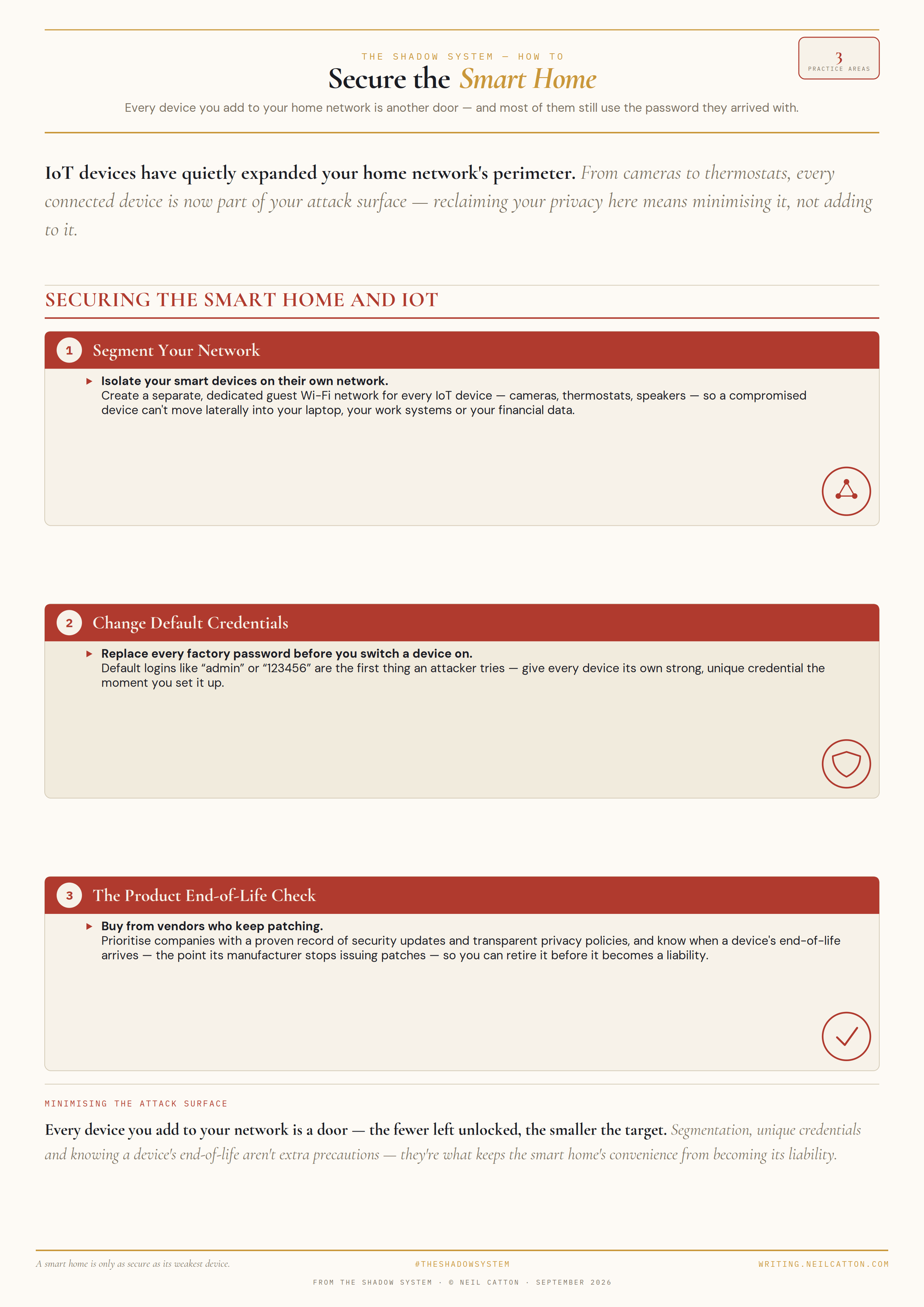
The card sets out three practices for a home full of connected devices — putting them on their own network, replacing the password they arrived with, and knowing a device’s end-of-life before its manufacturer stops patching it. It’s for anyone who’s added a smart device to their network this year and not thought about it since.
It comes from The Shadow System, where the fuller argument about personal cybersecurity, and the systems built to exploit exactly this kind of inattention, gets made at length. The card doesn’t need the book to make sense — it stands on its own.
Print it, or hand it to whoever in the house set up the last smart device without changing the password.
How many devices on your network right now could you actually name?
You’re reading The Next Evolution by Neil Catton, articles that explore the human world and the intersection of technology, they try and ask difficult questions - not to scare - but to inform. If someone forwarded this to you, you can subscribe free at neilcatton.substack.com.
Neil Catton is the author of The Next Evolution, The Cognitive Crucible and The Shadow System - available on Amazon, and writes at the intersection of technology, ethics, and human purpose.