

Jordan opens the phone to check one thing. Twenty minutes disappear before the original question even gets answered. Nothing about those twenty minutes was accidental — the interface, the notification, the infinite feed, all of it was built by people who understood exactly which nudge would keep a thumb moving.
Attention isn’t just spent there. It’s shaped there — what you focus on for that long starts shaping what you believe matters, whether you meant it to or not. The apps calling themselves free were never really free. Somebody paid for the engineering that made twenty minutes disappear, and the payment came out of exactly the resource that just vanished.
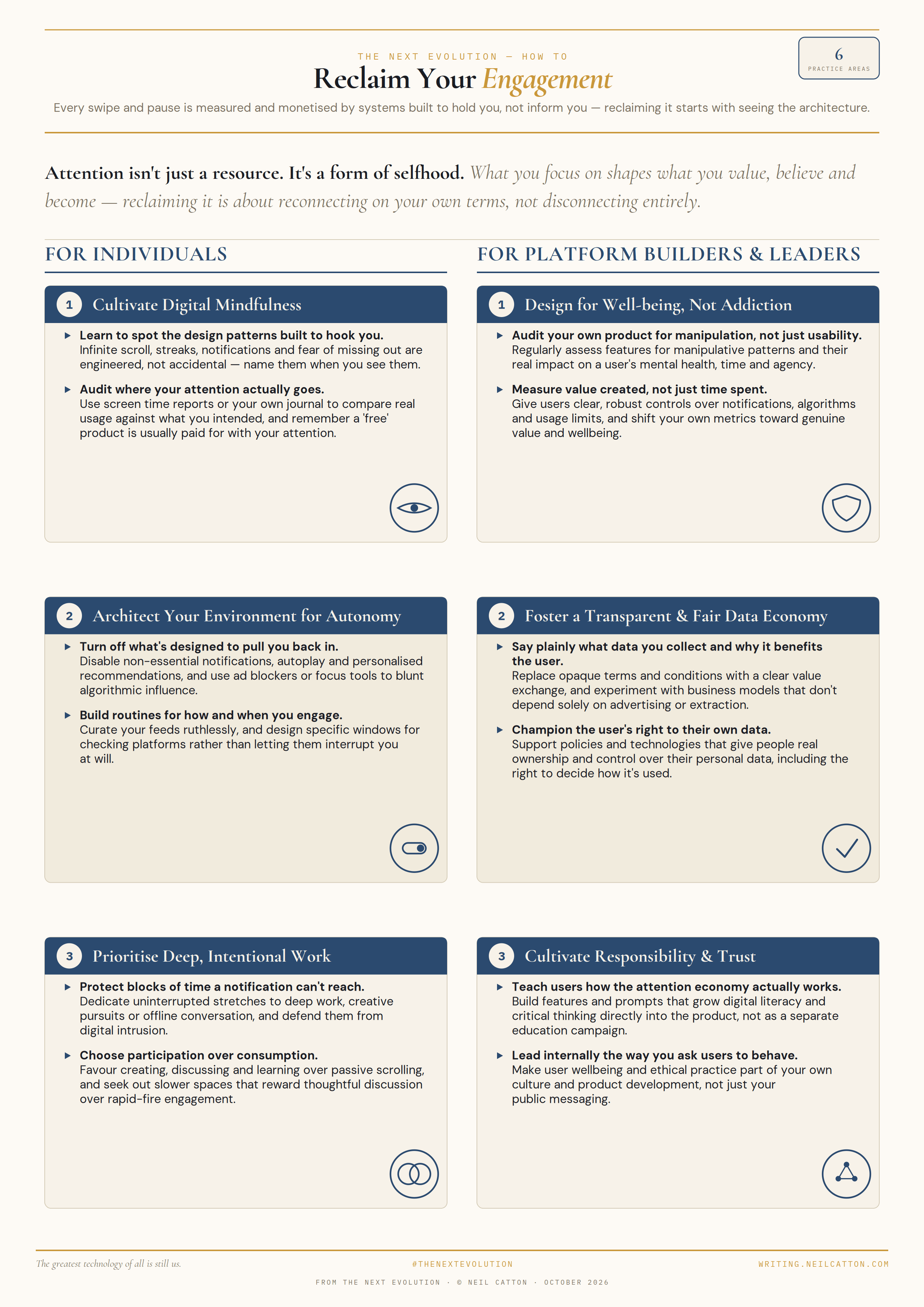
The card splits into two columns — three practices for anyone trying to take their attention back, and three for the platform builders and product leaders deciding what gets built in the first place. It’s for the person on either side of that design decision.
It comes from The Next Evolution, where the fuller argument about attention, engagement and the systems built to hold it gets made at length. The card stands on its own — you don’t need the book to use it.
Print it, or send it to whoever just told you they don’t have time to read any more.
If the platform is optimising for your attention, what exactly are you optimising for?
You’re reading The Next Evolution by Neil Catton, articles that explore the human world and the intersection of technology, they try and ask difficult questions - not to scare - but to inform. If someone forwarded this to you, you can subscribe free at neilcatton.substack.com.
Neil Catton is the author of The Next Evolution, The Cognitive Crucible and The Shadow System - available on Amazon, and writes at the intersection of technology, ethics, and human purpose.