

Sam’s bank called on a Tuesday morning: a login attempt from a country Sam had never visited, using a password Sam recognised at once — the one from a fitness app that had been breached two years earlier, back when the email about it went straight to spam. Nothing about that breach had felt urgent at the time. It felt urgent now.
That’s the shape most personal breaches actually take. Not a hacker who singled you out, but an old habit catching up with you months or years later — a password reused once too often, a profile left public, a text answered half a second too fast. The shadow economy behind this doesn’t need to outsmart anyone. It just needs you to stay predictable a little longer than you should.
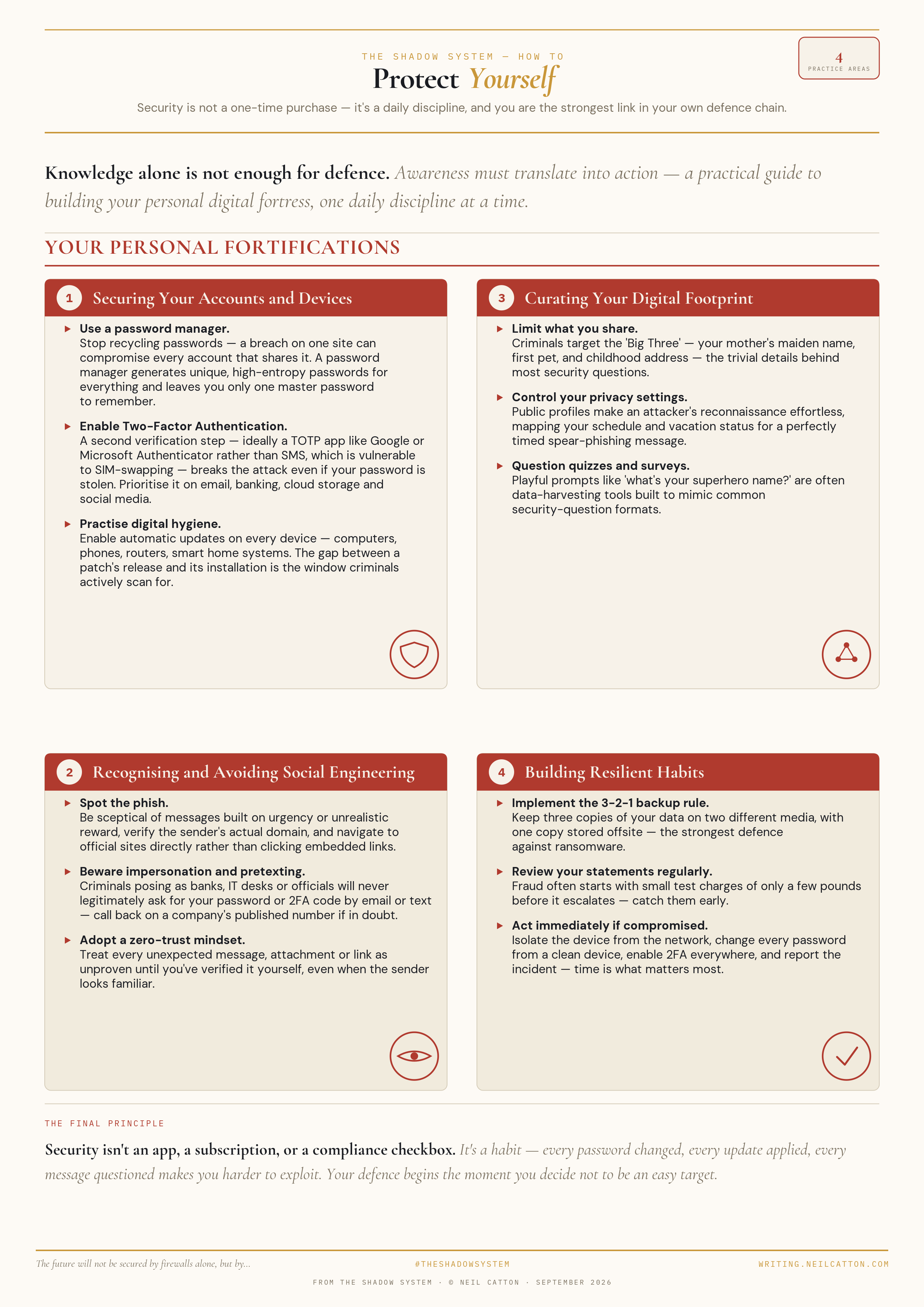
The card holds four practice areas, read as one sequence rather than split by audience: locking down the accounts and devices that are the front door to your digital life, recognising the manipulation aimed at your judgement rather than your hardware, curating the footprint that makes you easy to research, and building the habits — backups, statement checks, a rehearsed response — that turn a breach into an inconvenience instead of a catastrophe. Written for anyone with an inbox and an account worth protecting, which is everyone.
It comes from The Shadow System, where the fuller economics and anatomy of these attacks live. The card stands alone — you don’t need the book to use it.
Print it, or send it to whoever in your life still uses the same password everywhere.
So here’s the honest question: of the four fronts on this card, which one have you been quietly putting off?
You’re reading The Next Evolution by Neil Catton, articles that explore the human world and the intersection of technology, they try and ask difficult questions - not to scare - but to inform. If someone forwarded this to you, you can subscribe free at neilcatton.substack.com.
Neil Catton is the author of The Next Evolution, The Cognitive Crucible and The Shadow System - available on Amazon, and writes at the intersection of technology, ethics, and human purpose.