

A single company sets the protocol that every connected device in a region ends up speaking, and a government three time zones away finds its infrastructure now depends on a standard it had no hand in writing. Nobody signed a treaty. There was no vote. The standard simply won, because it shipped first and governance hadn’t caught up yet.
That pattern repeats across chips, cloud contracts, undersea cables and the training data behind the models a country’s own services now run on. Technology has stopped being just a tool nations use and become a form of power they compete over — and the rules meant to govern that competition are still being drafted while the competition is already well under way.
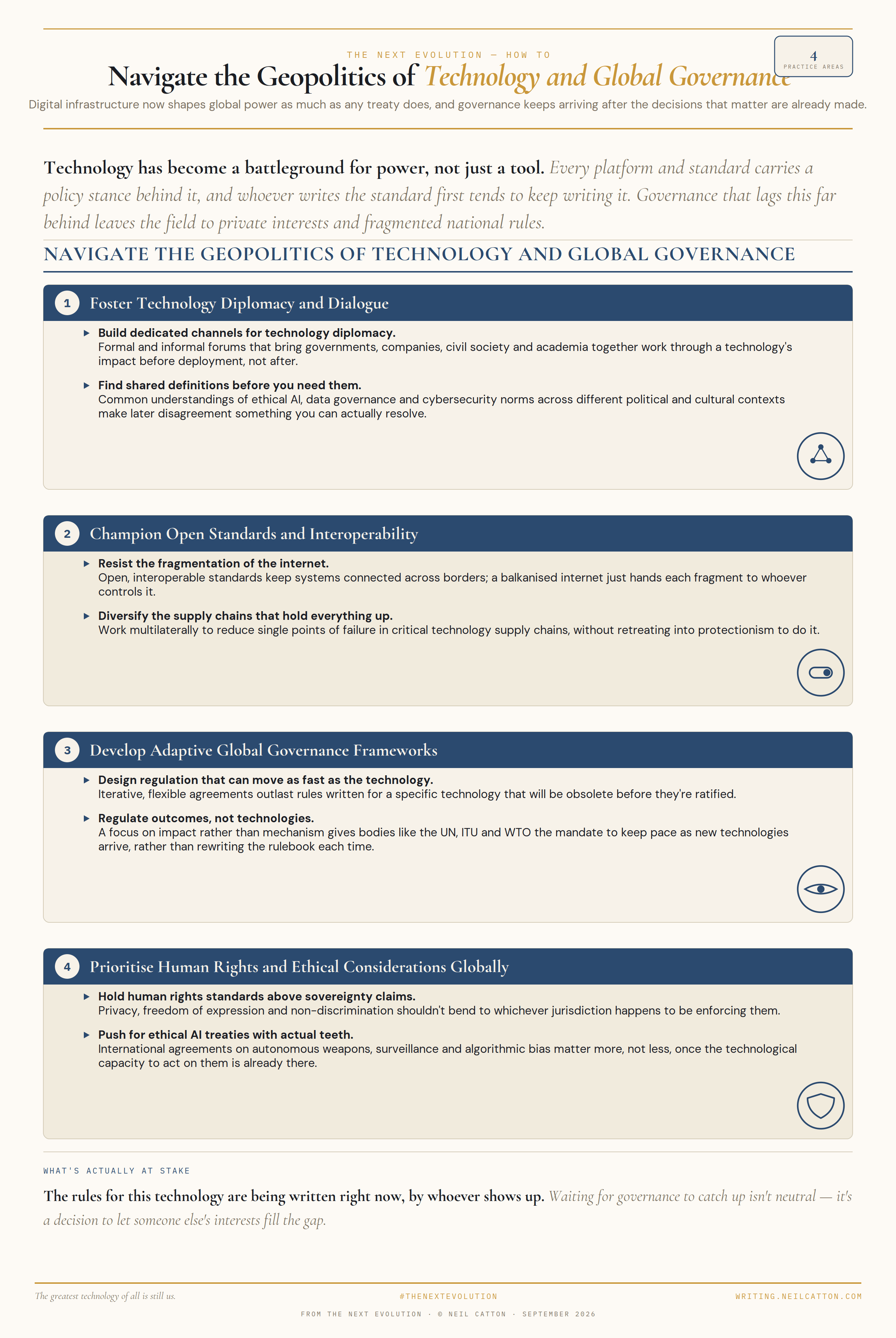
The card holds four practice areas in one column: fostering real technology diplomacy between governments, companies and civil society; championing open standards against the pull toward a fragmented internet; building governance frameworks flexible enough to survive contact with a fast-moving technology; and holding human rights above whichever jurisdiction’s convenience is being served. Written for anyone who wants to see the politics inside the technology, not just the engineering.
It comes from The Next Evolution, where the fuller argument lives. The card stands on its own — you don’t need the book to use it.
Print it, or send it to whoever keeps saying this is a technical decision, not a political one.
If the standard is already decided by the time governance arrives, who was actually in the room?
You’re reading The Next Evolution by Neil Catton, articles that explore the human world and the intersection of technology, they try and ask difficult questions - not to scare - but to inform. If someone forwarded this to you, you can subscribe free at neilcatton.substack.com.
Neil Catton is the author of The Next Evolution, The Cognitive Crucible and The Shadow System - available on Amazon, and writes at the intersection of technology, ethics, and human purpose.