

Jordan’s shift pattern used to come from a manager who knew Tuesdays were hard because of childcare pickup. Now it comes from a scheduling algorithm optimising staffing costs across forty stores, and the software was never asked to know that. Nobody at head office decided to ignore Jordan’s life outside the roster — they just stopped being the one making the decision.
That’s what the future of work looks like most days: judgement swapped for optimisation, one scheduling system and one reskilling programme at a time. The tools are changing. So are the terms — what counts as valuable, who gets to intervene, what a fair transition actually means — and most of that is being decided by default, not by anyone in particular.
The card holds four practice areas, split by where the change actually happens: what people and institutions build in themselves, like lifelong learning and a redefined sense of what work is for, and what has to change in the wider economic system, like real pilots of universal basic income and worker ownership, and automation held to a standard of dignity rather than pure output. Written for anyone with a hand on the transition, from the policymaker weighing a UBI trial to the manager who signs off on the next scheduling system.
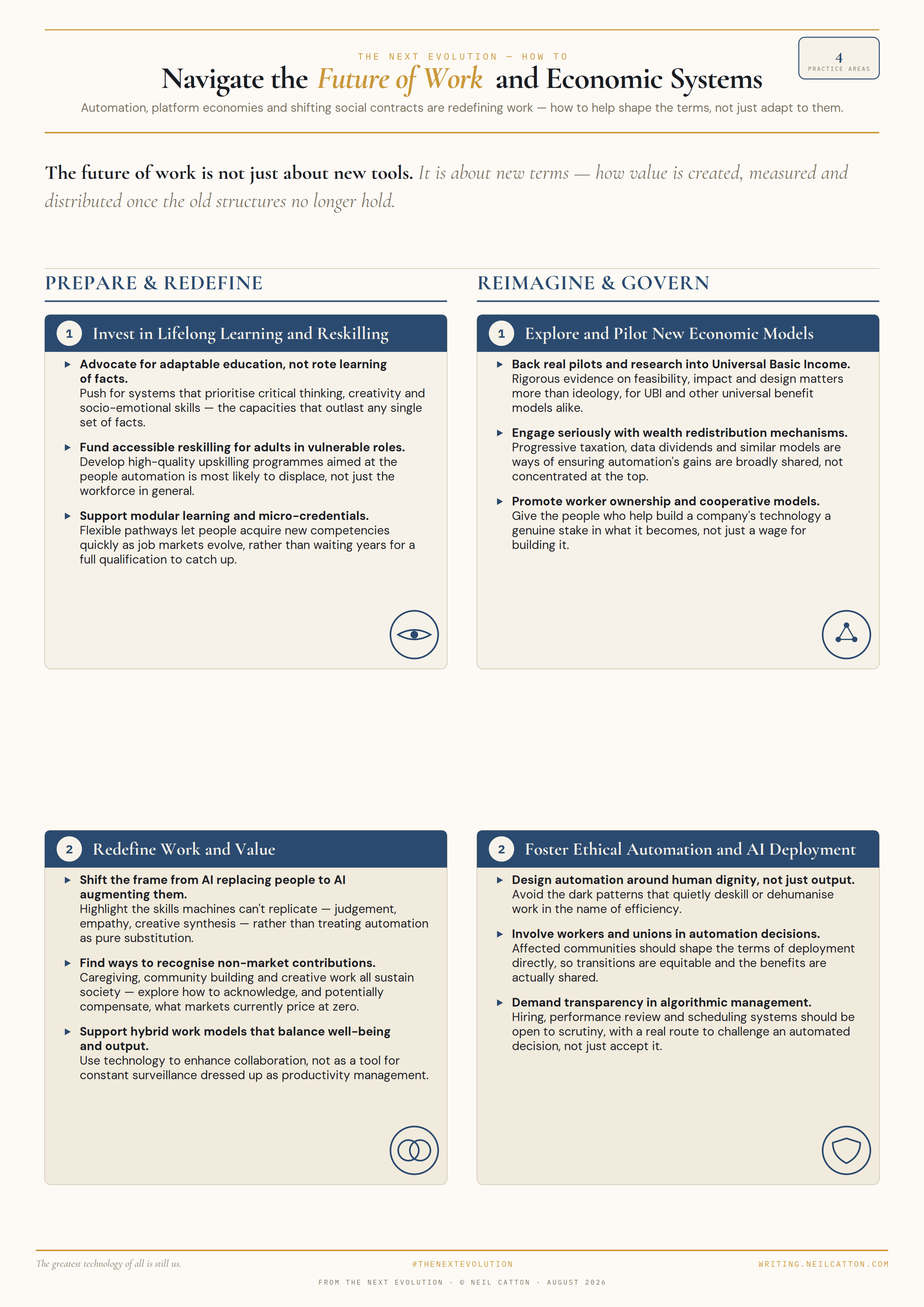
It comes from The Next Evolution, where the fuller argument lives. The card stands alone — you don’t need the book to use it.
Print it, or send it to whoever’s about to build the next system that quietly decides these terms for someone else.
So here’s the question I’d leave with Jordan’s employer: if nobody chose the terms this rota runs on, whose job is it now to choose better ones?
You’re reading The Next Evolution by Neil Catton, articles that explore the human world and the intersection of technology, they try and ask difficult questions - not to scare - but to inform. If someone forwarded this to you, you can subscribe free at neilcatton.substack.com.
Neil Catton is the author of The Next Evolution, The Cognitive Crucible and The Shadow System - available on Amazon, and writes at the intersection of technology, ethics, and human purpose.