

A mortgage broker declines an application and cites “affordability concerns” the applicant doesn’t recognise from their own accounts. Somewhere behind that phrase sits a score, built from months of transaction data, shopping patterns and search history nobody asked permission to use. The applicant never sees the score. They only see the decision.
This is happening across ordinary life — the price quoted for insurance, the job advert that never appears, the loan offer that’s slightly worse than a neighbour’s. None of it is illegal, and most of it was technically disclosed in terms nobody read. It is simply invisible, assembled from data most people never think of as a file with their name on it.
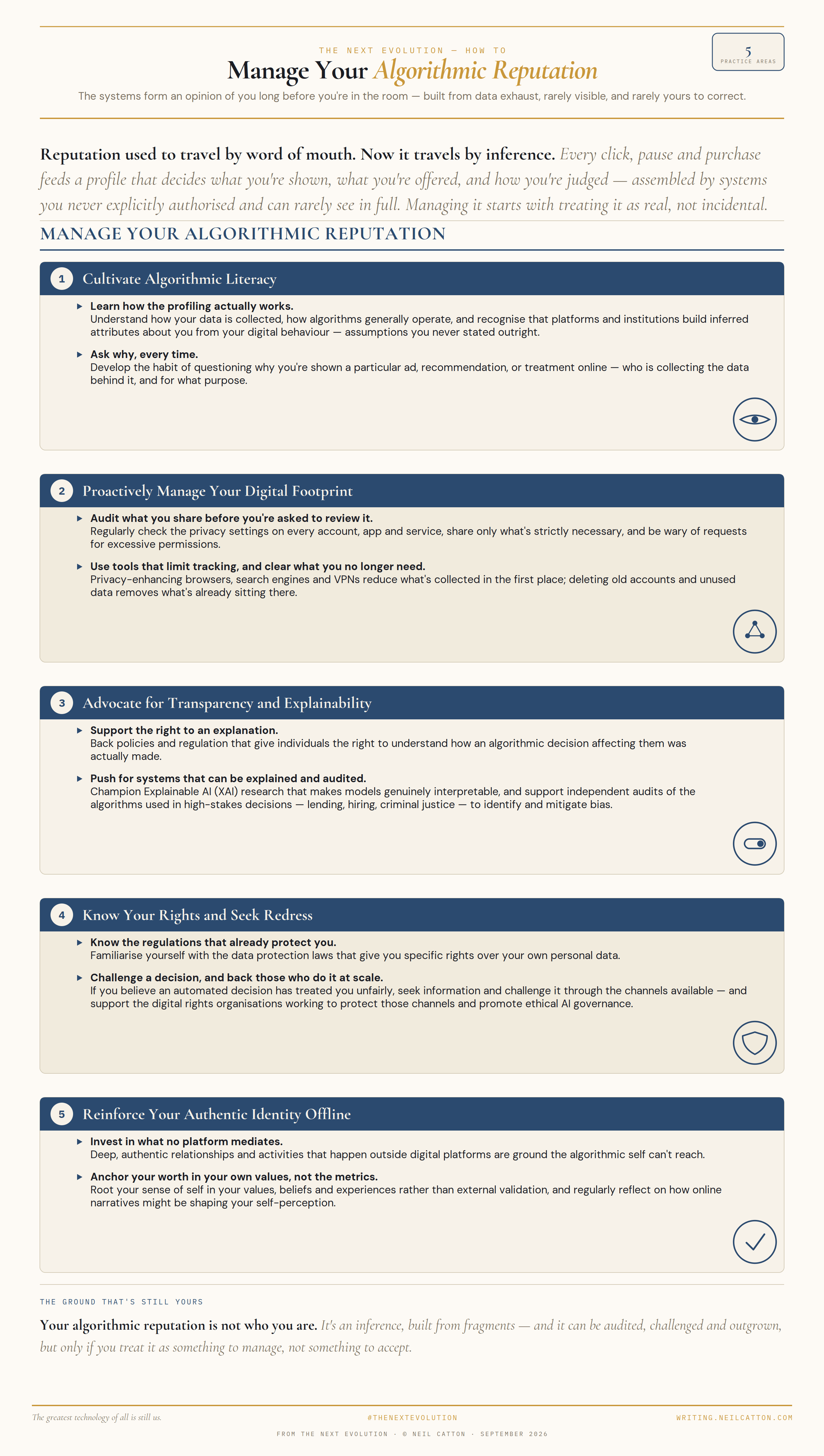
The card holds five practice areas in one column: building real literacy in how the profiling works, actively managing what you feed into it, pushing for systems that can explain themselves, knowing the rights and routes for redress that already exist, and keeping a version of yourself that lives outside the data entirely. Written for anyone who has been treated a certain way online and wanted to know why.
It comes from The Next Evolution, where the fuller argument lives. The card stands on its own — you don’t need the book to use it.
Print it, or send it to whoever just got a decision from a system that can’t say why.
So the next time a screen quietly decides something about you: whose version of you is it working from, and did anyone check?
You’re reading The Next Evolution by Neil Catton, articles that explore the human world and the intersection of technology, they try and ask difficult questions - not to scare - but to inform. If someone forwarded this to you, you can subscribe free at neilcatton.substack.com.
Neil Catton is the author of The Next Evolution, The Cognitive Crucible and The Shadow System - available on Amazon, and writes at the intersection of technology, ethics, and human purpose.