

A phone is designed, built, shipped and sold in under a year. The cobalt in its battery, the water used to cool the factory that made its chips, the device it replaced sitting in a drawer somewhere — none of that shows up on the price tag, and none of it was really designed either. It’s simply what happens when speed, scale and profit are the only things being measured.
Every platform, device and line of code carries a material and social cost across its full life, from extraction to disposal. Designing for sustainability means treating that whole lifecycle as part of the brief, not an externality somebody else absorbs later — and treating ethical limits as a design constraint from the start, not a review that happens after the fact.
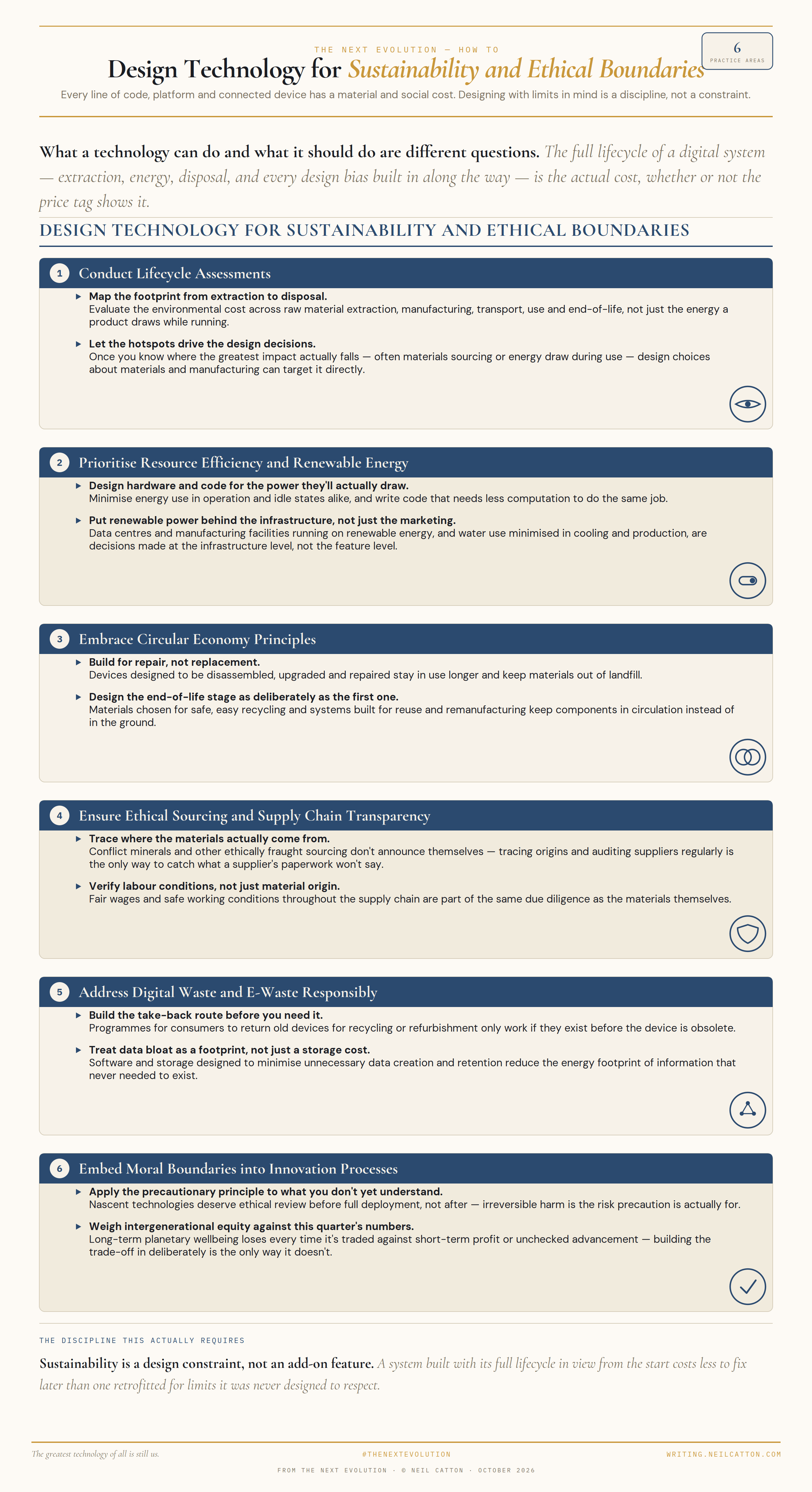
The card holds six practice areas in one column: running real lifecycle assessments, prioritising resource efficiency and renewable energy, building for a circular economy, ensuring ethical sourcing and supply chain transparency, addressing digital and e-waste responsibly, and embedding moral boundaries into the innovation process itself. Written for anyone building technology who wants the full cost on the table before the product ships, not after.
It comes from The Next Evolution, where the fuller argument lives. The card stands on its own — you don’t need the book to use it.
Print it, or send it to whoever just greenlit a product without asking what happens to it in five years.
If nobody on the team can say what a product actually cost to make, was it ever really designed at all?
You’re reading The Next Evolution by Neil Catton, articles that explore the human world and the intersection of technology, they try and ask difficult questions - not to scare - but to inform. If someone forwarded this to you, you can subscribe free at neilcatton.substack.com.
Neil Catton is the author of The Next Evolution, The Cognitive Crucible and The Shadow System - available on Amazon, and writes at the intersection of technology, ethics, and human purpose.