

A staff wellbeing platform asks how you are feeling, on a scale of one to five, each number carrying a small face. Someone whose father died the previous week picks three, because nothing on the scale describes where they actually are. The dashboard records a workforce in reasonable spirits and the quarterly report says engagement is holding.
The platform measured the part of the person that fitted the field. That is what most systems do, and not out of malice — attention, clicks and a sentiment score are simply the easiest things to represent. The rest of a human being is harder to put into a database column. Emotional range, the need for rest, the pull towards play with no goal attached, the willingness to sit with something unresolved: none of it is hostile to design, all of it gets left out because nobody has worked out what the field would look like.
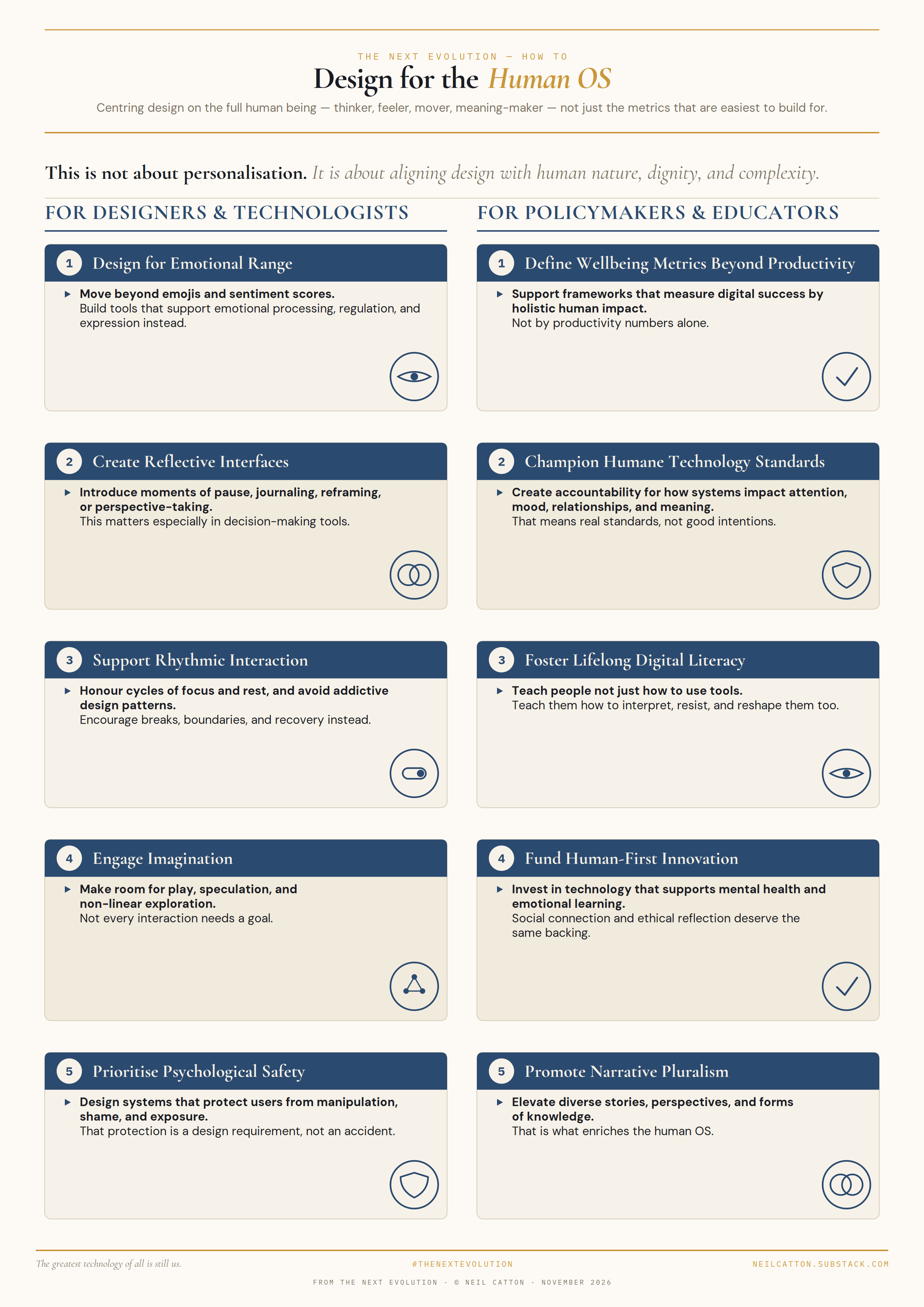
The card runs ten practices in two columns — five for designers and technologists building the systems, five for policymakers and educators setting the conditions those systems get built under. It’s for anyone who has watched a tool measure the wrong thing with real precision.
It comes from The Next Evolution, where the fuller argument about designing around the whole person gets made at length. The card doesn’t need the book to make sense — it stands on its own.
Print it, or send it to whoever owns the metric.
Every system decides which parts of a person are worth representing. In your organisation, who actually makes that call?
You’re reading The Next Evolution by Neil Catton, articles that explore the human world and the intersection of technology, they try and ask difficult questions - not to scare - but to inform. If someone forwarded this to you, you can subscribe free at neilcatton.substack.com.
Neil Catton is the author of The Next Evolution, The Cognitive Crucible and The Shadow System - available on Amazon, and writes at the intersection of technology, ethics, and human purpose.