

Casey checked the phone at the dinner table without deciding to. Nobody had messaged. The hand just went there, the way it does forty or fifty times a day, pulled by a notification that may or may not have arrived. By the time Casey looked up, the conversation had moved on without them.
That reflex isn’t a personal failing. It’s the product working as designed. The interfaces, the notifications and the metrics an app chases are built to hold attention, and holding attention has real costs — disrupted rhythms, eroded focus, a sense of self quietly reshaped by whatever keeps someone scrolling. None of that is inevitable. It’s the result of design choices, made deliberately or left unexamined.
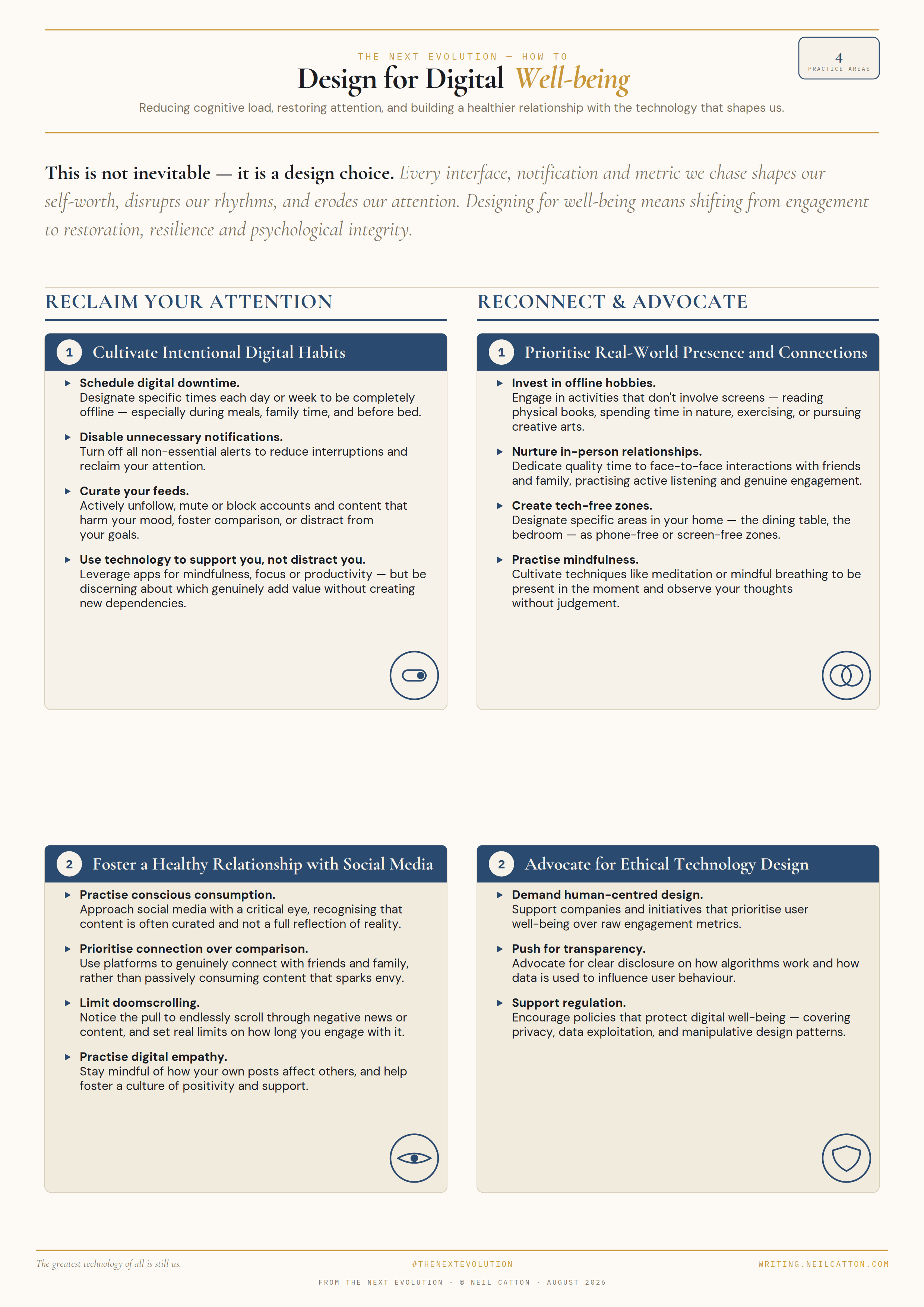
The card holds four practice areas across two columns: reclaiming attention through intentional habits and a healthier relationship with social media, then reconnecting through real-world presence and by pushing for design that answers to the people using it, not just the engagement metrics it’s measured against. Written for anyone whose phone currently has more influence over their day than they’d like — which is most people.
It comes from The Next Evolution, where the fuller argument for shifting from engagement to restoration lives. The card stands alone — you don’t need the book to use it.
Print it, or pin it somewhere you’ll actually see it — the kitchen, the desk, wherever the phone usually wins.
So here’s the honest question: the next time your hand reaches for the phone without you deciding to, whose interest is it actually serving?
You’re reading The Next Evolution by Neil Catton, articles that explore the human world and the intersection of technology, they try and ask difficult questions - not to scare - but to inform. If someone forwarded this to you, you can subscribe free at neilcatton.substack.com.
Neil Catton is the author of The Next Evolution, The Cognitive Crucible and The Shadow System - available on Amazon, and writes at the intersection of technology, ethics, and human purpose.