

A resident logs on to renew a blue badge, or chase a repair, and finds themselves typing to a face that nods, blinks and says “I understand you” in a voice built for reassurance. Nobody told them it was AI. There was no button marked for a person. The conversation just continued, patient and warm, until the resident gave up guessing and hung up.
Digital humans — avatars built to stand in front of the public on behalf of a service — are already live across government and healthcare settings. Every choice about how one speaks, when it escalates, and what it’s permitted to notice about someone’s distress was made months earlier, by people that resident will never meet. Most of those choices stay invisible until the day they fail somebody.
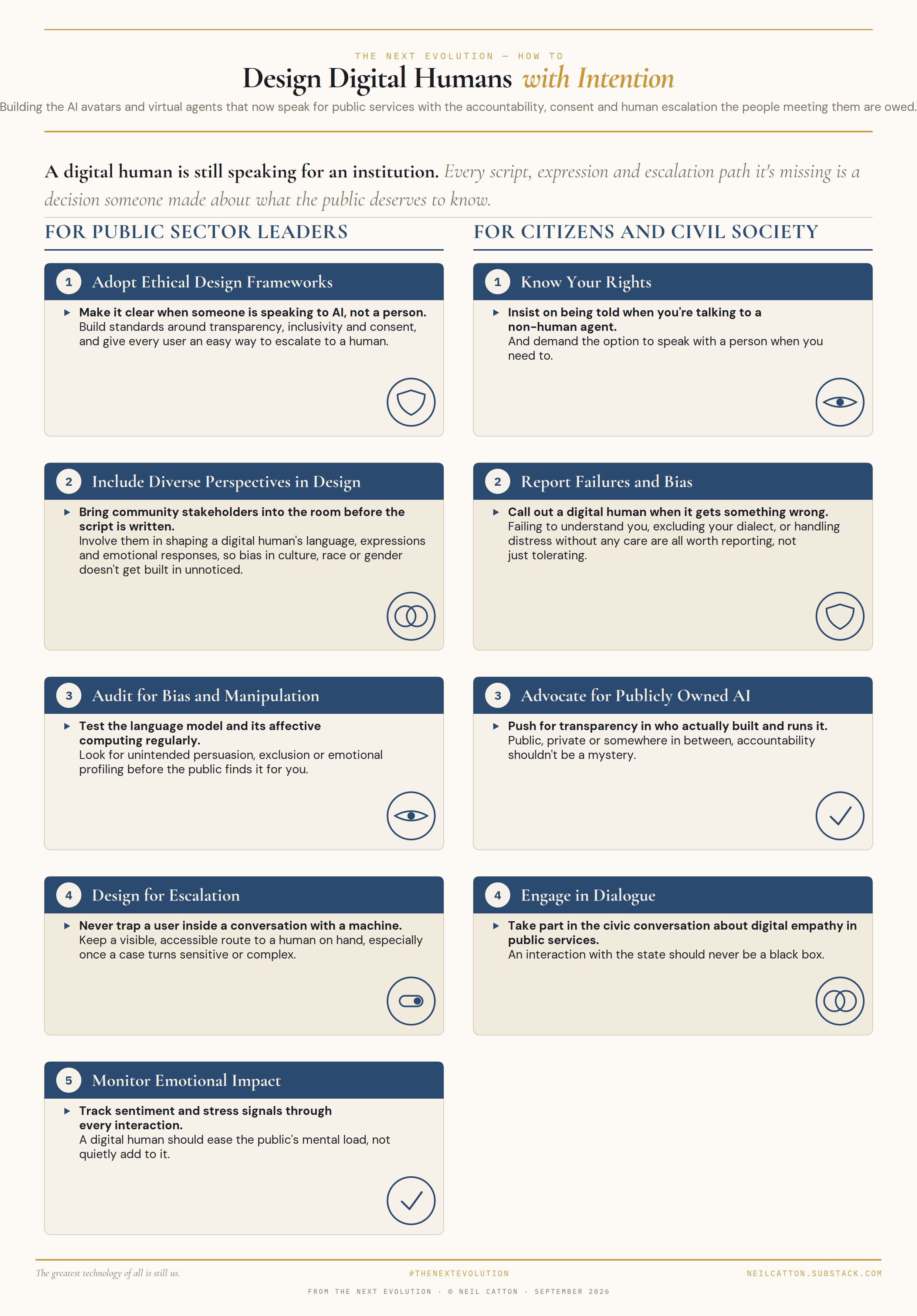
The card holds nine practices across two columns. Five for the public sector leaders commissioning and shaping these systems: adopting ethical design frameworks, bringing community voices in before the script is written, auditing for bias and manipulation, designing a real path to a human, and monitoring the emotional toll an interaction leaves behind. Four for the citizens and civil society groups meeting them: knowing the right to be told, reporting failures instead of shrugging them off, pushing for transparency in who actually owns the system, and staying in the civic conversation about what digital empathy is for.
It comes from The Next Evolution, where the wider argument — that technology should be built for the person in front of it, not the average user or the efficiency target it’s meant to hit — is made at length. The card stands on its own.
Print it, or send it to whoever is briefing the next digital human into service.
What happens to the person who never works out they were talking to a machine at all?
You’re reading The Next Evolution by Neil Catton, articles that explore the human world and the intersection of technology, they try and ask difficult questions - not to scare - but to inform. If someone forwarded this to you, you can subscribe free at neilcatton.substack.com.
Neil Catton is the author of The Next Evolution, The Cognitive Crucible and The Shadow System - available on Amazon, and writes at the intersection of technology, ethics, and human purpose.