

A training simulation ends and the trainee lifts the headset off. For a few seconds the real room feels subtly wrong — the colours flat, the floor too still. That passes. What stays behind is the record the session made: where the eyes went, how long each gaze was held, and how the skin’s electrical response shifted at the moment the scenario turned difficult.
Immersive environments have stopped being something you look at. They arrive through sight, sound, touch and, increasingly, scent, and they land in the body before any argument reaches the mind. That makes perception itself something a designer sets parameters for. It becomes possible to build an experience that genuinely grows a person’s empathy — and equally possible to build one that holds them by keeping the nervous system occupied. The same toolkit does both, and from inside the headset the two feel identical.
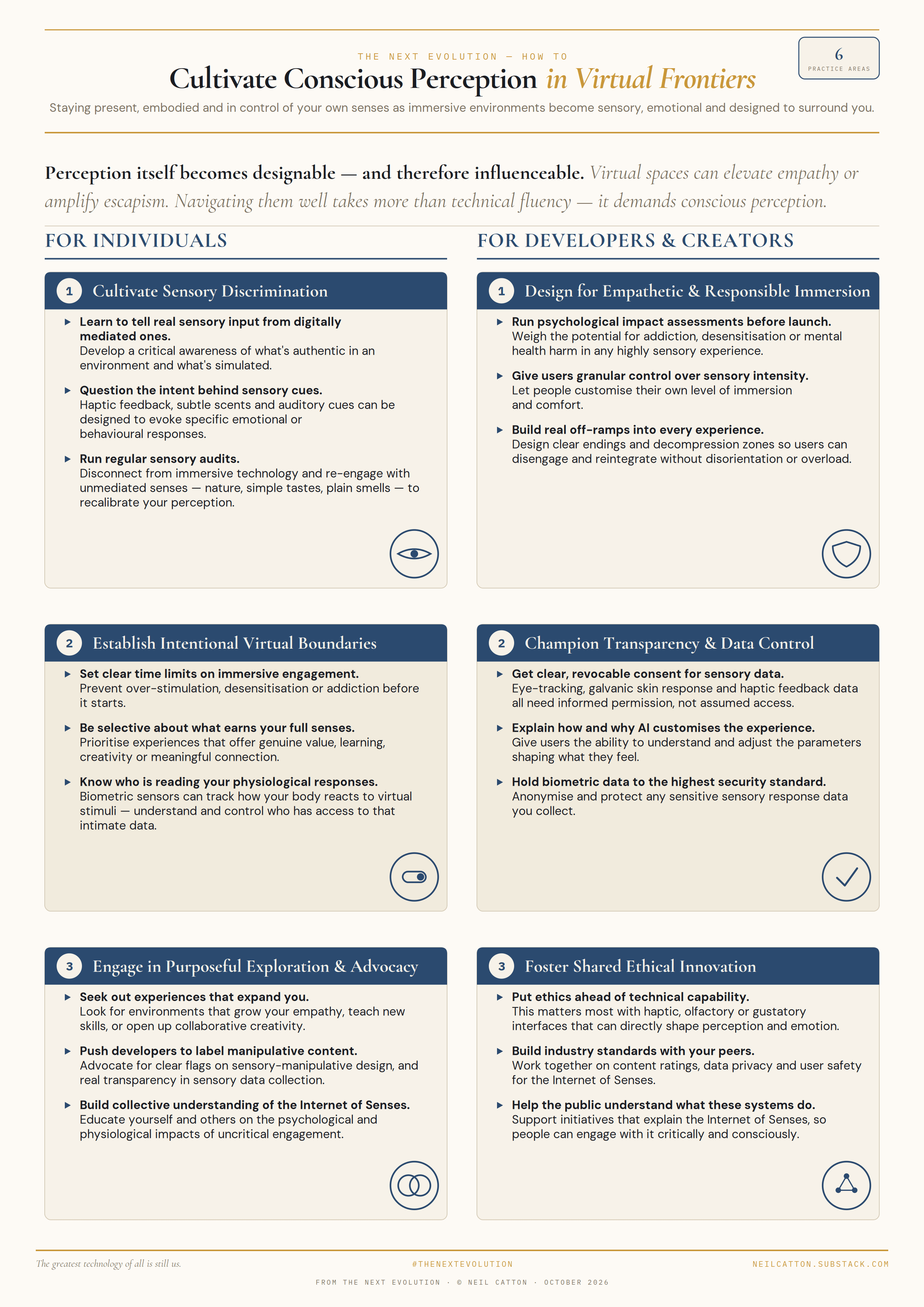
The card sets out six practice areas across two columns — three for people moving through these environments, covering sensory discrimination, virtual boundaries and what to do with the physiological data you shed on the way; three for the developers and creators building them, covering psychological impact assessments, consent for bio-sensory data and designing real off-ramps rather than leaving people to find the exit themselves. It’s for anyone who assumed immersion was just a stronger version of watching.
It comes from The Next Evolution, where the fuller argument about the Internet of Senses and conscious perception gets made at length. The card doesn’t need the book to make sense — it stands on its own.
Print it, or send it to whoever is signing off the headsets.
If a system can read how your body responded before you had formed an opinion, who should be allowed to see that?
You’re reading The Next Evolution by Neil Catton, articles that explore the human world and the intersection of technology, they try and ask difficult questions - not to scare - but to inform. If someone forwarded this to you, you can subscribe free at neilcatton.substack.com.
Neil Catton is the author of The Next Evolution, The Cognitive Crucible and The Shadow System - available on Amazon, and writes at the intersection of technology, ethics, and human purpose.