

The thermostat adjusts before you reach for the dial. The playlist queues the track you’d have picked anyway. The reply suggestion finishes your sentence before you’ve decided how it ends. None of it was requested. It just arrived, ahead of you, wearing the word “convenience.”
Becoming a system shaper starts with catching that moment: noticing when the environment has made a choice on your behalf rather than simply for you. Passivity and participation are both design choices now, the card’s own opening line argues — and only one of them is yours if you never notice you’re making it.
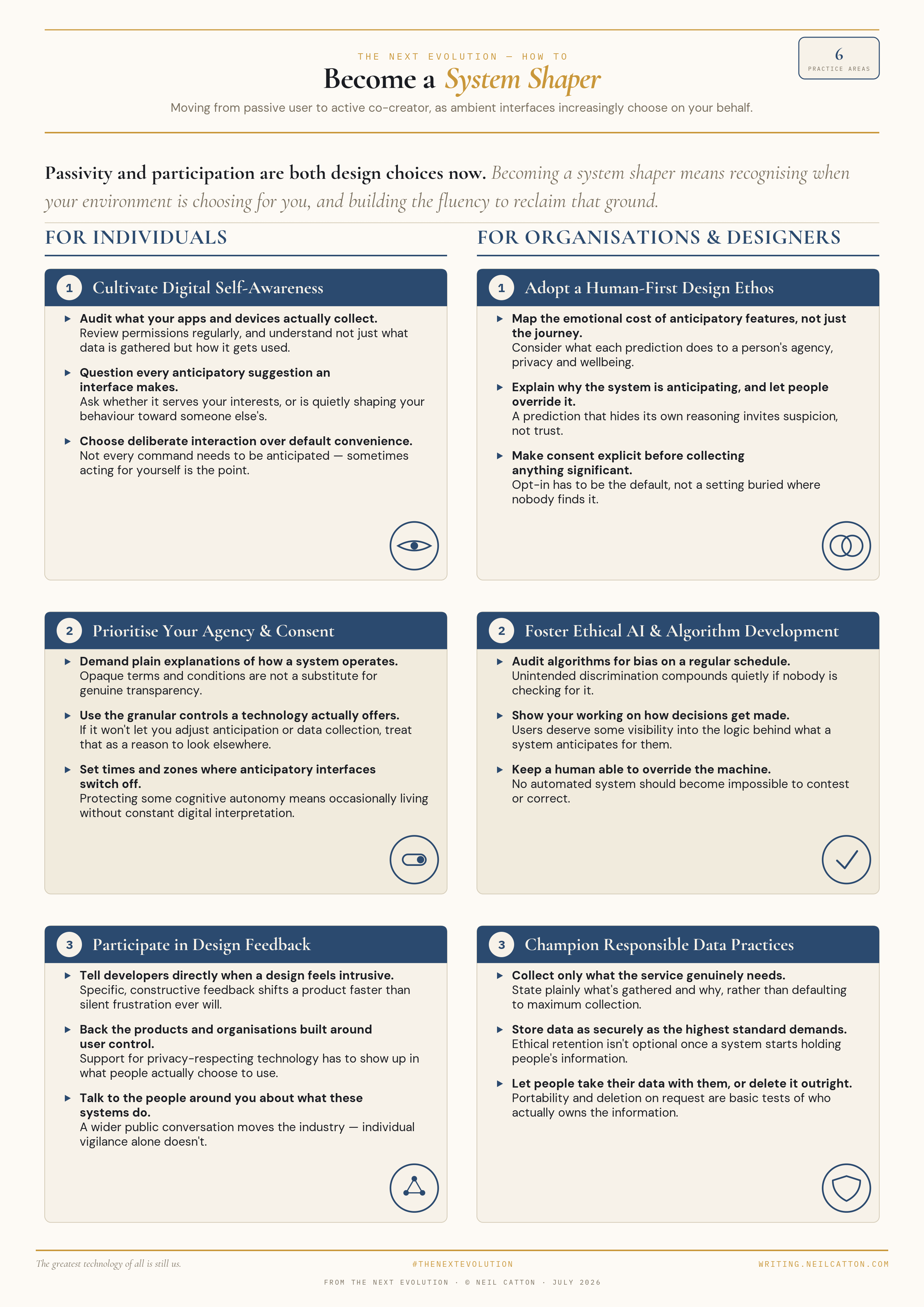
The card holds six practice areas across two audiences. Three for individuals: building the self-awareness, the agency and consent habits, and the feedback instincts that keep pace with anticipatory design. Three for organisations and designers: a human-first design ethos, ethical AI development, and responsible data practice. Written for whoever actually has a hand on the dial, on either side of the screen.
It comes from The Next Evolution, where the fuller argument lives. The card stands on its own — you don’t need the book to use it.
Print it, or keep it somewhere you’ll glance at before you next accept a default without reading it.
And here’s the question I’d leave with you: the last time a device anticipated what you wanted, how sure are you that it was actually what you wanted, and not just what was easiest to hand you?
You’re reading The Next Evolution by Neil Catton, articles that explore the human world and the intersection of technology, they try and ask difficult questions - not to scare - but to inform. If someone forwarded this to you, you can subscribe free at neilcatton.substack.com.
Neil Catton is the author of The Next Evolution, The Cognitive Crucible and The Shadow System - available on Amazon, and writes at the intersection of technology, ethics, and human purpose.