

The Internet of Things (IoT) has evolved beyond simple sensors into a vast real-time “Intelligent Connection” network. This ambient technological layer forms the foundation of our future, seamlessly merging the physical and digital worlds to create massive self-adjusting operational organisms. These include Smart City grids, integrated healthcare systems and global supply chains.
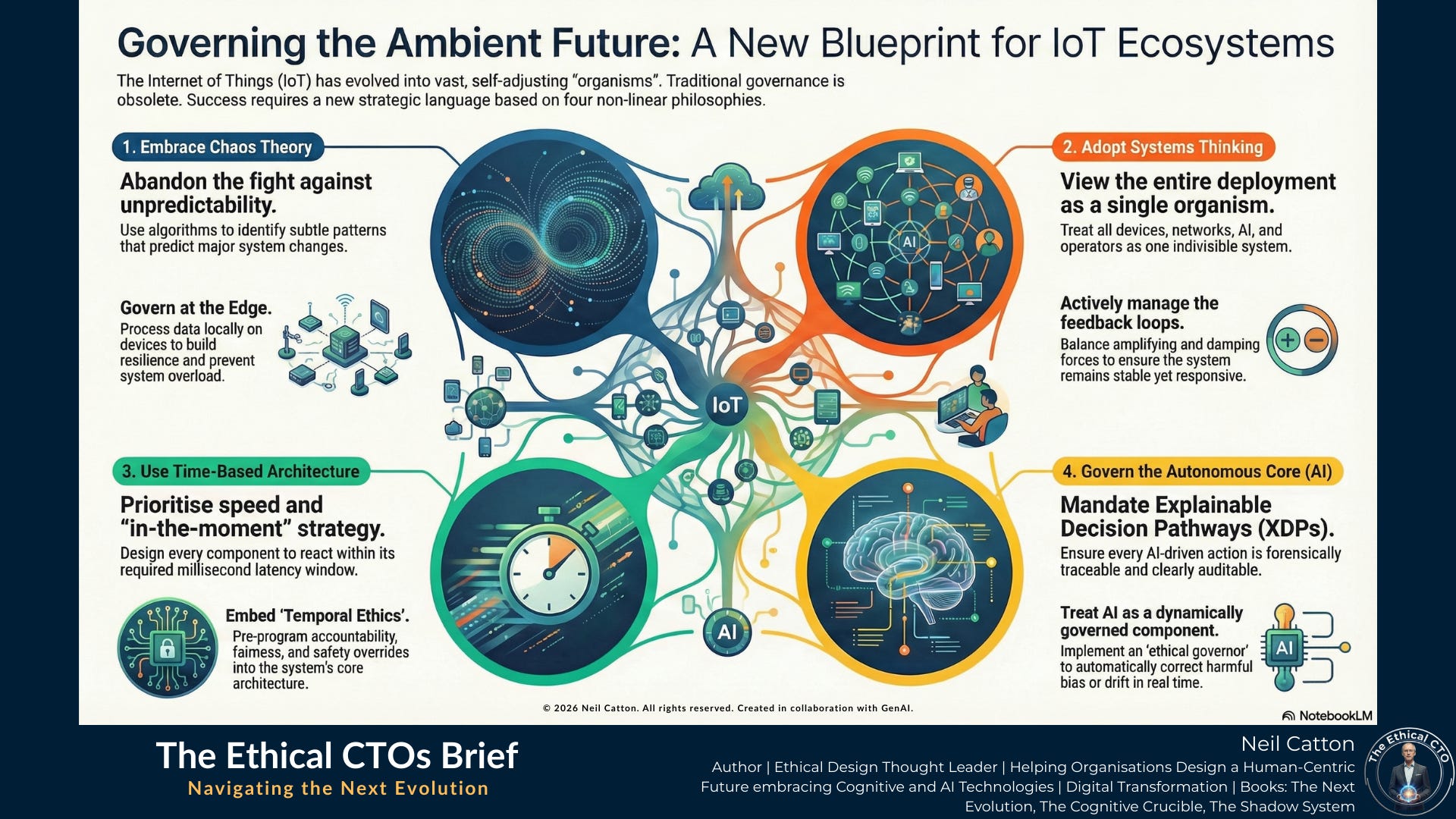
This transformation promises unprecedented efficiency but also presents a significant architectural challenge. Traditional linear governance models, relying on slow retrospective analysis and fixed planning cycles, are ill-suited to manage these dynamic environments. In the Ambient Future data value quickly diminishes and unpredictability becomes the norm. To successfully design and govern these complex ethical and self-optimising ecosystems architects and strategists must adopt a new non-linear strategic language grounded in four core philosophies: Chaos Systems Time and Autonomy.
Taming the Data Storm: Embracing Chaos Theory
IoT ecosystems flourish in a chaotic environment. The sheer volume and speed of data streaming from billions of endpoints such as traffic monitors, industrial controls, and health wearables create non-linear flows. This means even small initial inputs can lead to vastly different outcomes.
The Architectural Challenge (The Butterfly Effect): In these vast networks, even a minor fluctuation like a sudden weather change, a single delayed delivery or sensor mis-calibration can propagate through the system and trigger disproportionate rapid effects. Legacy systems often attempt to suppress this “noise” but this filtering process can also remove the earliest and most crucial warnings indicating a potential system shift.
The Chaos Solution: Successful IoT architectures must abandon the fight against complexity and embrace it. This demands a fundamental shift in how systems analyse and respond to data.
Predicting the Pivot: Systems must employ sophisticated algorithms to identify subtle non-linear patterns signalling a bifurcation point – a moment when a sudden and significant change is likely. This capability enables prediction beyond mere reaction, facilitating strategic interventions like predicting a widespread public transport failure 30 minutes before traditional congestion models raise any concerns.
Governing at the Edge: To build resilience directly into edge devices where data originates, we must process, interpret and apply control limits at the device level. This local governance prevents anomalous high-velocity data from overwhelming the central command system, ensuring the network remains coherent and globally functional.
Chaos Theory offers the essential technical framework to interpret the inherent unpredictability of the Ambient Future. This transforms volatility from a threat into a competitive advantage. However, mastering this data chaos demands a comprehensive understanding of how the system’s various components interact as a whole.
Architecting the Organism: Systems Thinking
The true power of an IoT solution lies in its instantaneous and continuous interaction between its components. This interconnectedness creates a chain reaction, making any large-scale deployment like a smart city or connected health network a Complex Adaptive System (CAS) – essentially a living organism whose behaviour is dictated by the sum of its parts.
The Architectural Challenge (Interdependencies and Feedback Loops): Connectivity inevitably blurs the lines between security and operations. For example, a successful cyber-attack on a municipal waste management sensor could disrupt the power grid, while a flaw in a private health wearable could compromise public health data. This creates circular causality in these systems where the output of one component instantly becomes the input for others making traditional linear root-cause analysis almost impossible.
The Systems Solution: Systems thinking requires a holistic view, concentrating on the relationships, interdependencies and feedback loops that make up the whole system rather than optimising individual components. This approach demands:
Defining the CAS: The entire deployment – devices, networks, cloud platforms, human operators, and AI models – must be considered a single indivisible system. This systemic approach compels architects to design resilience and security that permeate the entire entity eliminating localised weaknesses that could threaten the whole.
Governing the Loops: Architects must clearly define and control the feedback loops that influence system behaviour. For instance, a system designed to swiftly respond to anomalies, like a positive or amplifying loop, needs a counter-force, such as a negative or damping loop, to prevent overreaction and potential widespread instability or panic. Managing these loops ensures the system remains stable and responsive.
Systems thinking is crucial for establishing resilient boundaries and navigating the intricate, often hidden dependencies that shape the security and long-term stability of a connected organism. The next step is governing the pace at which this complex entity functions.
Governing the Real-Time
In an ambient environment, the most valuable resource isn’t just the data itself but the speed of action it enables. Stock market quotes and traffic jam alerts quickly lose their value, while a fire sensor warning is a life-or-death situation demanding immediate and accurate action. Time becomes the crucial strategic constraint.
The Architectural Challenge (Latency and Loss of Value): Legacy institutions and their systems are too slow, relying on human-scale batch processing like daily reports and hourly updates. The Ambient Future operates in milliseconds. To unlock IoT’s potential, such as autonomous healthcare and infrastructure management, architectures must prioritise Time to Action (TTA) and Time to Value (TtV). This demands a fundamental overhaul of technical infrastructure.
The Time-Based Solution: Time-Based Architecture (TBA) forms the cornerstone of this speed-driven imperative. Crucially, it introduces a vital governance layer known as Temporal Ethics.
In The Moment Strategy: This shift prioritises immediate operational readiness over long-term planning. Every system component must be explicitly configured to execute and react within the application’s specific latency window. For example, if a system needs a 50-millisecond response for safety, its architecture must ensure that the time-to-action is met.
Pre-Programmed Ethics: As IoT systems evolve towards autonomous decision-making, such as traffic control prioritising emergency vehicles, ethical and governance parameters must be pre-integrated. Temporal Ethics dictates that accountability, fairness, auditability, and safety overrides are embedded into the system’s architecture before any decision is made. This guarantees that the system’s core values remain unwavering even at high speeds.
Temporal Ethics and TBA are the essential foundations for governing systems operating at the pace of the hyper-future. This instant action capability is almost universally facilitated by the next most complex element: Artificial Intelligence.
AI and The Ethics of Delegation
Artificial intelligence serves as the operational brain of today’s Internet of Things ecosystem. It spans from lightweight machine learning models at the edge to sophisticated cognitive systems in the cloud. AI acts as the engine, detecting patterns in chaotic data optimising systemic performance and executing critical decisions within a tight timeframe. This transformation elevates IoT ecosystems from reactive networks to proactive autonomous entities.
The New Governance Challenge (Delegating Judgment and Concept Drift):
Granting AI the authority to perform “in-the-moment” actions like autonomous maintenance and resource balancing, effectively delegates human operational and ethical judgement. This delegation introduces significant risks including systemic bias, algorithmic discrimination, and a lack of clear human accountability. Furthermore concept drift poses a threat. As real-world conditions evolve over time, such as changes in traffic patterns following a new housing development, AI models can become inaccurate and potentially harmful.
The Next Evolution Mandate: Governing this autonomous core requires two critical architectural steps:
Explainable Decision Pathways (XDPs): The system must prioritise forensic auditability alongside speed. Every AI-driven action should leave a clear traceable and explainable path. This path should link the action back to the original sensor input, the specific model version that generated the insight, and the pre-programmed ethical constraint it adhered to.
AI as a Governed Component: The AI model should be considered a dynamically governed component of the Complex Adaptive System. Its architecture should include an “ethical governor” that recognises, flags and automatically corrects harmful bias or drift in real time. This prevents prolonged periods of dangerous or unjust autonomous operation.
Managing the autonomous core involves mastering the delegation of judgement. This ensures AI functions as a transparent and ethical extension of the institution rather than an unpredictable black box.
A Final Word
Intelligent connection and the Internet of Things are destined to shape the future of all complex operational environments. The biggest architectural challenge of this era lies in transitioning from simply connecting devices to effectively governing the autonomous real-time organism that emerges.
Strategists and architects face a new challenge: not just connecting devices but also designing the systems and governance frameworks needed to manage the resulting complexity speed and profound ethical dilemmas.
To create resilient, accountable and self-regulating ecosystems we must transcend traditional thinking and embrace the rigorous non-linear principles of Chaos Theory, Systems Thinking, Time-Based Architecture, and the governance of the Autonomous Core. This architectural revolution is essential for successfully navigating the Ambient Future.
You’re reading The Next Evolution by Neil Catton, articles that explore the human world and the intersection of technology, they try and ask difficult questions - not to scare - but to inform. If someone forwarded this to you, you can subscribe free at neilcatton.substack.com.
Neil Catton is the author of The Next Evolution, The Cognitive Crucible and The Shadow System - available on Amazon, and writes at the intersection of technology, ethics, and human purpose.