

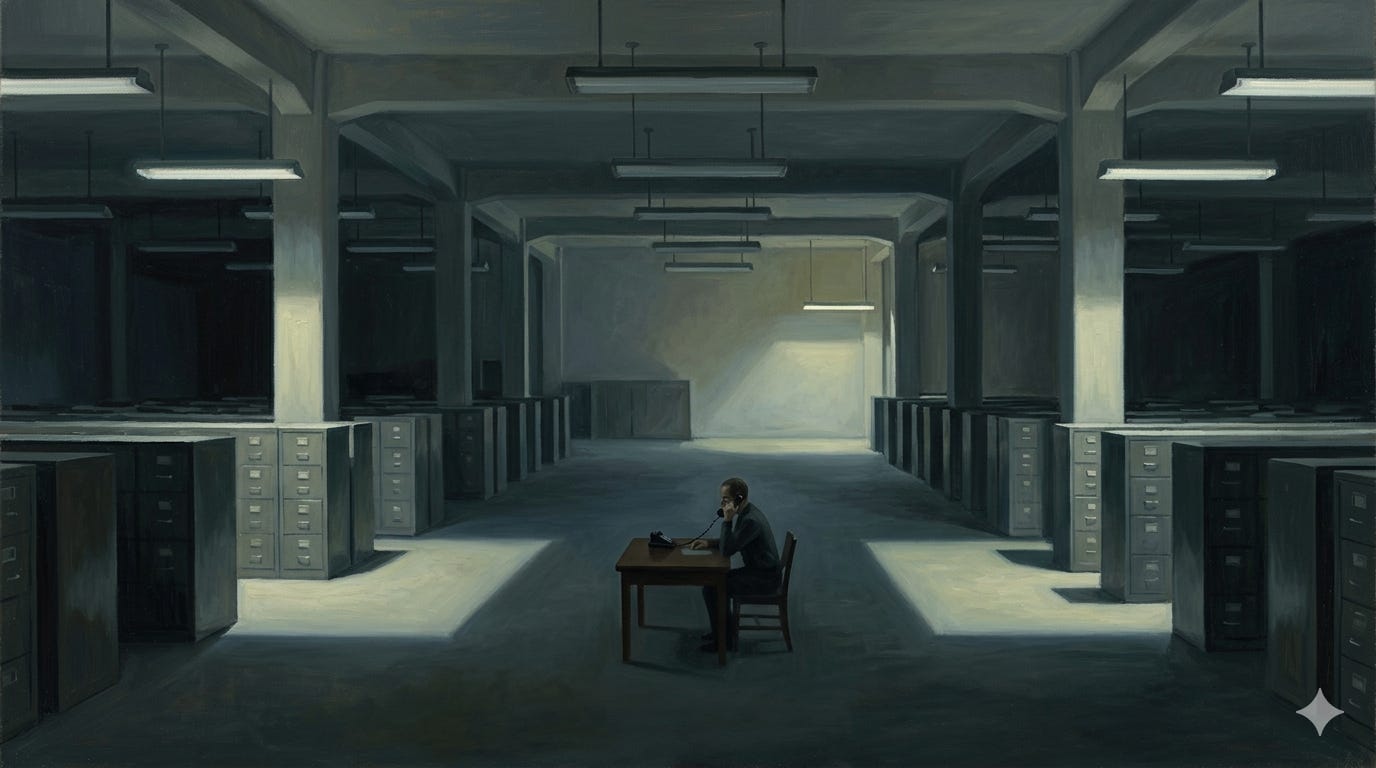
Morgan has been trying to sort out the same problem for eleven days.
It started simply enough with a direct debit taken twice for the same bill, the kind of thing that happens and can be fixed. Morgan called the bank. The bank said it was the supplier’s error. The supplier said the bank should reverse it. The bank said it could not reverse a transaction authorised by the account holder. Morgan explained, again, that they had not authorised it twice. The bank opened a dispute. The supplier closed the account as a precaution. A debt recovery letter arrived three days later.
Nobody in this chain has been unhelpful, exactly. Everyone Morgan has spoken to has followed the process correctly. The call handler at the bank was patient and thorough. The adviser at the supplier was apologetic and professional. The automated letter from the debt agency was, in its own way, politely worded. Every department did its job. Nobody solved the problem.
No procedure for this
Morgan is not the edge case. Morgan is the test.
The systems these organisations built were designed to handle the expected, the payment that goes through, the query that fits a category, the customer who follows the script. The infrastructure was built around the transaction, not the person making it. When something falls between the categories, there is no procedure for that, because the procedure assumes the categories are complete.
What this means in practice is that Morgan’s problem is simultaneously everyone’s responsibility and no one’s. The bank’s system registers a closed dispute. The supplier’s system registers a closed account. The debt agency’s system registers an outstanding balance. Three separate records, each technically accurate, none of them the truth of what actually happened. The institution has not failed Morgan through malice or incompetence. It has failed Morgan by design.
Six systems, imperfectly linked
There is a word for this: siloing. But the word has been used so often it has stopped meaning anything. What it actually describes is an organisation that was built around its own internal logic rather than around the person it was supposed to serve.
Most large institutions — banks, utilities, government departments, insurers — were built in an era when the world moved slowly enough that this approach worked. You designed a system for the eighty per cent case. The other twenty per cent called a human, and the human used judgement. Over time, the humans were replaced by more systems, the judgement was replaced by more rules, and the twenty per cent became a problem the institution officially did not have.
The systems grew, merged, were acquired, were updated in parts and left untouched in others. A organisation that has been through three mergers in fifteen years does not have one customer record system — it has six, imperfectly linked, each with its own logic about what a closed account means. None of this was anyone’s plan. It accumulated.
A mortgage application on hold
Morgan spent forty minutes on hold on day nine. Not because no one cared, but because the person who answered genuinely did not have the access or authority to look at all three records at once. They could see the bank’s side. They could not see the supplier’s. They transferred Morgan to a team that could see both, but that team had a two-day callback window and a queue of two hundred people in the same situation.
In the meantime, Morgan’s credit file now has a marker on it. The debt agency’s record, placed in error, on the basis of a dispute that was itself the result of a system failure, may take months to remove. A mortgage application Morgan was planning to make in the spring is now on hold. A real consequence, from a chain of events that no single person in any of the organisations would, if asked, say was the right outcome.
This is what institutional failure looks like from the outside. Not fraud, not negligence, just the compounding weight of systems that were built for a different problem.
The design failure
Morgan could not resolve this alone and neither could anyone in any of the three organisations, not because they lacked the will but because none of them had access to the full picture at once. A single competent person with all three records in front of them could have resolved it in five minutes. The system was not built to make that possible.
That is the design failure. Not the individual errors, not the staff who were in fact quite helpful, but the architecture that keeps the records separate, the authority fragmented, and the person in the middle responsible for bridging a gap they did not create.
The harder question is whether any of this is fixable. The technical answer is yes, slowly and expensively. The institutional answer is harder, because fixing the systems requires acknowledging they were built around the wrong thing. Not around the customer’s problem, but around the organisation’s categories. Admitting that means admitting thirty years of infrastructure has the wrong foundation.
What gets left behind
If you have worked inside a large institution, it is worth asking honestly: how many handoffs does a genuinely difficult problem cross before someone has the authority to own it? Most people, when they think about it, do not know the answer.
Whether the current model is still adequate with systems built around internal categories and humans filling the gaps, is a question most institutions are not asking of themselves. The gap between what people need and what the system can deliver is widening. The cost of that gap falls on whoever is in the middle.
Morgan’s problem will probably get resolved. Most do, eventually. What gets left behind is subtler, a quiet recalibration of expectations, a habit of low-grade dread before picking up the phone to a large organisation, a sense that the system was not built for you.
That recalibration is data. It tells us something important about what we built, and what we have yet to fix.
A note on Morgan
Morgan is a fictional character. Their story is drawn from a combination of professional observation and personal proximity to real events. The experiences described are real. The person is not.
You’re reading The Next Evolution by Neil Catton, articles that explore the human world and the intersection of technology, they try and ask difficult questions - not to scare - but to inform. If someone forwarded this to you, you can subscribe free at neilcatton.substack.com.
Neil Catton is the author of The Next Evolution, The Cognitive Crucible and The Shadow System - available on Amazon, and writes at the intersection of technology, ethics, and human purpose.