

Open any app you didn’t design and you’re using someone else’s decisions — what the button says, where it sits, how many taps stand between you and closing the thing. None of it is neutral. Every choice was made by a person answering to a target that has nothing to do with your evening.
Most of the time that stays invisible. It only surfaces in a small moment — reaching for the phone and catching yourself mid-reach, wondering who actually decided you’d do that.
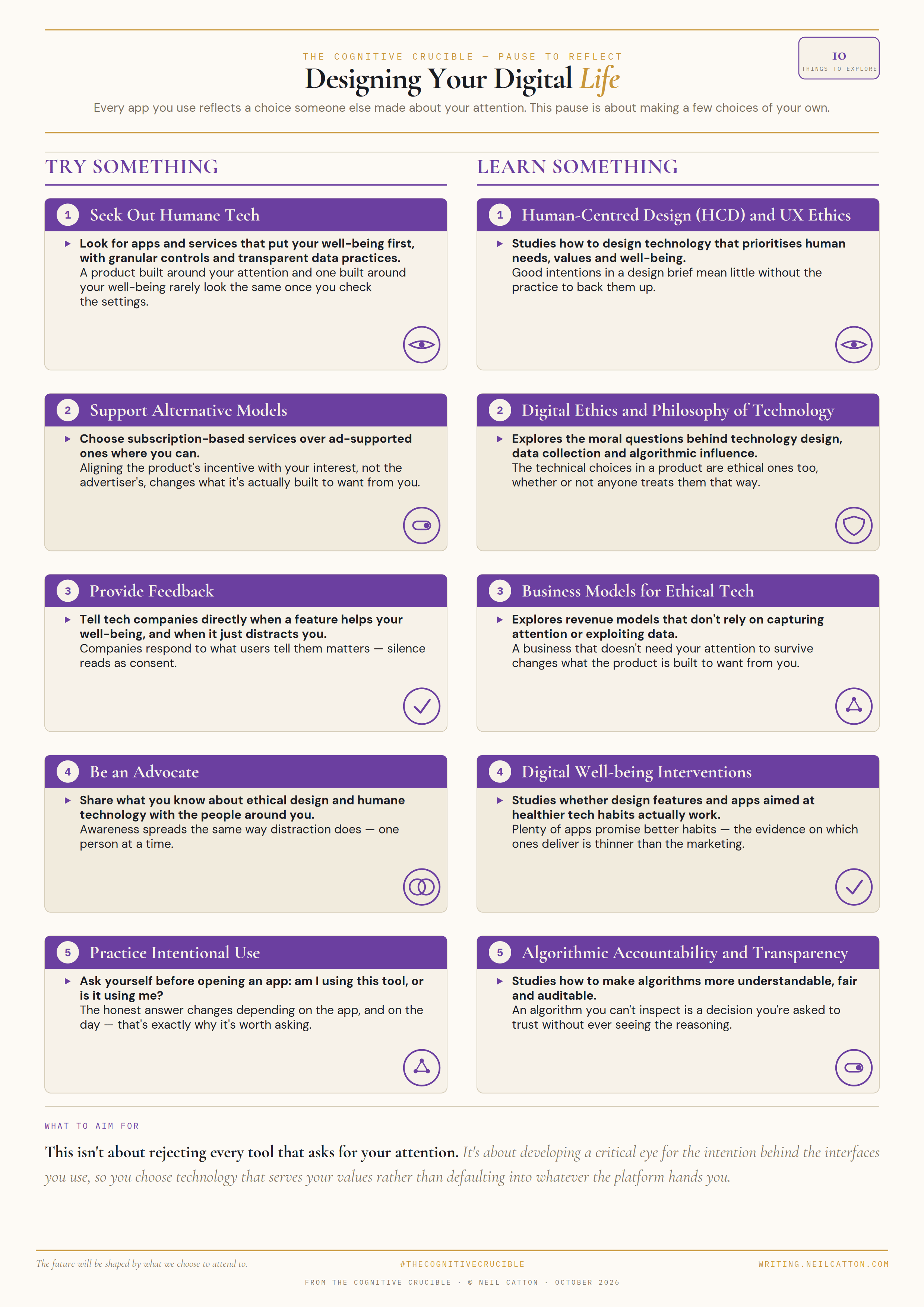
The card splits into two columns — five things to try this week, from seeking out subscription models that don’t need your attention to asking one honest question before opening an app, and five research threads for anyone who wants to go further, from human-centred design to algorithmic accountability. It’s for anyone who’s noticed the gap between what an app claims to offer and what it’s actually built to extract.
It comes from The Cognitive Crucible, where the fuller argument about attention, design and human agency lives. The card stands on its own — you don’t need the book to use it.
Print it, pin it by your desk, or send it to whoever just deleted an app and felt lighter for it.
Which of your daily apps would survive being redesigned around your interest instead of theirs?
You’re reading The Next Evolution by Neil Catton, articles that explore the human world and the intersection of technology, they try and ask difficult questions - not to scare - but to inform. If someone forwarded this to you, you can subscribe free at neilcatton.substack.com.
Neil Catton is the author of The Next Evolution, The Cognitive Crucible and The Shadow System - available on Amazon, and writes at the intersection of technology, ethics, and human purpose.