

The post looks like it’s from someone you follow — a genuine recommendation, in their voice, about a product they love. Three lines down, in grey, smaller than everything else: sponsored. You’d already half-decided to trust it before you noticed the label was even there to read.
That’s the shift the card is named for. Weaponised messaging isn’t advertising doing its ordinary job of trying to interest you in something — it’s communication built to exploit psychological vulnerabilities, sow division, and move you toward an outcome without your conscious agreement to be moved. The line between persuading and exploiting is thin, and it’s designed to be hard to see from the inside.
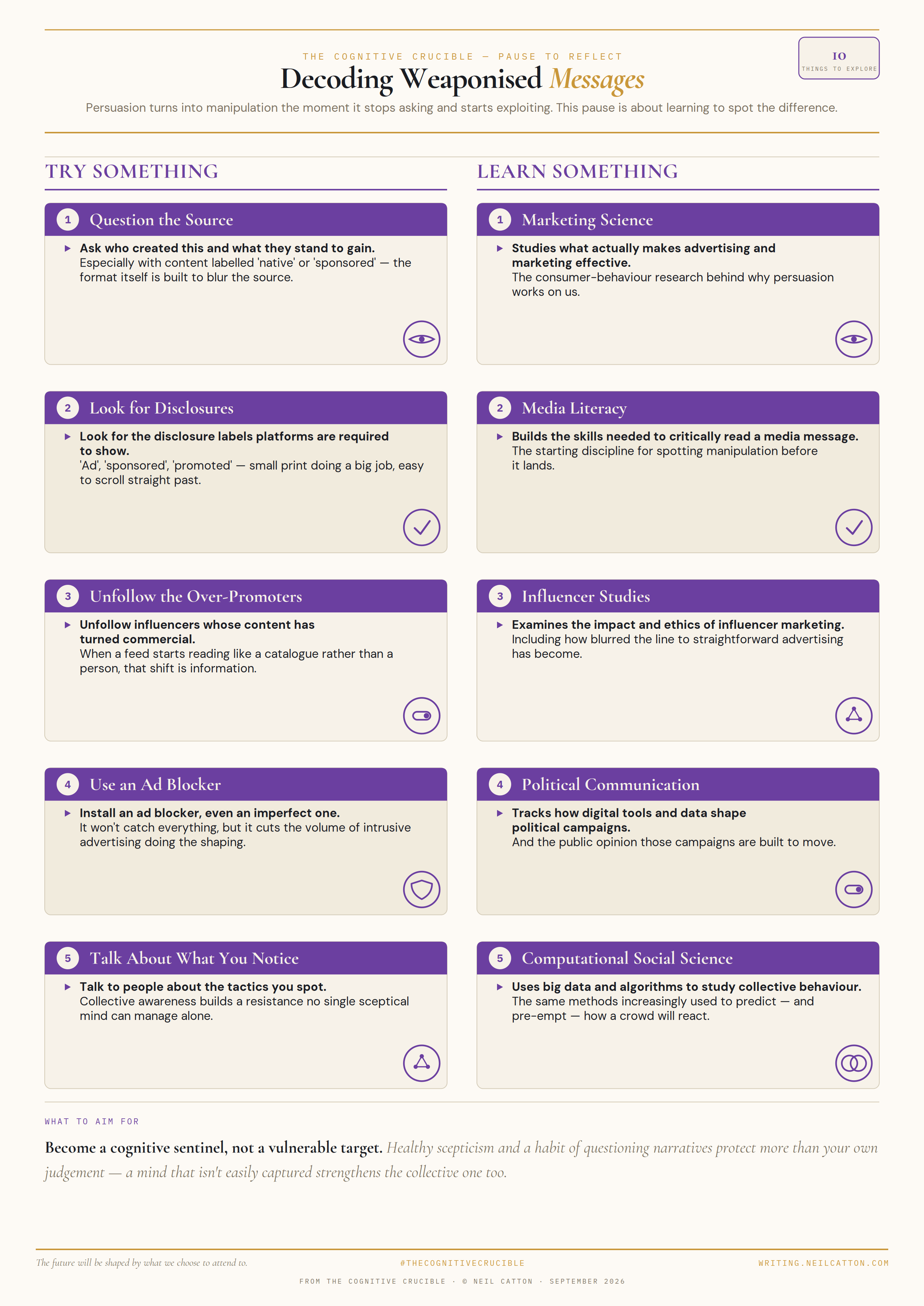
The card holds ten prompts across two columns. Five habits to try this week — asking who made a piece of content and what they gain from it, actually reading the disclosure labels instead of scrolling past them, unfollowing accounts that have quietly turned into catalogues, running an ad blocker even knowing it won’t catch everything, and talking to the people around you about the tactics you’re starting to notice. And five fields of research if you want to understand the machinery behind the pull, from the marketing science of what makes persuasion work to the computational social science now used to predict how a crowd will react before it does.
It comes from The Cognitive Crucible, where the fuller argument about attention as contested ground plays out. The card stands on its own — you don’t need the book to use it.
Print it, or keep it somewhere you’ll see it before the next scroll.
And here’s the question I’d leave you with: the last thing that changed your mind online — did you decide that, or was it decided for you?
You’re reading The Next Evolution by Neil Catton, articles that explore the human world and the intersection of technology, they try and ask difficult questions - not to scare - but to inform. If someone forwarded this to you, you can subscribe free at neilcatton.substack.com.
Neil Catton is the author of The Next Evolution, The Cognitive Crucible and The Shadow System - available on Amazon, and writes at the intersection of technology, ethics, and human purpose.