

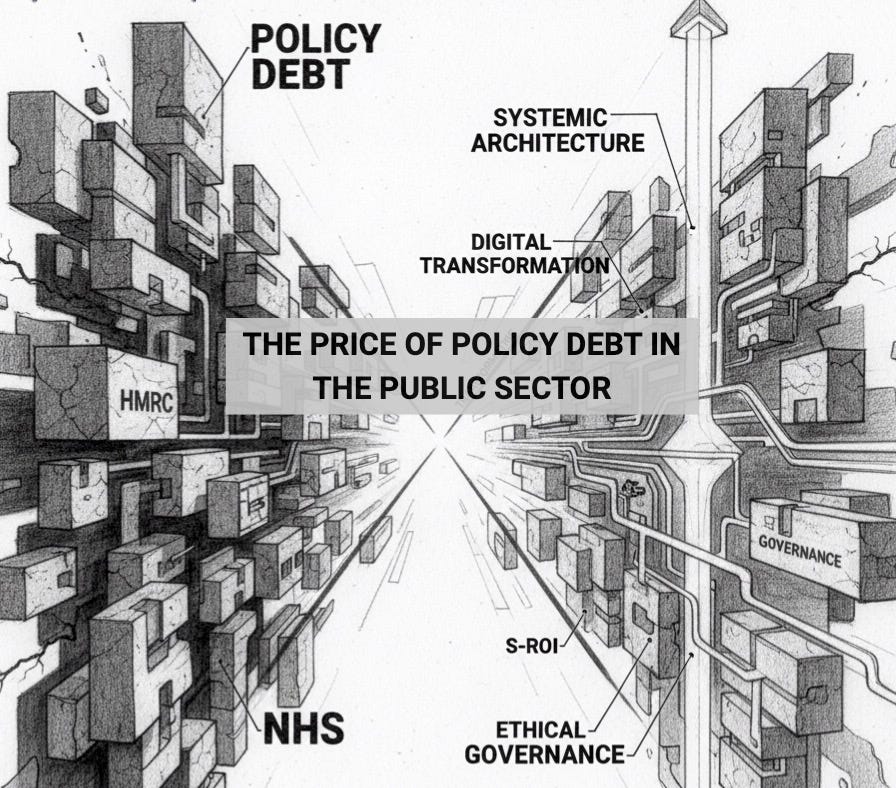
Data interoperability is often presented as a technical challenge – a complex problem solved through the right APIs and software. However, this perspective is fundamentally flawed and dangerously misleading. In the UK public sector, the pervasive problem of data silos isn’t just a technical oversight; it’s the accumulated cost of Systemic Architecture Debt. This significant structural liability stems from decades of fragmented policy decisions, isolated departmental budgeting, and a fundamental ethical failure to serve citizens holistically.
This structural debt manifests as an invisible operational tax on every citizen: the tax of repetition, delay and acute frustration when accessing essential public services. This results in a public sector that excels in isolated brilliance but often fails when citizens’ complex life problems necessitate seamless support across multiple agencies. To break free from this chronic cycle of inefficiency and fragmented service, we need a new strategic framework – a Systems Mandate – that demands a fundamental shift from simply managing data within departmental silos, to deliberately architecting value across the entire public service ecosystem. This article explores the significant costs of non-interoperability and outlines the strategic imperatives necessary to build a resilient future-proof public sector grounded in ethical foresight and measurable societal return
The True Cost of Non-Interoperability
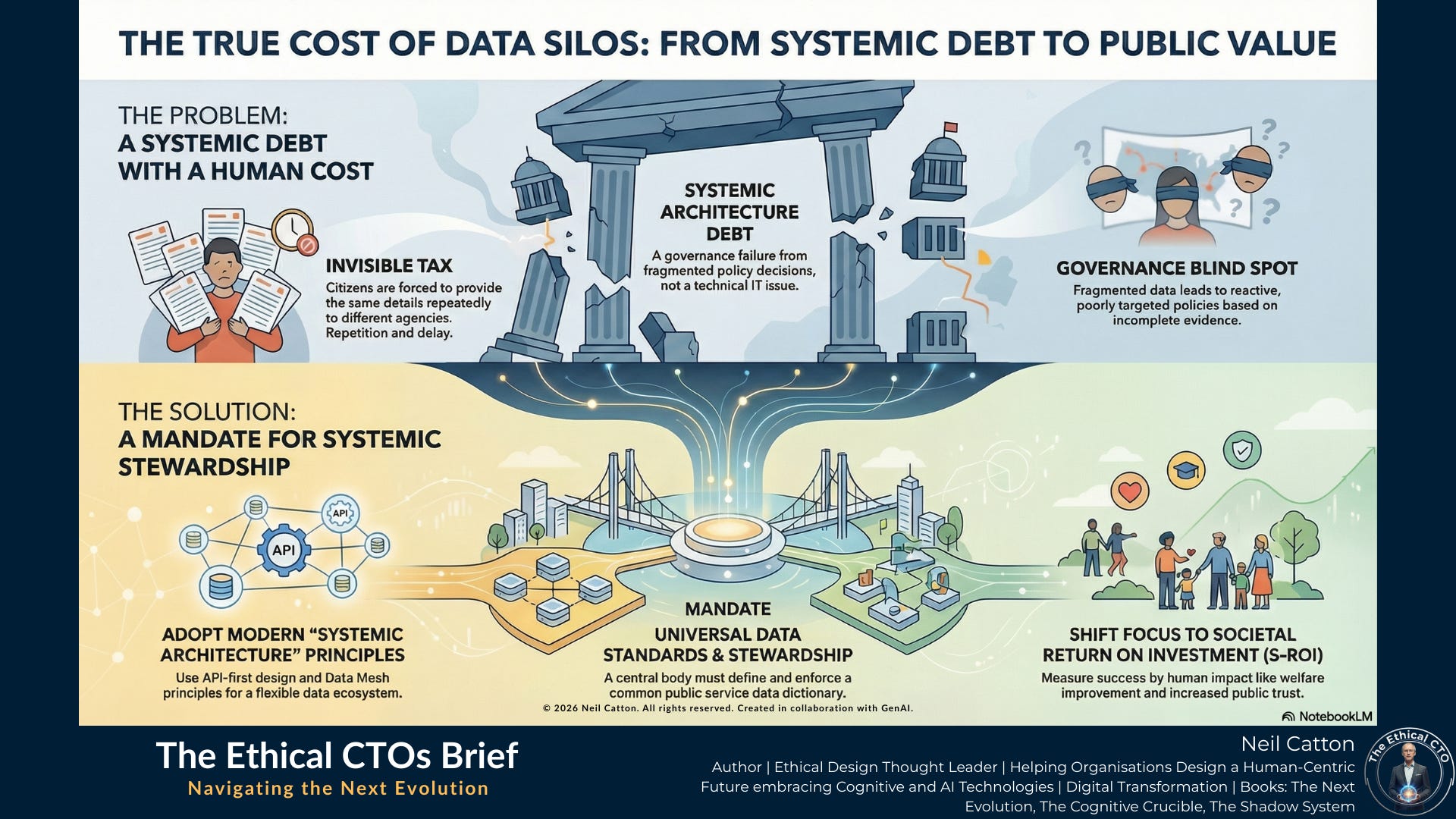
The cost of siloed data goes far beyond minor administrative inconveniences; it directly undermines the operational effectiveness, responsiveness and moral authority of public services. This section explores he concept of Systemic Architecture Debt, explaining why data fragmentation isn’t just a technical issue but a fundamental governance failure. This fragmentation creates policy blind spots and a continuous drain on the public purse. By isolating critical information, governments inadvertently ensure duplicated effort, inconsistent support, and a policy landscape built on incomplete often reactive evidence. Understanding this debt is the first step towards realising true interoperability is an economic necessity not a luxury.
The Cost of Fragmentation: Duplication and Delay
Fragmented systems are inherently inefficient. For example, when a citizen faces a major life event like becoming disabled, changing their address or registering a new child they’re often forced to provide the same personal details repeatedly to local councils housing authorities, the Department for Work and Pensions (DWP), and their health service provider. This duplication isn’t just frustrating it’s a major source of systemic delay in delivering essential services. The absence of joined-up systems prevents truly seamless services where a critical change is instantly and reliably communicated to all relevant agencies. This policy inertia slows aid delivery, prolongs citizen distress and vulnerability, and wastes valuable public money on redundant error-prone data entry and reconciliation.
The Blind Spot in Governance
Effective policy development hinges on a comprehensive real-time understanding of complex social realities. However, the essential data needed for this perspective is scattered across disconnected agency databases. Policymakers are forced to rely on only selected and curated data fragments, creating a massive governance blind spot. This hinders their ability to gain a holistic view of multifaceted issues like chronic health inequality, intergenerational crime patterns, and the true long-term impact of poverty. The result is often poorly targeted reactive policy that fails to address the root systemic causes. Without true interoperability, the promise of evidence-based policy is frequently reduced to anecdote-based policy leading to costly public failure and the unnecessary erosion of trust.
The Blind Spot in Governance: Policy Without Foresight (cont)
This hinders their ability to gain a holistic view of multifaceted issues like chronic health inequality, intergenerational crime patterns, and the true long-term impact of poverty. The result is often poorly targeted reactive policy that fails to address the root systemic causes. Without true interoperability, the promise of evidence-based policy is frequently reduced to anecdote-based policy leading to costly public failure and the unnecessary erosion of trust.
The Legacy Debt Drag: Paying for Policy Failure
Many public sector organisations depend heavily on older, siloed systems – often proprietary and hardwired – that weren’t designed for modern open data exchange. Maintaining and integrating these disparate systems through custom interfaces is technically complex, financially draining and diverts precious capital and expertise from essential frontline services and genuine innovation. This severe financial burden is the most obvious sign of the Systemic Architecture Debt. It’s not a debt from IT departments, but from decades of policy decisions prioritising isolation over collaboration. We’re perpetually paying a high tariff just to keep these fragmented suboptimal structures running. This inertia stifles agility, suppresses innovation and locks the public sector into outdated models. As a result, true citizen-centric digital transformation remains a distant dream rather than a current reality.
Interoperability: An Ethical and Architectural Mandate
Viewing interoperability solely as a technical addition to existing systems severely underestimates its fundamental importance. It’s not just about connecting databases; it’s a core design principle for ethical resilient and effective governance in the digital age. This section introduces the Systemic Architecture framework arguing that the technical challenge of data sharing is ultimately a moral and architectural one stemming from a lack of unified data governance. Moving forward requires shifting away from temporary fixes towards enforcing standards and building decentralised secure ecosystems grounded in Privacy by Design principles.
The Data Governance Crisis: A Moral Failure to Standardise
The single greatest technical hurdle to system integration is the sheer lack of common data standards. This includes inconsistent naming conventions, varying data formats and undefined metadata. The root cause is a fundamental governance failure: departments have been allowed to develop in isolation, creating proprietary data dictionaries, and fostering a culture of data hoarding. This lack of standardisation is a failure of moral foresight. Without agreement on what constitutes a ‘citizen’, ‘household’ or ‘critical event’ across the government we can’t ethically or effectively serve them. A central empowered authority must be established to define and enforce a universal public service data lexicon. This ensures shared data is reliably trustworthy and contextually meaningful across all platforms regardless of the agency handling it.
Beyond Point-to-Point: The Rise of Systemic Architecture
The historical approach to integration, building custom and fragile “point-to-point” connections between systems, is fundamentally unscalable and unsustainable. This creates a complex web of dependencies that are costly to maintain and impossible to adapt. The solution lies in embracing modern distributed Systemic Architecture patterns that prioritise modularity and reusable data products.
API-First Design: This must be mandatory for all new services. It mandates that every system exposes its core data and functionality via secure standardised Application Programming Interfaces (APIs). This architectural shift immediately transforms the paradigm from a rigid hardwired infrastructure to a flexible plug-and-play data ecosystem easily consumed by authorised services.
Data Mesh Principles: This approach treats data as a product, owned and managed by domain experts within each agency. It decentralises data quality and access control, moving away from unwieldy monolithic data warehouses towards autonomous and interoperable data domains. This shift embeds shared responsibility for data quality and ethical exchange directly into each department’s operating model.
Privacy as a Design Requirement, Not a Barrier
Concerns about privacy, particularly adherence to stringent regulations like GDPR, are often used inappropriately to block necessary data sharing. This needs to change. Robust interoperability doesn’t mean indiscriminate sharing; it demands secure, purpose-limited exchanges. Systemic Architecture necessitates privacy and security aren’t optional additions but fundamental design elements from the start.
Privacy by Design (PbD): Systems should be designed to minimise data collection, pseudonymise or anonymise information at its source and enforce strict role-based access controls. These controls should only allow access to the minimum data needed for a specific task. This proactive approach ensures data isn’t unnecessarily exposed.
Ethical Data Frameworks: Governments must create clear publicly accessible ethical guidelines and rulesets governing data linkage. These guidelines should specify the reasons, timings and methods for data linkage. This transparency and recourse empower citizens, fostering trust through demonstrable security and ethical design rather than simply asserted through policy documents.
The Path Forward: From Silo Management to Systemic Stewardship
Having established the scale of the Systemic Architecture Debt, this section outlines the definitive strategy for moving forward. Overcoming this liability demands strategic action championed at the highest levels ofgovernance. We must shift leadership focus from departmental silos to Systemic Stewardship. All future policies and digital investments should be evaluated through Governance Foresight and the profound metric of Societal Return on Investment (S-ROI). This is how the public sector can truly build resilience and sustainability.
Prioritising Governance Foresight
Governance must shift from reacting to immediate crises to proactively planning for the complex long-term future, often referred to as the ‘100-year life’ challenge. Governance foresight involves making today’s decisions relevant to tomorrow’s challenges.
Mandating Data Standards and Stewardship: This involves establishing and empowering a central governance body to define and enforce a universal public service data dictionary and technical standards. This is the single most crucial step and must be completed before any large-scale technical integration project can begin. It necessitates long-term stewardship models to ensure the perpetual relevance usability and integrity of public data assets.
Policy Audit: Systematically auditing all new and existing policies is crucial to prevent the creation of data silos and architectural debt. This involves a ‘No New Silos’ mandate – a constitutional restraint on policy that encourages fragmented data handling.
Measuring Societal Return on Investment (S-ROI)
Current public sector measurements primarily focus on operational efficiency, such as cost per transaction and process completion time. While these metrics are important, they’re strategically insufficient as they don’t capture the human impact. Ultimately, the success of interoperability should be judged by its positive effect on the human experience – the Societal Return on Investment (S-ROI).
S-ROI requires moving beyond narrow efficiency to measure:
Welfare Improvement: Quantifying the reduction in citizen stress, anxiety, and vulnerability directly attributable to integrated, seamless service access.
Policy Efficacy: Measuring improved health, educational, and social mobility outcomes directly linked to proactive, integrated service provision that was enabled by data sharing.
Trust Capital: Assessing the increased public confidence in government data handling and overall policy efficacy.
By prioritising Social Return on Investment, interoperability is no longer seen as a costly IT project but as an investment in human capital. This shift leads to strategic decisions grounded in the profound impact on citizens rather than simply adhering to limited departmental budgets.
A Final Word
The UK public sector faces a critical moment. The failure of data interoperability stems from structural fragmentation – a systemic debt that demands genuine leadership. This mandate requires the courage to dismantle outdated governance models strategic foresight to enforce common ethical standards and clarity to prioritise the citizen’s holistic experience over departmental convenience.
The core of the Next Evolution mandate lies in this profound systemic shift. It moves from a fragmented approach to one grounded in Moral Foresight, Systemic Architecture and measured by S-ROI. This is the essential foundation for a future-ready public service. It empowers government to effectively harness emerging technologies like Artificial Intelligence and quantum computing. Crucially, it ensures the delivery of resilient, integrated and trustworthy services that the public rightly expects and deserves.
You’re reading The Next Evolution by Neil Catton, articles that explore the human world and the intersection of technology, they try and ask difficult questions - not to scare - but to inform. If someone forwarded this to you, you can subscribe free at neilcatton.substack.com.
Neil Catton is the author of The Next Evolution, The Cognitive Crucible and The Shadow System - available on Amazon, and writes at the intersection of technology, ethics, and human purpose.