

The public sector worldwide is grappling with a significant dual challenge: a rapid decline in both financial and human resources, alongside an exponential increase in citizen expectations for high-quality and accessible services. The initial wave of digital transformation focused on automating straightforward, linear transactions, offering some efficiency. However, this approach falls short of addressing the intricate, multi-layered social and logistical issues that characterise contemporary governance.
Enhanced Reality (ER), encompassing both Augmented Reality (AR) and Virtual Reality (VR), is often mistakenly viewed as a consumer entertainment device. This misconception hinders public sector leaders from appreciating its true potential. ER isn’t just a new user interface; it’s a novel layer of persistent operational intelligence and experiential governance. It empowers the state to simulate, predict, and intervene in the physical world with precision once reserved for science fiction. Leaders must realise this technology is transcending bulky headsets and evolving into seamless persistent spatial computing.
For senior decision-makers in government, justice and infrastructure, the integration of ER isn’t just a technical upgrade; it’s a fundamental pillar of the Next Evolution of public service. This shift demands an immediate and proactive approach to strategic risk management and robust governance.
From Transactions to Immersion
If the strategic goal of ER is to tackle complex issues, its functional aim is to transform the citizen-state relationship. This is achieved by shifting from passive, form-based transactions to active, highly informative and deeply engaging immersive experiences.
Precision and Presence: ER’s High-Impact Use Cases
The seamless integration of digital data with physical reality within ER dramatically enhances service outcomes particularly in high-pressure situations. This evolution is crucial as public services increasingly incorporate Intelligent Automation and Digital Humans into their frontline delivery models.
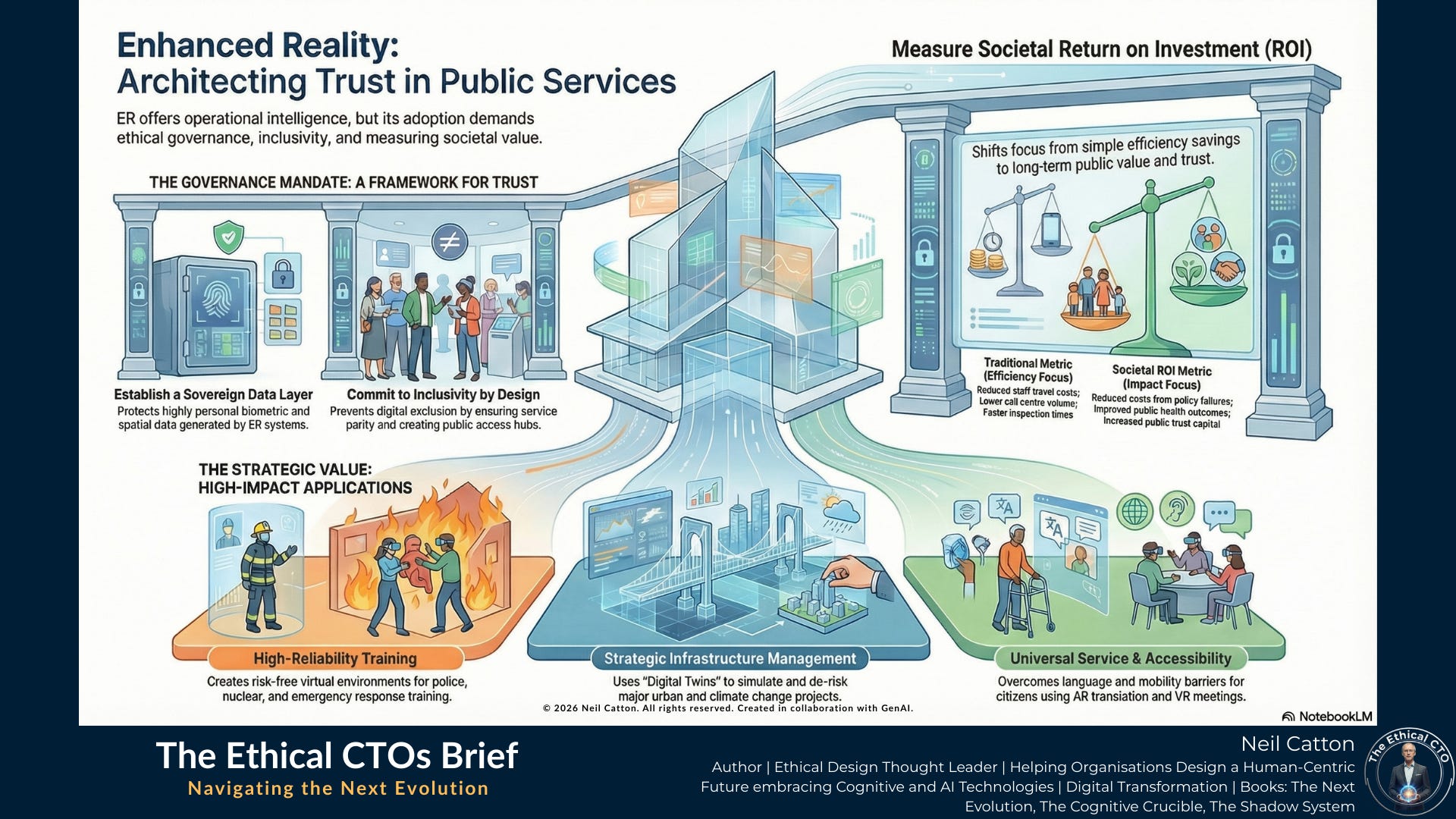
High-Reliability Training (HRT): It offers a risk-free environment for learning complex scenarios which leads to verifiable improvements in decision-making under pressure. Police forces train in realistic crowd control and domestic violence intervention scenarios using virtual reality. Meanwhile nuclear decommissioning teams utilise augmented reality overlays to safely navigate hazardous radiologically mapped environments.
Strategic Infrastructure Management (Digital Twins): It generates a living predictive model of physical infrastructure enabling informed data-driven policy simulation and proactive maintenance. Urban planners create a digital twin of a city to simulate the effects of climate change, traffic flow changes, and new rail construction before any construction begins. This significantly reduces costly real-world errors.
Universal Service Parity & Accessibility: It ensures complex civic information is universally legible by overcoming language, literacy and mobility barriers. AR mobile apps utilise real-time visual translation to assist non-native speakers in comprehending public signs and forms. VR simulations enable citizens with mobility challenges to virtually attend public consultation meetings or visit properties.
Complex Field Service and Diagnostics: By integrating expert knowledge directly into the physical workspace, this solution dramatically reduces human error and downtime. It empowers employees with smarter productivity tools. Public utility field engineers use smart glasses to overlay electrical diagrams and component histories onto machinery. This guidance helps them follow precise repair sequences and integrates seamlessly with predictive maintenance data.
The Governance Mandate
While the operational advantages are evident, the most significant structural hurdle to widespread ER deployment lies not in technical limitations but in governance failures. Scaling immersive systems requires the collection and analysis of highly sensitive personal data necessitating a robust ethical framework from the outset. This is particularly crucial when ER interfaces are powered by the same AI platforms driving Intelligent Automation and Digital Humans.
Defining the Sovereign Data Layer
Enterprise Resource Planning systems create a new class of data – ambient, biometric and spatial – that’s exponentially more revealing and personal than traditional records. This includes minute-by-minute eye tracking, physical gestures, stress levels measured by galvanic skin response and detailed 3D maps of a user’s surroundings. This data reveals our feelings reactions and locations. To protect this profound level of information, the public sector must establish a rigorous Sovereign Data Layer framework:
Biometric Sanctity and Retention: Clear, time-bound policies are essential for capturing pseudonymised raw biometric data during VR or AR sessions and eventually deleting it. Leaders must commit to data minimisation by only collecting what’s absolutely necessary for the service and ensuring citizens retain control over their physiological responses.
Spatial Mapping Integrity: When augmented reality devices map public buildings or potentially private homes for service delivery, the ownership and security of these spatial maps must be absolute. These maps contain sensitive infrastructure data and must be stored securely within sovereign data enclaves to prevent commercial or external entities from exploiting extensive public spatial information.
Ethical AI in Immersive Environments: Given ER’s heavy reliance on AI – the core engine of Intelligent Automation – for interpreting user actions and generating real-time environments, algorithmic bias is a significant concern. This bias can infiltrate spatial recognition algorithms resulting in varying service quality depending on architectural style or manifest in the design and tone of governmental digital human avatars within these spaces. Clear governance models are essential for auditing mitigating and explaining these real-time algorithmic decisions ensuring transparency and accountability.
Inclusivity by Design: Addressing the Moral Hazard
Public service is fundamentally about universal access. However, if the government exclusively shifts critical services to enhanced reality platforms, it risks creating significant moral hazard. This exclusion could affect citizens who can’t afford the necessary hardware, lack digital literacy or have specific sensory needs that aren’t catered for by the technology. Forcing citizens into a single technological model erodes public trust.
True leadership requires moving past simple technological adoption to implementing Inclusivity by Design:
Technology Parity Commitment: For every ER service provided, a non-ER equivalent channel like traditional in-person, phone or web services must be maintained. This guarantees that service quality and outcomes are comparable and helps ensure essential human interaction remains accessible, as citizens always need the option to speak to a real person.
Public Access Hubs: Dedicated publicly funded physical hubs, akin to libraries or civic centres, should be established. These hubs will provide secure access to high-quality ER equipment and essential digital literacy training. This approach ensures technology benefits all demographics and helps close the digital divide.
Societal ROI
The financial justification for ER should never solely focus on reducing upfront capital expenditure on training facilities or paper costs. The true measure is the Societal Return on Investment (ROI) – the public value generated through improved governance reduced social friction and better outcomes. The most important benefit of ER isn’t the money saved today but the immense cost of inaction tomorrow. By pre-empting crises through immersive simulation and building a more resilient and better-trained public workforce, the long-term societal savings far exceed the initial investment.
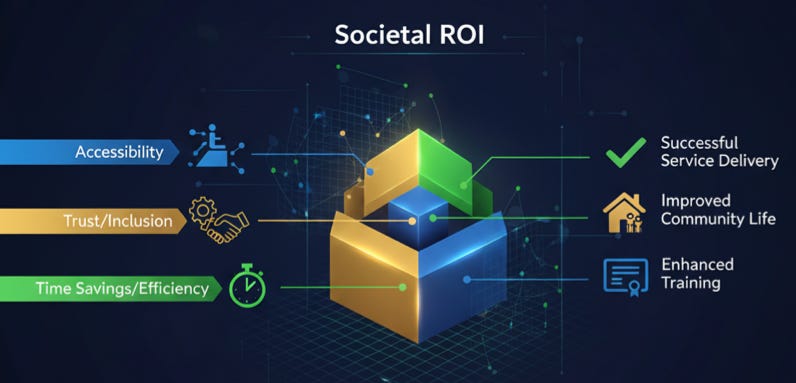
Reduced Policy Failure Costs: Improved scenario planning and predictive Digital Twin analysis prevents catastrophic failures in infrastructure or disaster response, avoiding millions in public inquiry and recovery costs.
Increased Public Trust Capital: Seamless, intuitive, and secure service interactions build vital public confidence in governmental competence, which is a non-monetary asset.
Improved Public Health Outcomes: Accessible, anonymous VR therapies for veterans or patients with anxiety and PTSD reduce the long-term, multi-generational burden on social care and hospital services.
A Final Word
The convergence of enhanced reality, hyper-scale AI, 5G and digital twins represents the ultimate tipping point for public services. The digital transformation of the past decade merely automated existing processes, but the next evolution demands a fundamental redesign of the citizen-state relationship. Enhanced reality serves as the mechanism for this physical and experiential redesign.
The question isn’t about technological capability but moral foresight and leadership. While ambient immersive technologies are inevitable, a passive or purely efficiency-driven approach will inevitably erode trust and lead to significant governance failures.
To navigate this seismic shift, leaders must adopt systems thinking and commit to the ethical architecture necessary to ensure equitable service for all citizens. This commitment is defined by two non-negotiable mandates.
The Sovereign Data Layer: Protecting the deeply personal ambient biometric and spatial data generated by ER systems involves rigorous pseudonymisation and secure sovereign storage.
Inclusivity by Design: To combat the moral hazard of digital exclusion, we must guarantee service parity and provide public access hubs. This ensures the state serves citizens based on their needs rather than their ability to afford hardware.
The public sector must proactively shape the future with integrity and strategic purpose. By embedding these principles, public bodies can create an immersive state that fosters equitable governance and enduring trust. This fulfils the promise of the Next Evolution: a service model rooted in purpose people and long-term societal value. Now is the time to establish these foundational standards.
You’re reading The Next Evolution by Neil Catton, articles that explore the human world and the intersection of technology, they try and ask difficult questions - not to scare - but to inform. If someone forwarded this to you, you can subscribe free at neilcatton.substack.com.
Neil Catton is the author of The Next Evolution, The Cognitive Crucible and The Shadow System - available on Amazon, and writes at the intersection of technology, ethics, and human purpose.