

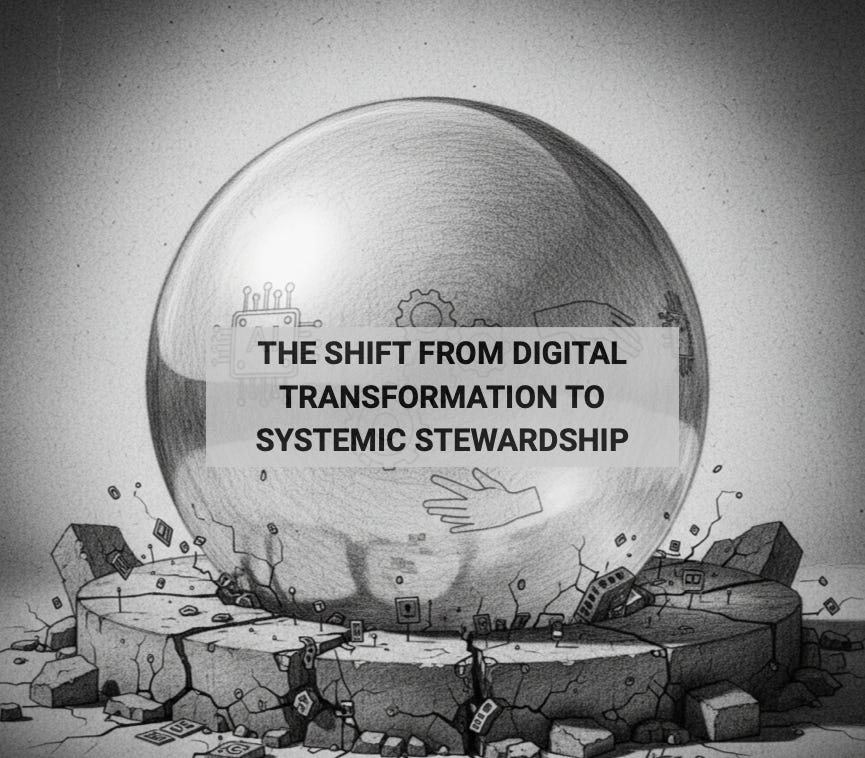
The UK public sector is facing increasing demands driven by economic pressures, rising citizen expectations and the rapid growth of emerging technologies. However, the traditional ‘digital transformation’ approach is proving inadequate. Citizens accustomed to the seamless personalised experiences of modern banking and retail rightly expect public services to be equally responsive, accessible, and intuitive. Simply digitising old paper processes isn’t enough; it often creates faster more efficient silos.
The real challenge lies not in technology but in systemic change. The public sector needs to move from fragmented digital projects to a unified model of Systemic Stewardship. This involves fundamentally redesigning services to meet the needs of the future citizen, guided by moral foresight, powered by interconnected data and designed to flourish in an era shaped by Generative AI, Spatial Computing and the growing influence of Quantum Systems. This article delves into the key pillars and prescriptive frameworks essential for navigating this transition and building a public service that’s ready for the Next Evolution Era.
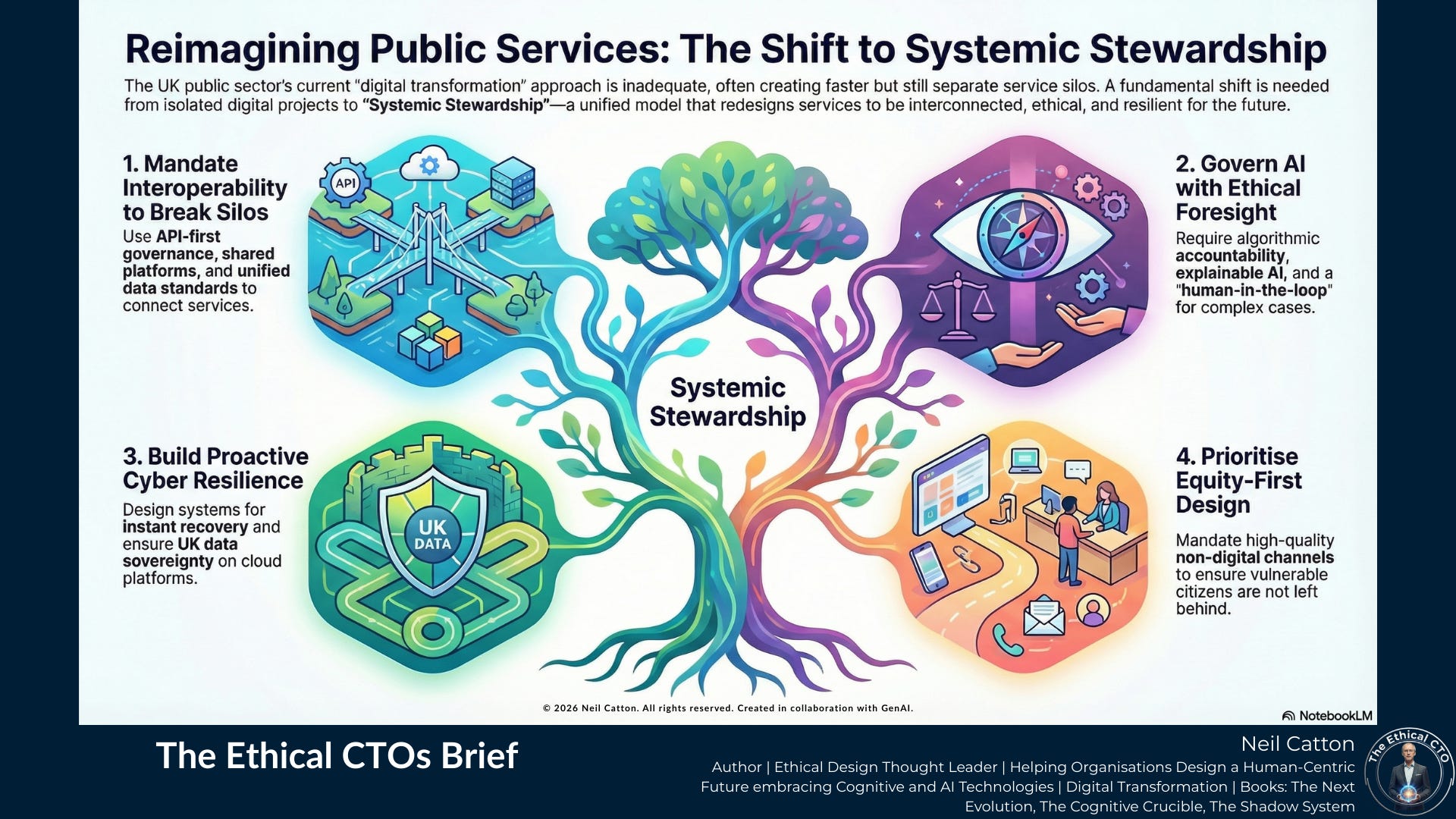
Pillar 1: Systemic Stewardship
The biggest obstacle to integrated public service delivery isn’t a lack of technology but rather a failure of interoperability. Data remains trapped in departmental silos , hindering the holistic view needed to tackle complex multi-faceted citizen needs like integrated welfare housing and employment services.
A commitment to Systemic Stewardship demands a governance model where interoperability is not optional, but mandated. This requires three critical actions:
API-First Governance: Every new service or platform must provide secure, well-documented Application Programming Interfaces (APIs) to expose its data and functionality. This facilitates seamless and secure data exchange between central government departments, devolved administrations, and local councils, ultimately creating a unified public service ecosystem.
Mandatory Data Standards: Unified non-negotiable data standards and dictionaries across the public service are essential. Without semantic consistency, like ensuring “address” means the same to HMRC and local authorities, data exchange becomes meaningless. This technical discipline is the cornerstone of genuine collaboration.
Platform Thinking over Project Thinking: Rather than funding short-term, single-department projects, investment should be directed towards building reusable cross-government platforms like identity verification payment processing and notification services. This approach reduces technical debt accelerates innovation by sharing capabilities and ensures a consistent citizen experience across all touchpoints.
Pillar 2: The Algorithm-Driven Citizen:
Generative AI (GenAI) is rapidly becoming the new gateway to public services. It’s moving beyond simple chatbots to offer sophisticated policy guidance automating complex case summaries and even supporting diagnostic decision-making. This powerful shift fundamentally alters the trust relationship between citizens and the state.
As AI adoption scales, the focus must shift entirely to Algorithmic Accountability and Moral Foresight:
Bias Mitigation and Fairness: AI models are trained on historical data which often reflects societal biases. Deploying these models without rigorous continuous auditing risks institutionalising and accelerating inequality in areas like policing, benefits allocation, and resource prioritisation. Ethical stewardship demands building continuous monitoring frameworks to proactively detect and correct algorithmic bias.
Explainability (XAI): Citizens and staff need to understand the reasoning behind decisions. While complex AI models like deep learning can be opaque, the public sector has a moral obligation to ensure traceable and justifiable automated decisions impacting citizens’ lives. This involves investing in explainable AI tools and robust governance structures.
The Human-in-the-Loop: Automated efficiency should never come at the expense of ethical responsibility. A clear strategy is essential to define when human judgement and oversight are indispensable. This means escalating the most complex sensitive or high-risk cases to trained human staff. AI’s role is to augment staff not replace the state’s moral responsibility.
Pillar 3: Building Trust Capital
Transitioning to flexible scalable cloud-based infrastructure offers efficiency gains but fundamentally reshapes the security perimeter. The rise of Ambient Technology – the fusion of Spatial Computing (AR/VR) and Edge Computing – sees services shifting from centralised data centres to the physical environment and the edge devices citizens carry.
This requires the public sector to focus on building ‘Trust Capital’ through advanced Cyber Resilience and Data Sovereignty:
Proactive Resilience Planning: Cyber security needs to move beyond a reactive perimeter defence approach. Resilience planning involves designing systems that can safely fail, recover instantly and continue critical service delivery even under active attack. This is a strategic governance issue, not just an IT function.
Securing the Ambient Edge: As services become more integrated into everyday life, like through augmented reality for planning or location-based public health alerts, the attack surface grows significantly. Protecting data in transit and at the network’s edge becomes crucial, necessitating new protocols for securing decentralised data processing.
Data Sovereignty and Cloud Strategy: While adopting global cloud platforms is essential for scalability, the public sector must maintain complete control over its data. Cloud strategies should clearly define data jurisdiction mechanisms. This ensures data storage and processing comply with UK laws and that the public sector remains the sole owner and controller of citizen information regardless of the cloud server’s physical location.
Pillar 4: Equity-First Design
A digital-first strategy is a moral failure if it leads to a “digital-only” service that leaves behind the most vulnerable. Public service redesign must critically adopt an Equity-First Design approach, recognising accessibility as the cornerstone of inclusive governance.
The challenge faced by non-digital citizens is dynamic and multifaceted. It encompasses socio-economic factors, adult illiteracy, disability, and poverty. Therefore, strategic solutions must acknowledge and address these interconnected issues.
Multi-Channel Governance: Every service must be governed by a mandate to deliver quality outcomes through all necessary channels. For many complex issues, face-to-face interaction, telephone calls or paper applications will still provide the highest quality service. Digital services should support these non-digital channels rather than replace them, freeing up human agents to focus on high-complexity and high-empathy cases.
Accessibility as a Core Metric: Digital accessibility standards like WCAG should be treated as a performance metric alongside budget and security compliance. This ensures services are usable by citizens who rely on screen readers large fonts and other assistive technologies.
Digital Skills and Infrastructure: The government must actively collaborate with partners to address the underlying causes of digital exclusion. This involves investing in nationwide digital skills training and tackling connectivity “deserts”. Service design must consider citizens accessing services on mobile devices with unreliable connectivity and expensive data plans.
A Final Word
The modern public sector faces its defining challenge in transitioning from fragmented “digital transformation” to adopting a unified model of Systemic Stewardship. This shift is essential from simply seeking efficiency to ensuring unified ethical and resilient governance across a growingly complex technological landscape.
Ultimately, the future health and trust of the public sector depend on its ability to lead with moral foresight. This involves mandating interoperability to dismantle departmental silos, embedding Algorithmic Accountability to govern emerging AI, prioritising comprehensive Cyber Resilience in the ambient cloud, and leading with Equity-First Design to ensure no citizen is left behind. Success demands a strategic commitment from government’s highest levels to halt the creation of services based on yesterday’s processes and instead govern for tomorrow’s citizen complexities ensuring public service remains synonymous with equitable effective and trustworthy delivery.
You’re reading The Next Evolution by Neil Catton, articles that explore the human world and the intersection of technology, they try and ask difficult questions - not to scare - but to inform. If someone forwarded this to you, you can subscribe free at neilcatton.substack.com.
Neil Catton is the author of The Next Evolution, The Cognitive Crucible and The Shadow System - available on Amazon, and writes at the intersection of technology, ethics, and human purpose.