

You’ve clicked “Accept All” on a cookie banner without reading it more times than you could count. Getting on with the page mattered more, in the moment, than knowing what you’d just agreed to. Somewhere in that fine print is nearly everything a company needs to know before it does what it wants with your data, and almost nobody reads far enough to find it.
That’s not really a failure of attention. It’s a document built long, a clause buried deep, a path of least resistance that always points towards yes. Rights exist to counter that design: to see what’s held on you, to have it corrected or deleted, to ask a company what it’s actually doing with what you gave it. A right nobody exercises isn’t functioning as a right.
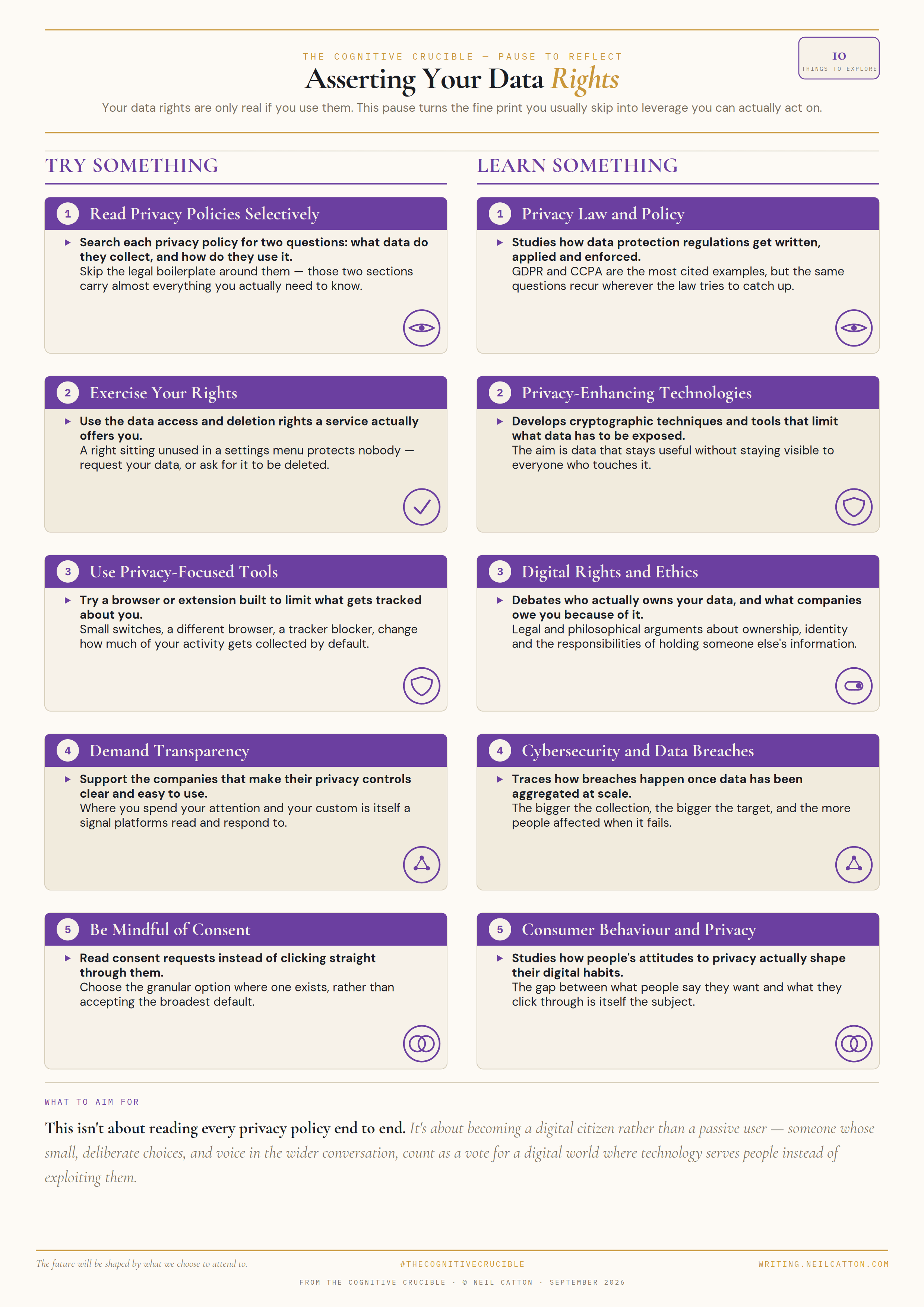
The card holds ten prompts across two columns. Five habits to try this week — reading a privacy policy for exactly two questions instead of the whole document, using the access and deletion rights already sitting in an account’s settings, trying a browser or extension built to limit tracking, backing the companies that make their controls genuinely clear, and reading consent requests instead of clicking straight past them. And five fields of research if you want to go further, from the regulation behind GDPR and CCPA to the philosophy of who actually owns your data in the first place.
It comes from The Cognitive Crucible, where the fuller argument about attention and agency in a system built to erode both plays out. The card stands on its own — you don’t need the book to use it.
Print it, or keep it somewhere you’ll see it before the next cookie banner asks for your yes.
Next time a consent form asks for thirty seconds of your attention: will you give it, or keep scrolling past, the way you always have?
You’re reading The Next Evolution by Neil Catton, articles that explore the human world and the intersection of technology, they try and ask difficult questions - not to scare - but to inform. If someone forwarded this to you, you can subscribe free at neilcatton.substack.com.
Neil Catton is the author of The Next Evolution, The Cognitive Crucible and The Shadow System - available on Amazon, and writes at the intersection of technology, ethics, and human purpose.