

A grandparent explains what they remember about waiting for the evening news. A teenager explains what a group chat notification actually means. Neither is wrong, and neither has fully understood the other — the disagreement usually isn’t about values, it’s about which version of shared attention each generation grew up inside.
Shared focus is an old human trait, built for collaboration and survival long before any platform existed to profit from it. What’s changed is the scale at which it can now be engineered — and that’s where most generational friction over technology actually starts.
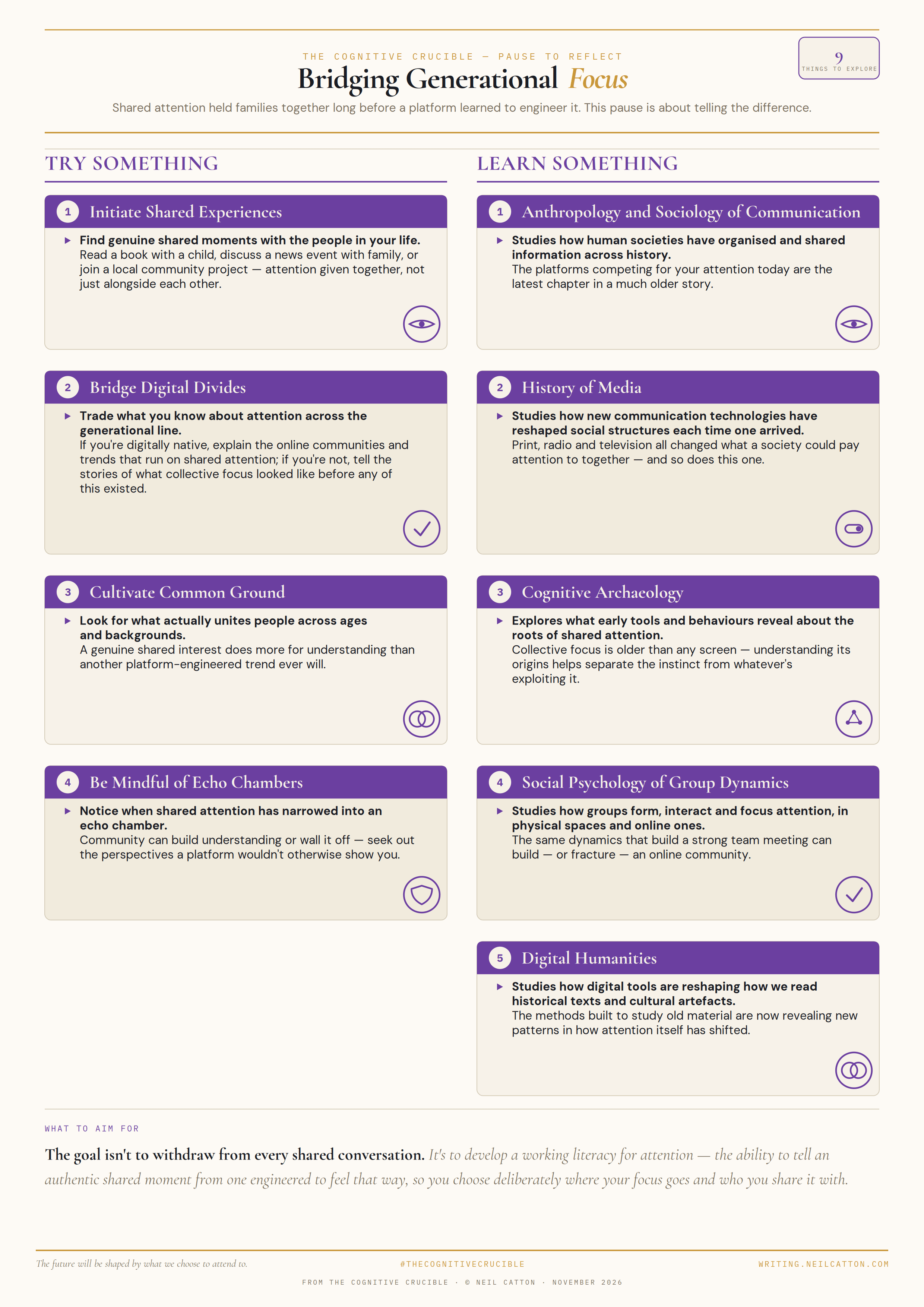
The card splits into two columns — four things to try, from trading stories about collective focus across the generational line to noticing when a shared interest has narrowed into an echo chamber, and five research threads for anyone curious where collective attention comes from, from cognitive archaeology to the history of media. It’s for anyone mid-argument about screens with someone twenty years older or younger than them.
It comes from The Cognitive Crucible, where the fuller argument about attention and the systems built to capture it lives. The card stands on its own — you don’t need the book to use it.
Print it, pin it somewhere the whole household will see it, or send it to whoever just had the same argument about phones at dinner, again.
What would your family actually choose to pay attention to together, if nothing was engineering the choice for you?
You’re reading The Next Evolution by Neil Catton, articles that explore the human world and the intersection of technology, they try and ask difficult questions - not to scare - but to inform. If someone forwarded this to you, you can subscribe free at neilcatton.substack.com.
Neil Catton is the author of The Next Evolution, The Cognitive Crucible and The Shadow System - available on Amazon, and writes at the intersection of technology, ethics, and human purpose.