

Jordan’s phone rang from a number that looked exactly like the bank’s. The voice on the other end already knew the last four digits of the card, sounded exactly like every legitimate fraud-team call before it, and asked for one thing: a verification code, just sent by text, to stop a payment already in progress. Jordan almost read it out.
What stopped Jordan wasn’t a piece of software. It was a habit — the pause before reacting, then hanging up and calling the bank back on the number printed on the card itself. The scam collapsed the moment it met that one second of doubt. Nothing about it was unsophisticated; it simply hadn’t planned for the mindset on the other end.
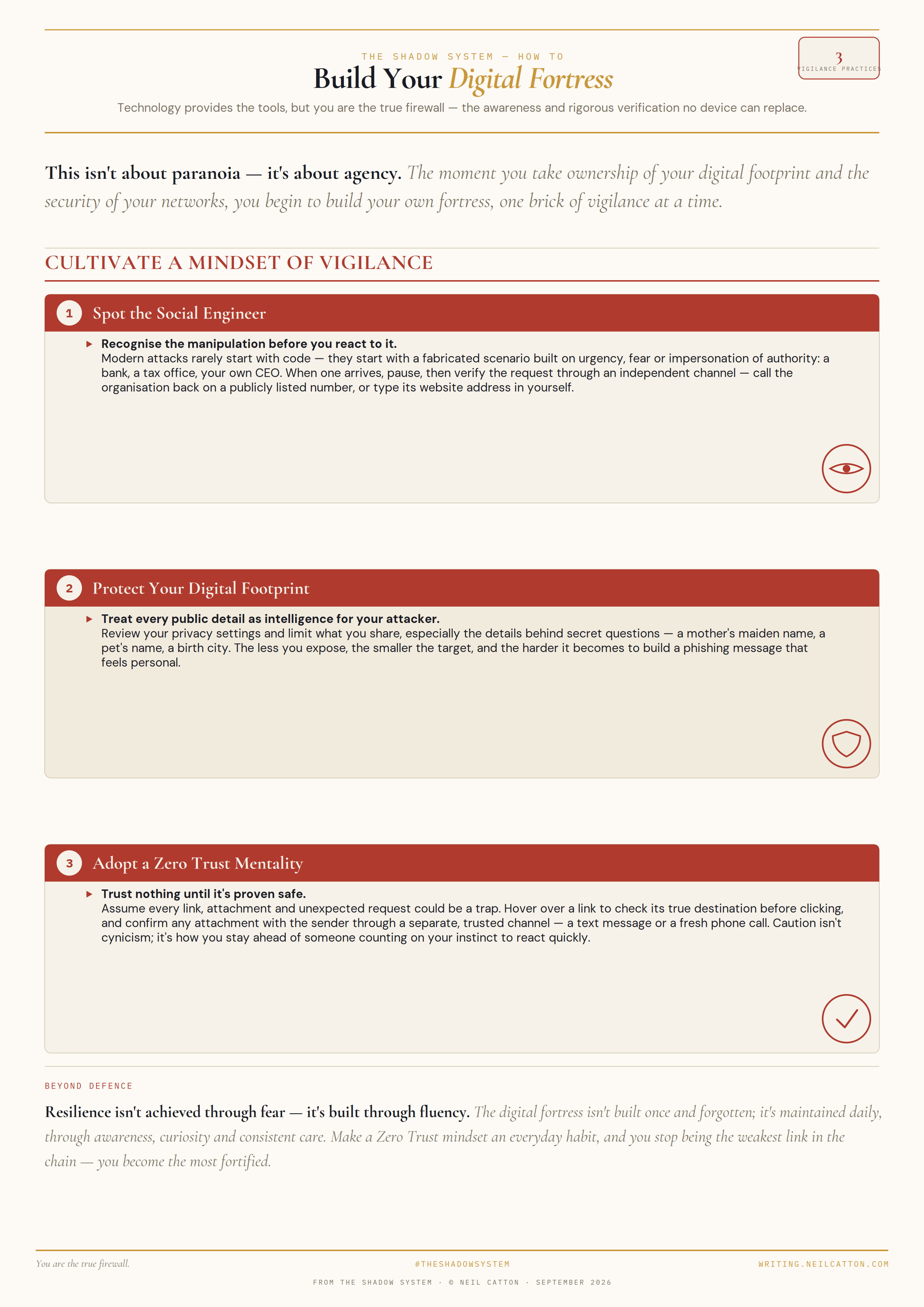
The card holds three practices, each about mindset rather than hardware: spotting the fabricated urgency behind a social-engineering attempt, limiting the personal detail that turns a generic scam into a convincing one, and treating every unexpected link or attachment as unproven until it’s checked. It’s the layer that sits above the passwords and the authentication apps — the judgement a device can’t apply for you.
It comes from The Shadow System, where the fuller anatomy of these attacks lives. The card stands alone — you don’t need the book to use it.
Print it, or keep it somewhere you’ll see it the next time an urgent message arrives at exactly the wrong moment.
So here’s the honest question: the last time something online asked you to act fast, did you pause — or did you already know you wouldn’t?
You’re reading The Next Evolution by Neil Catton, articles that explore the human world and the intersection of technology, they try and ask difficult questions - not to scare - but to inform. If someone forwarded this to you, you can subscribe free at neilcatton.substack.com.
Neil Catton is the author of The Next Evolution, The Cognitive Crucible and The Shadow System - available on Amazon, and writes at the intersection of technology, ethics, and human purpose.